Sax at the Park

Yesterday was gorgeous though a bit chilly–what can you expect in Michigan in mid-March, after all?–and I was anxious to put my new camcorder through its paces. So off to Fallasburg Park I went. Located north of Lowell on the Flat River, the park is a beautiful location adjacent to a historical village complete with a functional and well-trafficked covered bridge.

I had meant to use my tripod, but when I got to Fallasburg I discovered that I had left behind the plate that screws into the bottom of my camcorder so it can engage with the tripod’s quick release. Fortunately, I was able to induce a young guy who was at the park with his wife and little boy to film me. The result: not too shabby for a whimsical production using an on-the-spot cameraman! Just a little free-form saxophone improvisation–nothing fancy, just fun. Start with a note and then see where it takes you. Pardon the wind noise about halfway through–it was pretty breezy out there.

This is my first attempt at embedding a video in WordPress. Let’s see how it goes.
The Tritone Scale

Many years ago, when I first became aware of chord superimposition, I hit upon a unique concept. Inspired by my new awareness of tritone substitution, I thought, What would happen if I took two major triads a diminished fifth apart–C and F#, for example–and crunched all the notes together to form a scale? Wouldn’t that be cool!

Of course it had already been done, just not by me. My musical innovations tend to be in the same league as my discovering fire, gravity, the wheel, Chicken McNuggets, things like that. In this case, I had stumbled upon the tritone scale, so named for obvious reasons.

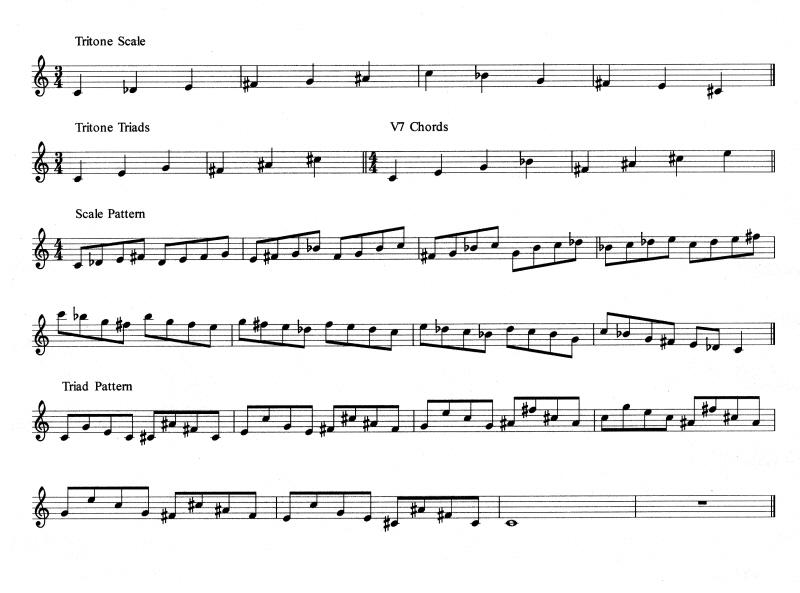
Think of a diminished scale with two notes missing, kind of like a smile with a couple teeth knocked out, and you have the tritone scale. The standard C half/whole-step diminished scale consists of the notes C, Db, D#, E, F#, G, A, Bb, C. If you remove the notes D# and A, the result–as shown in the first example (click to enlarge)– is a C tritone scale: C, Db, E, F#, G, Bb, C.

The tritone scale falls in the class of scales called hexatonic (six-tone), which also includes the augmented, whole tone, and blues scales. Since the tritone scale is derived from two major triads, you’ll of course find those triads contained in it. You’ll also find two dominant seventh chords native to the tritone scale. (See second and third examples.)

The leap of a minor third between the second and third tones, and between the fifth and sixth tones, renders the tritone scale asymmetrical. That asymmetry lends color to the scale and makes it a good source of angularity. By its nature, the tritone scale will make you think a bit differently than you would if you were using a complete diminished scale–with which, I should add, the tritone scale is interchangeable.

The last two examples in the image are actually exercises on the tritone scale. The first is a straightforward scale exercise. The second alternates the two triads that are native to the scale, taking you through their different inversions. As always, play each exercise through the full range of your instrument.

How to use the tritone scale in improvisation

All that theory is fine, but what about actual application? Naturally you want to know how the tritone scale is used.

Use it anywhere you would use a whole/half-step diminished scale. The most obvious use is with a V7b9 chord. Since, as I’ve said, the tritone scale is interchangeable with the diminished scale, you can use it with any of four different dominant chords. For instance, you can use the C tritone scale with C7b9, Eb7b9, F#7b9, and A7b9. Note that two of these chords, the Eb7b9 and A7b9, are built upon the “missing notes,” which means you can skate around the chord roots without ever landing on them.

Tritone scales built on the roots of dominant chords pack the advantage of having the tritone substitution built right into them. The second exercise (last example) demonstrates this beautifully and is one you definitely should get under your fingers.

The tritone scale also adds interest to minor scales. Use the seventh of the scale as the chord root. Another way of thinking of it is, use the note that’s a major second above the chord root as the tonic of your scale. For example, if the chord is a Bbmin7, use a C tritone scale.

If you want a good example of the tritone scale in action, the first part of Michael Brecker’s solo on “Quartet Number 3” in the Three Quartets album by Chic Corea is a tritone tour de force.

And with that, I’ll sign off. Practice hard, experiment, and have fun!

Yet Another Update: Huge Progress!

I know I’ve been posting a lot of status updates concerning Stormhorn.com. Maybe I’m guilty of overkill, but I feel it’s better to let you know what’s going on with this blog than keep you wondering.

And the fact is, a LOT has been going on. I should have scrapped my old NexGen plugin weeks ago, done the reinstall, and gotten on with replacing my image files. I didn’t because all I could think was, “Oh, man, all those files!” Nearly 500 of them. But as it turns out, reinstalling them hasn’t been nearly the prolonged hassle that I thought it would be–not that it isn’t time-consuming grunt work, but the process is moving along just fine. Much better, in fact, than I expected.

Image Files Are Now Largely Restored

That’s right–I’ve got the bulk of my galleries back in place. The work certainly isn’t finished, but right now, if you go to my photo page, you’ll see that most of what used to be there is back where it was. Well, sort of. I took the opportunity to do a little reorganizing, but that’s a good thing that brings a little more order to my collection. Anyway, just about all of my storm photos are back in place. Ditto my wildflower, bird, and other images. Check ’em out!

The CopyFox Has Reopened for Business

One of the worst parts of this whole debacle was having to take my CopyFox page and subpages offline. There was no alternative. Nothing looks worse than a copywriting business site that’s having communication issues!

But huzzah! The days of woe are past and the time of jubilation is at hand! The CopyFox now has its very own website, which is how things should have been from the beginning. Bang the drums, bring on the jugglers and dancing bears, and let there be music in the streets! And by all means, check out the site at www.thecopyfox.com.

What Still Needs Doing

Now that I’ve got the bulk of my image files downloaded, I need to sift through my posts one by one and restore images to their proper places. There are also plenty of galleries that still need to be downloaded.

But so much has already been accomplished. This blog is essentially well on its way to complete recovery. And even as I sort backwards through past posts, you may notice that Stormhorn.com is also moving ahead with new posts that will keep storm chasers current on the incoming spring weather season and equip jazz musicians with fresh food for thought and material for the woodshed.

So there you have it. The news is all good. Thanks for your continued interest and loyalty to this site as it endures its growing pains. I’ve been amazed and encouraged to see that traffic has not only remained consistent through the worst of it, but now appears to be experiencing some impressive growth. Having changed to a new web host, I’m not sure yet how accurate my WordPress stats are–perhaps they are inflating the numbers and need to settle in a bit; but I think that Awstats is pretty dependable, and assuming that’s the case, then March is off to an awesome start.

So again, thanks for bearing with me. And stay tuned, because repairs are being made rapidly at this point.

Goodonya,

Bob

Contrafact for “Cherokee”

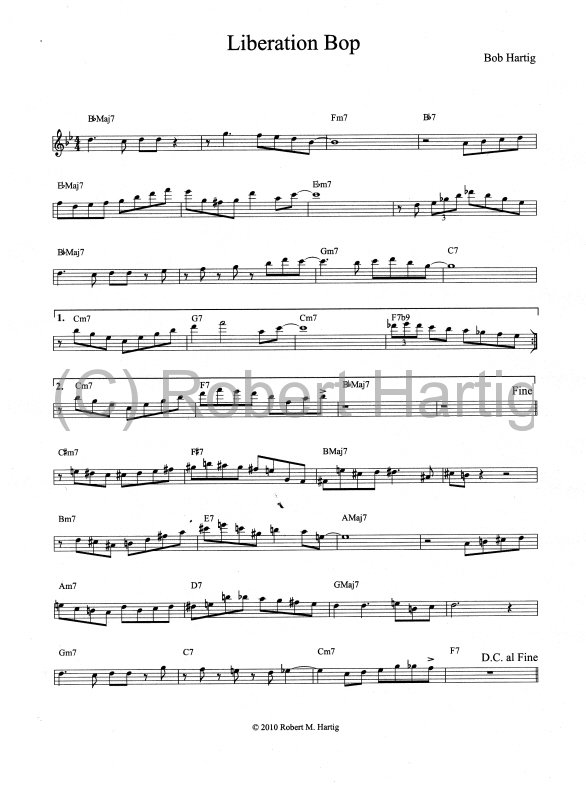
Okay, all you bebop saxophonists and assorted jazz instrumentalists, here’s a little something to have some fun with. Next time you want to work over “Cherokee,” try this instead. It’s a contrafact I wrote over the “Cherokee” changes–quite a few years ago, in fact; it’s copyrighted 2010 only because that’s when I finally got around to charting it with transcription software so it looks nice and pretty. Just click on the image, print it out, and you’re good to go.

It’s a good, strong melody, so I’m accompanying it with this statement:

1) You may use “Liberation Bop” on the gig.

2) You may NOT use “Liberation Bop” for any other commercial purposes, such as but not limited to recordings or written music collections, without my express consent. If you want to use it for commercial purposes, click the tab that says “contact” and shoot me a request.

In other words, keep it honest. And that being said, I hope you’ll enjoy the tune.

PS–I didn’t intend for the watermark to be that freaking big. But I don’t think it’ll interfere, so I’m leaving it as, at least for now.

Moonlight in Vermont: American Songbook Haiku

“Moonlight in Vermont” is one of my favorite ballads to play on the sax. Written by John Blackburn and Karl Suessdorf and published in 1943, it’s a gemstone of the American Songbook with its sensory, impressionistic lyrics and evocative melody. Simple as it is, nevertheless it’s also a tune with a few surprises, notably its cadence to an altered V7/vi chord, which injects color into the otherwise static harmony of the A section; and also its six-bar form, again in the A section.

Having finally given myself credit as a vocalist as well as a saxophonist, I recently learned the lyrics to “Moonlight in Vermont” and have been singing it quite a bit in the shower, driving down the road, and of course when I’m playing a gig. Naturally I got to thinking about that odd six-bar A section. It was the first thing that struck me about the tune when I acquired it years ago as a developing jazz musician seeking a nice ballad to improvise on. Why write a six-bar A section? Not that one can’t, not that one shouldn’t, but why abbreviate the usual, deeply ingrained eight-bar phrase? How strange, yet how effective.

Yesterday the answer finally dawned on me in an inspired flash. I started counting syllables to make sure–five syllables in the first line…seven in the second…and, sure enough, five in the third…why, the song lyrics were written as a haiku!

Now, I realize that this discovery is probably no news flash to some of you, but it was to me. Each of the three stanzas in the A section is a little haiku gem which, married to the limpid melody, flows beautifully and demonstrates just how evocative compactness can be. The  pentatonically derived A section, steadily descending, pausing at the end of each line, reminds me of a stream flowing through the woods, tumbling over little waterfalls and reposing in quiet, reflective pools before commencing the next phase of its journey.

“Moonlight in Vermont” is a song of the seasons, painting the annual progression in three-line daubs of verse. The first tercet gives us “falling leaves, a sycamore”; the second stanza moves us into winter with “snowlight in Vermont”; and the last one brings us a summer evening filled with meadowlark song.

The first half of the tune’s bridge continues with the word pictures while providing a digression into standard, eight-bar phrasing. The second half injects, for a brief moment, a human element into a tune whose romantic images have hitherto mentioned nothing of romance or of people.

Songwriters who contributed to the body of music we call the American Songbook were masters at their craft, and “Moonlight in Vermont” is exquisite proof. For more on the tune, read this commentary in Jazz Standards. A Wikipedia article also does a good job of addressing the haiku aspect of “Moonlight in Vermont,” though it incorrectly attributes two inaccuracies to lyricist Karl Suessdorf. Vermont is in fact well within the range of the eastern meadowlark, and while sycamores may be uncommon in the state, the southern part lies within range of the tree.

And that’s enough about that. I don’t know whether Vermont was moonlit last night, but it’s presently a cloudy Saturday morning here in Michigan and time I got on with my day.

Pentatonic Scales by Major Third

Lately I’ve been spending considerable practice time on pentatonic scales. So named because it has only five notes, the pentatonic is as basic a scale as you can get. Its fundamental use for jazz improvisers is to provide a down-homey sound that’s great for playing the blues and a lot of gospel and contemporary praise music. Lacking a major scale’s handle-with-care tension tones of the fourth and raised seventh, the pentatonic furnishes a steady supply of consonant notes that work with pretty much any diatonic chord. It’s hard to go wrong using a pentatonic scale!

But once you start exploring its more complex applications, the pentatonic scale becomes more demanding. It is used freely as a source for angularity and a tool for outside playing, and you have to work out its possibilities in the woodshed if you want to use them skillfully in performance.

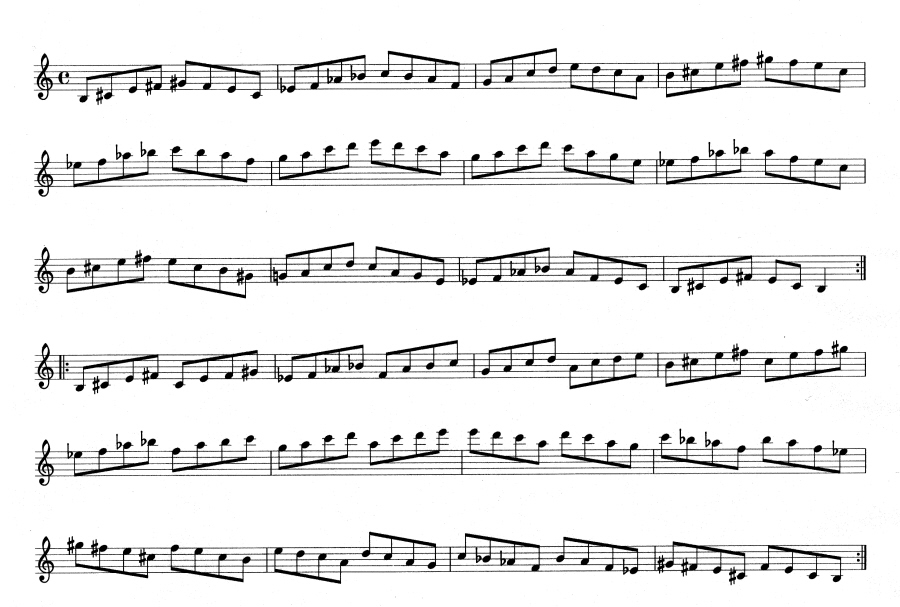
penta-mode-4-by-maj-3rdThe two exercises shown here take the fourth mode of the pentatonic scale and move it by major third. This approach spotlights tone centers that divide the octave into three equal parts. (Click on the image to enlarge it.)

The exercises don’t lay easily under the fingers at first, but stick with them and you’ll soon be ripping through them with Breckerish velocity. Remember, the key is to memorize these patterns as quickly as possible so you don’t need to look at the written notes. Since each exercise takes you through three tonal centers, you’ll need to transpose the material by half-step three times in order to cover all twelve keys.

Get cracking–and have fun!

If you found this post helpful, visit my jazz page for more exercises, articles, and solo transcriptions.

Double-Time Solos: Tips on Playing Fast

Last Saturday’s gig at the Cobblestone was once again a blast. The lineup was different, as Dave DeVos and Paul Lesinski both have previous commitments through February. But  bringing in new players livens things up with fresh approaches, and with Steve Talaga playing keyboard and Charlie Hoats supplying the bass, I had no concerns about the quality of musicianship for the evening. It was my first time playing with Charlie, and he was every bit as superb a player as I’d been told. As for Steve, he’s always been nothing short of fabulous. I am so blessed to get to make music with the kind of guys I’ve been working with lately–not just great musicians, but really decent, down-to-earth people.

But enough about the gig. Let’s talk about playing in double-time.

I don’t know why it has taken me till now to think of writing about this topic. There was a time in my musical development when it consumed me. My introduction to it began when I got my first earful of Bird back in my college days and found myself thinking, “How the heck did he do that?” A lot of people over the years have wondered the same thing about Bird, but I quickly came to realize that he wasn’t the only jazz musician capable of playing really fast and sounding really good. Starting with the boppers, there was Dizzy. There was Dexter. There was Bud Powell. There was Sonny Criss, and Sonny Rollins, and of course Sonny Stitt, who seemed to have built his home in Double-Time Town. Then along came Trane, who progressed from ridiculously fast to…well, what would you call it? In 1958, “Downbeat” jazz critic Ira Gitler described Coltrane’s approach as “sheets of sound,” and the term has been used ever since.

The speed, creativity, and beauty with which skilled jazz improvisers incorporate double-time passages into their solos can seem daunting to beginning players, not to mention flat-out bewildering. I mean, you’ve heard it played, so you know it can be done, but how do you even begin?

As is true with a lot of things musical, the answer is quick but the implementation takes considerable time. Really, the answer is plain old musical common sense that applies to learning how to do anything as a jazz musician: Listen analytically and practice carefully, ad infinitum. And, I should add, transcribe solos or at least memorize a few solo transcriptions.

That being said, let me expand on that wisdom with a few suggestions.

1. Identify a double-time passage that you like and then memorize it. By memorize, I mean work it over faithfully every practice session for a while until it sails effortlessly out of your fingers. If you really want to get something out of it, memorize it in every key, or at least a few other keys besides the one it was originally played in. Doing so will not only develop your dexterity, but also your ability to think quickly in different keys.

2. Start slow! Yes, it’s double-time, but you won’t play it well fast unless you can first play it well slowly. Once you’ve nailed down your passage at that slower speed, then increase your tempo a bit, and keep increasing it incrementally until you’re playing the lick at the same speed as it was originally performed–or, if it’s an idea of your own creation, at a speed as fast as you’d like to be able to pull it off on the bandstand.

3. Use a metronome. It’s easy to race with double-time, and trust me, it doesn’t sound at all impressive when you end up two beats ahead of the rhythm section.

4. Once you’ve got the passage drilled into your fingers fairly well, play with the artist’s recording or with some kind of accompaniment that lets your ears hear a harmonic and rhythmic context for what you’re playing.

5. Note any distinctive features of the passage. Does it involve one or more grupettos (a favorite device of Sonny Stitt’s)? Where do passing tones occur? Are there any alterations to a dominant chord such as an augmented fifth or a flatted ninth?

6. Be aware of how the scales, intervals, and arpeggios you’ve been practicing relate to your double-time passage. They do, and seeing how will add inspiration and direction for your ongoing work on the fundamentals and suggest new ways of approaching them.

7. Be patient and be persistent. This stuff doesn’t come overnight. But it will come provided you stick with it.

8. Realize that you’re striving for the snowball effect. You know: You start with a small snowball, and as you roll it along, it collects more snow and becomes larger and larger–and the bigger it gets, the greater quantities of snow it is able to pick up as you continue to roll it. As you build your musical vocabulary and the technique to execute it skillfully, you’ll find yourself adding material to material, expanding your musical inventory in increasingly creative ways, and ultimately, spontaneously generating brand new ideas. Your thinking will speed up, your capacity to respond intuitively to the music will increase, and so will your dexterity to play on your horn what you hear in your head.

I’ll conclude with a bit of cautionary advice: Just because you can play fast doesn’t mean you should. Let taste, not technique, be your guide. As a jazz musician develops speed and discovers that he or she can play swift passages with increasing effectiveness, a temptation enters to “prove” oneself by playing lots of double-time. But playing fast isn’t the same thing as playing well.

A good jazz soloist knows how to build a solo using slower passages, longer tones, and space as well as the really fast stuff. Double-time is just one device to use along with other devices in the larger context of telling a musical story. The story’s the thing, and a good story is about pace, contrast, and development, not perpetual fast action.

I’m preaching to myself as I say this, because I’m prone to overplay, and one of the things I’m working at is to hold that tendency in check–to lay back more and play in ways that are stylistically appropriate. Strangely, I have a hard time playing with blues bands, and one of the reasons is because in that style, simpler is usually better. Once you develop speed and complexity, it can be hard to trust simplicity. But it’s important to do so.

Enough on this subject. I hope you’ll find this article to be helpful and encouraging. The big thing, again, is  to practice hard and stick with it. Do that and you’ll do fine. Like everything else in music, you’ll master the art of playing double-time in due time as long as you keep working at it.

Stormhorn Jazz: It’s Happenin’ Saturday at the Cobblestone!

Last week’s gig at the Cobblestone was the best yet! The turnout was fantastic, and it included some very welcome faces. My sweet mother and sister, Diane, came to listen. So did Kyle Wellfare, band director for the Caledonia Senior High School and a jazz bass player. And so did long-lost and recently found high school classmates Sue Marie Carrick and Steve Afendoulis.

Steve and I go back a long ways. We were both still in junior high school when he asked me to play in a big band he was forming called The Formal Aires. Managed by Steve’s dad, Gus Afendoulis, and co-directed by saxophonist and big band veteran Ted Carino and composer Sid Stellema, the Formal Aires enjoyed constant weekend bookings at country clubs, weddings, and social events. The band was my introduction to jazz, and Steve was our leader.

When Steve got wind of my gig via FaceBook, he told me he was coming out and asked if he could sit in. Heck yes! It was a real joy to reconnect with him and make music together again after over 35 years. And Steve did great. He hadn’t touched his set in a long time, but he fit right in, keeping the beat and catching the breaks in a way only someone informed by plenty of prior experience could do.

This Saturday my regular partners in music, Dave DeVos and Paul Lesinski, have previous bookings, and that’s the case for the next couple weeks as well. Never fear, though–I have some stellar players joining me: Steve Talaga on keyboards and Charlie Hoats on bass. I’ve not met Charlie in person yet, and I’ve been wanting to, not only because he comes with glowing recommendations, but also because he lives right here in Caledonia just a couple miles up the road from me. As for Steve Talaga, I’m well acquainted with his playing. The man is fabulous. ‘Nuff said.

So put Saturday in your book and come on out. The Cobblestone is developing a reputation for urban-quality dining in an accessible, refreshingly non-urban setting. And of course you’ll enjoy listening to live jazz! Here’s what you need to know:

• Date & Time: Saturday, February 5, 6:0-9:00 p.m.

• Place: The Cobblestone Bistro & Banquet Center

• Address: 9818 Cherry Valley Ave. SE (M-37), Caledonia, MI

• Phone: (616) 588-3223

Reservations are recommended, but walk-ins are welcome.

Update and Gig

The Latest on Stormhorn.com: Navigating the Move

This is my first post after changing my Web host to Dryline Hosting. The transition has been a bit bumpy, largely because I’m not familiar with the details involved in Web hosting and have had to deal with the learning curve. My friend Karina Myers, who with her husband, Mitch, operated the now-defunct Tablox Web Solutions, was gracious enough to move my files for me, and as I look at how many of them there are, I realize how overwhelmed I’d have felt if I’d had to handle the transfer myself. That kind of thing takes infinitely longer when you don’t know what the heck you’re doing!

Anyway, right now you’ll notice that the header and all my images are missing. That includes all the practice exercises and solo transcriptions I’ve developed over the years.

RELAX! (I’m saying that to myself as well as to you.) The image files all still exist. But I’ve obviously got a bit of work to do in order to get them back to where you can once again view and access them. Trust me, doing so is high on my to-do list. I want to get my Stormhorn blog site fully functional as soon as I can, so stay tuned, and please bear with the current, stripped-down look, sans images. It’s only temporary.

Gig Saturday at the Cobblestone

A reminder that my jazz trio plays again Saturday night, January 22, from 6:30-9:30 p.m. at the Cobblestone right here in Caledonia, Michigan. The place is an ideal setting for jazz. The room is such that you can hear the music anywhere while at the same time being able to carry on a conversation. The food and wine are great. And my fellow musicians, bassist David DeVos and keyboardist Paul Lesinski, are some of the best in West Michigan.

Tomorrow is our last booking, and while I hope that the owner will  extend our stay, I don’t know at this point whether that will happen. Ben loves jazz and really wants to make it happen at his place, but he needs an increasing customer base in order to make it work for him financially. So come on out, show your support, and enjoy an evening of  live jazz with the Stormhorn Jazz Trio  in the warm, relaxed, and inviting setting of the Cobblestone Bistro.

• Date & Time: Saturday, January 22, 6:30-9:30 p.m.

• Place: The Cobblestone Bistro & Banquet Center

• Address: 9818 Cherry Valley Ave. SE (M-37), Caledonia, MI

• Phone: (616) 588-3223

Reservations are recommended, but walk-ins are welcome.

Stormhorn Jazz Tonight at the Cobblestone

A quick reminder, in case you haven’t gotten one from me on Facebook, that my jazz trio, Stormhorn Jazz, is playing tonight from 6:30–9:30 p.m. at the Cobblestone Bistro in Caledonia, Michigan. This is a beautiful place with superb food, world-class wines, a good offering of domestic, imported, and craft-brewed beers, an elegant and comfortable bar, and ambiance galore complete with a fireplace and even, yes, a waterfall–plus, of course, live jazz by Dave DeVos on bass, Steve Durst on keyboards, and me on the alto sax and vocals.

The Cobblestone is one of the best things about Caledonia, at least from a musical and dining perspective, and Ben, the owner, loves jazz. So come on out and show your support. I promise you, you’ll be pleased at what you find. Here are the details:

• Date & Time: Saturday, January 15, 6:30-9:30 p.m.

• Place: The Cobblestone Bistro & Banquet Center

• Address: 9818 Cherry Valley Ave. SE (M-37), Caledonia, MI

• Phone: (616) 588-3223

Reservations are recommended, but walk-ins are welcome.