Live Saxophone Jazz Friday at The Seasonal Grille in Hastings

Tomorrow night keyboardist Bob VanStee and I join forces to play for the one-year anniversary of The Seasonal Grille in downtown Hastings. I feel honored to be a part of the celebration. Justin Straube and his crew are great to work with. They appreciate their musicians, genuinely enjoy the music, and all around are just plain “good people.” In other words, this place is a pleasure to play at.

Justin has turned out a first-class dining establishment that gives his patrons far more than their money’s worth. The ambiance is comfortably elegant, the kind where you can dress up or dress down and feel good about either option. As for the food and the prices, it’s hard to believe that culinary creations of such superb quality can be so ridiculously affordable. You’d have to look far and hard in order to find meals of comparable gourmet deliciousness that cost so little. Frankly, I don’t know how Justin does it. I think a large part of it is, he simply wants to give people a good deal.

Anyway…Bob and I play tomorrow (Friday) from 6:00–9:00 p.m. Come on out and get a plateful, a beerful, and an earful. I might add, this is a great date-your-mate location! Here’s the info:

  • The Seasonal Grille
  • 150 West State Street
  • Hastings, MI
  • Time: 6:00–9:00 p.m.
  • Phone: (269) 948-9222

Some of my storm chasing friends will be coming out tomorrow to hang out with each other. Maybe I’ll see you there too.
The Augmented Scale: A New Pattern to Whet Your Fingers On

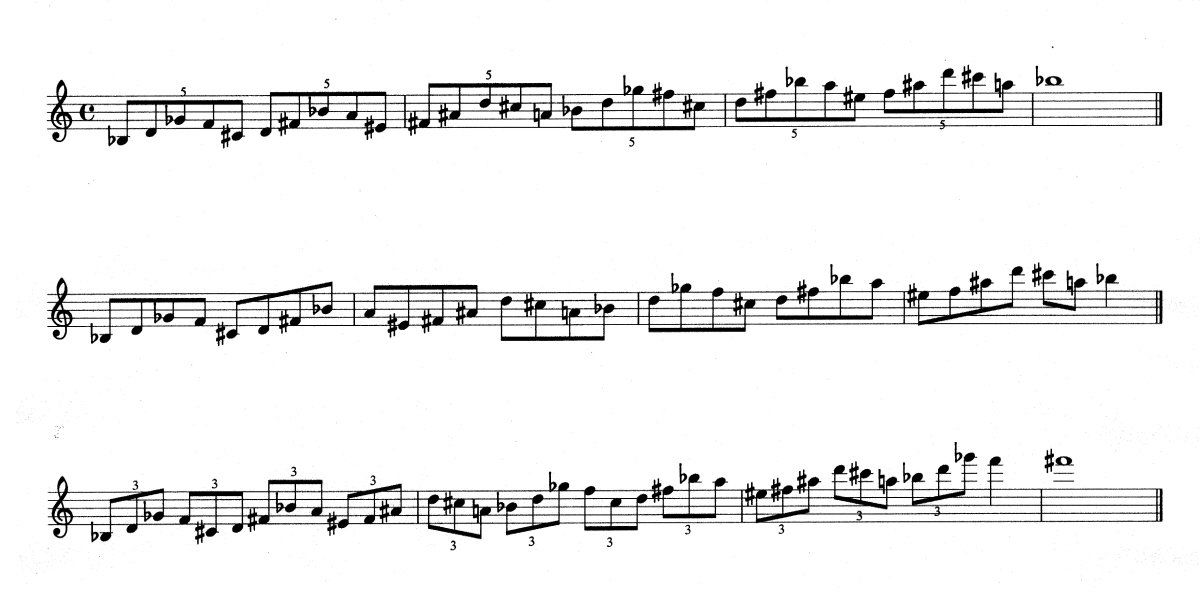
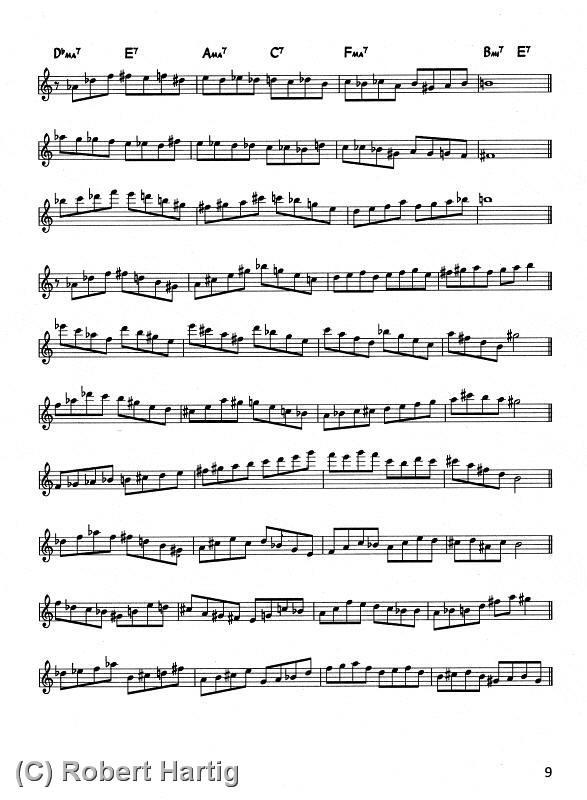
Here is an augmented scale pattern that I started tinkering with yesterday. It’s similar to one I’ve practiced fairly often, but inserting an extra note into each four-note grouping–resulting in quintuplets–adds both harmonic and rhythmic color.

The exercise uses the Bb augmented scale. Since it is a symmetrical scale, it also functions as D and F# augmented scales. For the theory behind it, see my first post on the augmented scale and view my page on jazz theory, technique, and solo transcriptions for a number of other articles.

The image to your right (click on it to enlarge) contains three rhythmic variations of the pattern. The topmost is the pattern as I originally conceived it in five-note groupings. The line below it shows how the pattern lays out in a standard eighth-note flow. Last of all you’ll find the pattern set to triplets. These latter two exercises introduce a polymetric element, displacing accents in ways that pack added interest.

During the last few months my focus has shifted to pentatonic scales, and my augmented scale work has consequently suffered. The simple truth is, I just don’t have time to cover all the bases. (I wish I did, but no one is paying me to practice eight hours a day!) Lately, though, now that I’ve gotten the preliminary muscle-memory curve behind me with my pentatonic work, I’ve begun to return to the augmented scale. It is a fascinating, hauntingly colorful scale at which I want to become increasingly adept. The augmented and pentatonic scales both now fit into my practice regimen, along with the diminished whole tone scale. By the time I’m finished working all these weird scales into my fingers, I just hope I’ll remember how to play my major scales.

It goes without saying–it does, doesn’t it?–that you’ll practice this pattern in all four of its tonal iterations (I don’t know how else to say it; you can’t rightly call them “keys”). Remember to keep application in mind. It’s not enough to get this pattern under your fingers; how are you going to use it? Again, see my initial post on the augmented scale.

Other than that, there’s nothing left to say except, as always, practice diligently and enjoy the journey.

The Giant Steps Scratch Pad: As Crass a Plug as You’ll Ever Encounter Anywhere

BUY MY BOOK! BUY MY BOOK! BUY MY BOOK! BUY MY BOOK! BUY MY BOOK!

Never mind the rest of the gobbledegook on this page–just go to the bottom and start clicking on shopping carts.

As for you less impulsive types: Gosh, I hope I’m not being too forward. In real life, I’m the retiring, wallflower type who would never think of grabbing you by the lapels and shaking you wildly about while protruding my eyeballs at you and screaming, “BUY MY BOOK!” Never. The marketing methods I use to get you to buy The Giant Steps Scratch Pad–available in C, Bb, Eb, and bass clef editions–are far more subtle. I prefer to drop discrete hints, such as sending out glossy, full-color mailers that say things like, “This Father’s Day, give Dad the gift that says ‘I love you!’ Give him The Giant Steps Scratch Pad.” Low-key is best, that’s what I say.

Ummm…did you get the mailer?

Well, no matter, because here is your reminder that now is the perfect time to get Dad, or Mom, or your Aunt Bronte who plays the crumpophone, or maybe even your little old self, a copy of the Scratch Pad. Why is now so perfect a time? Because now is such a totally in-the-moment time, and jazz improvisation is such an in-the-moment art form, and Coltrane changes typically fly by at such an in-the-moment, near-light speed, that, overlooking the utter pointlessness of everything I’ve just written, you really should cough up $9.50 and BUY MY BOOK.

Do it. Not only will you be keeping a starving artist in Ramen for a week, but–seriously now–you will also be getting a truly unique and valuable practice companion for jazz improvisers. If you’ve ever wanted to master Coltrane changes, this book will do the trick. To the best of my knowledge, it’s the first practical, hands-on resource for jazz instrumentalists of every kind that helps you develop the technique to play Giant Steps changes. You can find plenty of material on Coltrane’s theory, but very little that you can actually wrap your fingers around in the woodshed.* The Giant Steps Scratch Pad fills that gap, taking you beyond theory to application.

Here’s what you get:

  • * A brief overview of “Giant Steps” theory
  • * Insights and tips for using this book as a practice companion
  • * 155 licks and patterns divided into two parts to help you cultivate facility in both the A and B sections of “Giant Steps”
  • * 2 pages of licks using the augmented scale–the “universal scale” for Coltrane changes

Click on the image to your left to view a printable page sample from the Bb edition (for tenor sax, soprano sax, trumpet, and clarinet). Print it out, take it with you to your next practice session, and get a feel for what the Scratch Pad has to offer. Each line takes you through the first four bars of Giant Steps changes. Transpose the pattern down a major third for the second four bars.

AVAILABLE IN C, Bb, Eb, AND BASS CLEF EDITIONS, AND BOTH IN PRINT AND AS A PDF DOWNLOAD. 32 PAGES.

Instant PDF download, $9.50
C edition Add to Cart
Bb edition Add to Cart
Eb edition Add to Cart
Bass clef edition Add to Cart
View Cart

Print editions–retail quality with full-color cover, $10.95 plus shipping: order here.

PRAISE FOR THE GIANT STEPS SCRATCH PAD

“Ever since John Coltrane recorded ‘Giant Steps,’ its chord progression has been a rite of passage for aspiring improvisers. Bob’s book The Giant Steps Scratch Pad presents a practical approach to Coltrane changes that will challenge advanced players and provide fundamental material for those just beginning to tackle the challenge of Giant Steps.’”Ric Troll, composer, multi-instrumentalist, owner of Tallmadge Mill Studios

“In this volume, Bob has created an excellent new tool for learning how to navigate the harmonies of ‘Giant Steps.’ This is a hands-on, practical approach with a wealth of great material that will be of assistance to students of jazz at all levels of development.” Kurt Ellenberger, composer, pianist, jazz educator and author of Materials and Concepts in Jazz Improvisation

——————————-
* Unless you’re a guitarist. For some reason, I’ve found a modest offering of good, practical material available for guitar players. You’d think that tenor sax players would be the prime audience for lit on Coltrane changes, but not so. Guitarists are the torch bearers. Sheesh. You string pickers have all the luck.

Uh-oh! Time for Sax Maintenance AGAIN?!

So there I am in Ed Englerth’s basement tonight, getting set to rehearse for our set this coming weekend at the Buttermilk Jamboree near Delton, Michigan.  I pick up my alto sax, clamp my lips around the mouthpiece and blow, and what happens? FWEEEEEFFFF, that’s what happens. My horn goes FWEEEEEFFFF.

That’s not a promising sign. Hoping it’s just the reed, I substitute a different one, but once again, anything from low D down balks like crazy, and the higher notes aren’t all that cooperative either.

So I take my leak light out of my case and run it down the horn, and what’s really frustrating is, I can’t see any sign of a leaky pad anywhere. Maybe that’s due to my strictly neophyte abilities when it comes to troubleshooting saxophone ailments, but still…not even a pinprick of light shining from one of the palm key pads? Nothing?

Next step: remove the mouthpiece and check to make sure it’s sealing properly. It is–no problems there. And here’s the interesting part: when I put it back on the saxophone neck, my horn plays just fine–for about fifteen seconds. After that, HHAAARRRRNNKKK!!!

Nutz. This sucks.

So I set the alto aside and do the rehearsal using my soprano. I’m not crazy about that option since my intonation on the soprano sax leaves something to be desired, but I don’t have much choice. My alto is unplayable.

I’m wondering whether a loose cork or something may have lodged somewhere in the horn and is impeding the air stream. Better that than have to take my horn to the shop for repair work that I just don’t have the money for right now. It has only been a few months, after all, since I slapped down $160 to have the sax repadded and ministered unto by my repairman.

Whatever the problem is, I’ve got to get it fixed by this weekend, because I have two gigs, and one of them is a big band gig that doesn’t give me the liberty of simply swapping the alto for the soprano.

Ugh. Saxual problems. But they can wait till tomorrow to figure out. I’m done thinking about the matter for today.

Altered Major Scales for Secondary Dominant Chords

Some months ago I shared a table of non-diatonic tones and their common uses. This morning I found myself thinking once again about non-diatonic tones, and specifically about an effective way to practice them, one that could quickly translate to actual jazz improvisation.

The standard bebop scales came to mind. The insertion of one extra note into a scale–typically a raised fifth in a major scale, and a raised seventh in a dominant (Mixolydian) scale–does more than allow a soloist to move through a scale with ease and land on an octave. It also creates new harmonic possibilities. That principle can be exploited by inserting other tones that also suggest secondary harmonies.

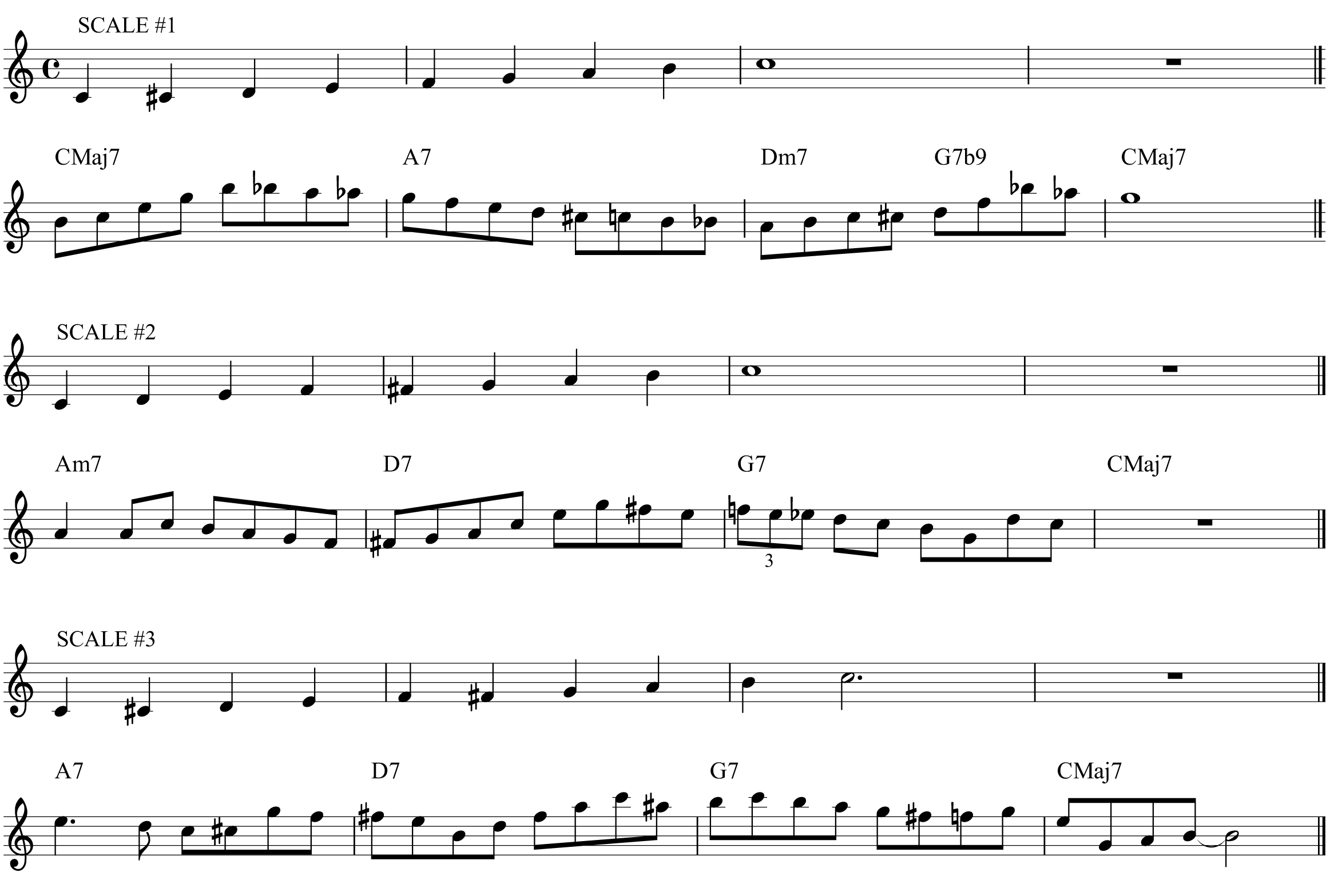
Click on the image to your right to enlarge it. You’ll see three scales. The first two contain a single added note. Scale #1 includes a raised first, and scale #2, a raised fourth. The interpolation of these notes adapts a basic major scale for use with two commonly encountered secondary dominant chords: the V7/ii (or VI7) and the V7 of V (or II7). In the key of C, which these scales are written in, those chords are A7 and D7.

These scales are as fresh to me as they are to you at the time of this writing. Not that I’ve never played them before; I just haven’t made a conscious point of focusing on them as actual scales to invest my time in practicing. I see two benefits to doing do. The first is, obviously, developing technical facility. The second is raising one’s awareness of the added notes as harmonic devices, with an eye on the secondary chords that they apply to.

Each added note serves as the major third–a critical identifying tone–of its secondary dominant chord. So when you play scale #1, remember that it works readily with the VI7; and likewise, scale #2 pairs with the II7. Many playing situations feature both of those secondary dominants, and often the VI7 moves directly to the II7, which in turn moves to the V7–in essence, coasting around a segment of the cycle of fifths.

The third scale incorporates both the raised first and the raised fourth, making it a kind of granddaddy scale that accommodates both secondary dominants.

Now, don’t look at these scales as magic harmonic bullets.. Rather, look at them as resources that allow you to judiciously select certain tones when you need them as well as furnishing you with good linear resources. It’s not all about your fingers mastering the technique of the scales. It’s also very much about applying your mind to grasp the uses of the introduced tones.

In other words, build harmonic awareness, not just digital dexterity. To assist you, I’ve included an exercise for each scale that will help you hear how each added note implies a certain harmony. Play these exercises on the piano so you can chord along with the melody line, or else get a keyboard player or guitarist to comp for you while you play the different lines.

Have fun! And if you enjoyed this post, drop in on my Jazz page and check out the many other exercises, articles, and solo transcriptions.

Tonalism: Some Things Don’t Change

If Western tonalistic music was inaugurated with the publication of Jean-Philippe Rameau’s Treatise on Harmony in 1722–a commonly accepted date–then it has now been with us for nearly 300 years. It has been expressed in many different genres, from Baroque, to Classical, to jazz, Tin Pan Alley, and the blues. Yet no matter what garments it wears, no matter how it has been modified and expanded within various musical styles, the eight-tone major/minor scale system with its primarily dominant-tonic harmony has been the underpinning of virtually all popular music.

I don’t see that changing anytime soon. Not that it needs to; I just can’t fathom how it could do so in any meaningful way. Note the word meaningful. Modern composers have long experimented with alternatives to traditional harmony. It’s just that you don’t find most Americans or Europeans whistling Schoenberg or Indian ragas as they stroll down the sidewalk. And while the rise of “world music” (whatever exactly that is) has awakened at least some Western ears to other possibilities, it can’t match the extent to which Western tonalism has influenced other cultures. I mean, you tell me the difference between Mexican banda music and polka, other than the language. And more contemporarily, popular artists in Asian and Eastern cultures have been founding their careers on the major/minor scale system while preserving distinctive musical elements of their own cultures and languages. (Don’t ask me to name any of these artists; I just know what I’ve listened to on NPR!)

I found myself thinking about the persistence and ubiquity of Western tonalism as I stood in church last Sunday listening to our worship team play. It struck me how the same tonal relationships not only have been repackaged a seemingly infinite number of times over the centuries, but also how, unless our culture somehow undergoes a complete musical sea change, those same relationships and harmonic formulae will continue to come at us in literally millions of new songs over the coming decades.

That’s not a bad thing. Rather, it’s a necessary thing. We are steeped in tonalism, not just intellectually but also emotionally. Other approaches may intrigue us, particularly those of us who are jazz musicians and like to reach for different colors and fresh possibilities. But tonalism provides a gut-level sense of center that all of us innately desire, and a vocabulary by which we all can relate to the stories that melody tells.

Tonalism is in some respects similar to a spoken language. Languages evolve, but they do so slowly and they do so around the edges. The core remains, must remain as a context for any changes to be understood. That’s true of music. While we’re free to experiment, yet the more abstract our experimentation gets, the more that it obscures the core, then the less likely it will be to speak meaningfully to the world at large. I’m all for creative exploration; I’m just pointing out that the average American who cut his or her teeth on Billy Ray Cyrus or Stevie Ray Vaughan isn’t likely to stray far afield when it comes to listening habits. Most folks prefer stuff that’s accessible, visceral, and familiar.

While technology is racing along in seven league boots, other aspects of our world remain the same. Western tonalism may undergo cosmetic changes, but it still is what it is. It may get stretched, it may try on different clothes, but a flatted fifth will remain a flatted fifth by virtue of how it relates to the 12 tones of the chromatic scale.

Why did I write about this topic? Because I’m struck not only by the enduring nature of tonalism, but also by our amazing penchant for personalizing it. You’d think we’d have exhausted the possibilities long ago, but uniqueness continues to drift like snowflakes out of the tonal ether. As I stand singing in church, the tune may be the beloved old hymn “Holy, Holy, Holy,” written nearly 200 years ago, or it may be the recent creation of some contemporary Christian artist. Either way, the tonal foundation is the same. Two hundred years from now, if our Lord tarries and we humans haven’t outright wiped ourselves out, the music we sing will probably still be tonal in its foundations. As with the wheel, zippers, and apple pie, there’s just no need for some things to change.

Sax and Wedge: Maybe This Year

This afternoon I have a gig with Paul Lesinski at the Amway Grand. I’m looking forward to it, but it indisposes me to chase what could be Michigan’s first round of severe weather this afternoon. Practically speaking, the “storm” and “horn” parts of Stormhorn sometimes conflict with each other. I can’t do two things at once; I can’t play a gig and chase storms, and when I post here about one subject, then the other half of my readership gets left out.

Yet I view the two interests as connected in spirit, to such an extent that one of my life goals is to get some footage and/or photos of me playing my sax out on the Plains with a big wedge churning in the background. Given how active this April has been, maybe 2011 will be the year when I fulfill that ambition. I almost always bring my horn with me on my long-distance chases for just that reason (plus, yeah, I like to get in some sax practice when I can). The one notable occasion when I left it home last year was on May 22, a milemarker in my chase career. Unfortunately, the vehicle was so packed that there was no room for the horn, and given how events unfolded out there by Roscoe, it was probably just as well.

Today my buddy Bill is chasing down in Arkansas. Yesterday he filmed a large, violent wedge that hit the town of Vilonia. Round two today looks to be at least as bad, and I hope Bill stays safe. I don’t have a good feeling about what lies in store for the folks in that region. But I won’t be following any of the developments because I’ll be doing the other thing I love as much as storm chasing: playing my saxophone. This time of year the storm chaser in me has the edge over the musician, but once I’ve got my horn in my hands I forget everything else and just go with the flow of the music. Playing jazz is one of the most in-the-moment experiences a person can have, and I get tremendous satisfaction out of being a practitioner.

Afterwards maybe I’ll still get a crack at whatever weather shapes up. Probably not; today, such as it is, looks like it’ll play out on the eastern side of the state.  But I’ll take my gear with me to the gig just in case.

Jazz Sax Friday at The Seasonal Grille

With the advent of storm season, I’ve been so preoccupied with severe weather that I’ve let my jazz saxophone posts slide. But the jazz musician in me is still very much alive, and I’ll be kicking out the jams this Friday evening in downtown Hastings. Did I mention that besides playing the sax, I’ve added vocals to my tool kit? Yes, I can sing! And having finally gathered the courage to do so, I’m finding that people like my voice.

The Seasonal Grille is the venue. I’ve played there once before. It’s a wonderful new restaurant, all ambience, featuring gourmet Italian food impeccably prepared by Justin Straube, the owner and head chef, at prices that are almost ridiculously affordable. Really, it’s one of the best dining deals you’ll find in these parts, and the setting is enhanced by a beautiful bar. I’ll be playing there from 6:00–9:00 p.m. with West Michigan keyboard veteran Bob “Gus” VanStee, so you can pleasure not only your taste buds but your ears as well.

I might add that Bob and I will be fitting into the larger tapestry of the annual Hastings Jazz Festival. It’s a weekend of urban music in an unexpected and very cool small-town setting. I love how this modestly sized community halfway between Grand Rapids and Battle Creek has embraced the American art form known as jazz! Kudos to Justin for supporting the music at his restaurant. It’s a perfect fit. The Seasonal Grille is the kind of place that’s tailor made for live jazz.

So ink this Friday into your planner. Here are the details:

The Seasonal Grille

150 W State St, Hastings, MI 49058

Friday, April 15

6:00–9:00 p.m.

(269) 948-9222

Video: One for Daddy-O

The classic Cannonball Adderly album Something Else includes a wonderful Bb minor blues written by Cannon’s brother, Nat, titled “One for Daddy-O.” The moody head fits the slow, shuffle groove perfectly and sets the tone for some fun improvisation.

I videotaped this tune with my new Panasonic HDC-TM700 camcorder in my buddy Ed Englerth’s basement studio, Blueside Down, the same evening as I taped “The Summer Knows.” My Band-in-a-Box accompaniment doesn’t capture the original arrangement’s antiphonal quality, but it did what I needed it to for a simple, low-key recording.

Video: The Summer Knows by Michel Legrand

Ever since I heard Phil Woods’ rendition of it, I’ve loved Michel Legrand’s haunting ballad “The Summer Knows.” The theme song for the 1971 movie The Summer of ’42, the tune showcases Legrand’s ability to extract tremendous beauty and emotion from a simple, four-note motif.

Videotaped with my brand-new Panasonic camcorder in Ed Englerth’s basement studio, here is my version of “The Summer Knows.” Just me on my beloved Conn 6M Ladyface, the trusty Band-in-a-Box orchestra (even gives you string if you want them!), and Ed operating the video camera. Maybe not studio quality, but the internal microphone didn’t do a bad job. I hope you like it!