Intuitive Jazz Solos: Hearing the Music with Your Fingers

Last night, after a particularly inspirational practice session, I found myself thinking about what it was that I was accomplishing. Saturating myself in the rarely used key of concert A, as I’ve been doing lately, and also taking new material through all twelve keys, has not only been unlocking my saxophone technique overall, but it is also causing me to consider the result I’m after. In a nutshell, I want my fingers to hear the music.

That’s my way of saying that I want to get the muscle memory in my fingers integrally linked with my inner ear, and my inner ear to what I’m actually hearing moment by moment in a given improvisational setting, so intimately that I can conceive ideas instantly and execute them flawlessly.

Have you noticed that there are certain keys in which your fingers just naturally know where to go? Keys and tunes in which you’ve mastered your melodic materials to the point where they’re innate; where licks and patterns are just tools in your toolkit, not your life raft that keeps you afloat? Concert Bb, F, and C major are keys most jazz musicians are quite familiar with, for instance. But what about B, D, A, or F#? The American Songbook may not abound with tunes written in the “hard” keys, but lots of songs have momentary digressions to them.

“Ornithology,” for example, has a temporary excursion into the key of concert A in the form of a iii-VI7-ii-V7 progression. The bridge section to “Cherokee” includes an entire four-bar ii-V7-I cadence in that same key. Spending time trying to master those two tunes has given me incentive to hash out the key of A, to the point where my fingers are starting to “hear” in that key. They “feel” where the third and leading tone of the scale are, and how those notes fit into different harmonic contexts; they’re getting better at handling the avoid-tone of the fourth; they’re becoming friends with passing and non-harmonic tones, and growing more adept at using non-diatonic notes to realize borrowed harmonies.

It’s a process that begins with thinking things through, then working your thinking into your fingers through repetition over many practice sessions. The result, over time, is less deliberation (“If I play an E, that’ll be the #9 of the C#+7#9 chord, moving down to D, then resolving to the root”) and more instantaneous response. Once you reach that point, you no longer need to tell your fingers what to do; they feel it for themselves in their wee little finger souls. Your thinking speeds up, and your fingers are right there with you, eager to serve your ideas and fully capable of doing so.

How many keys, and how many tunes, can you hear with your fingers? Pay your dues in the woodshed, transcribe and memorize jazz solos, play out whenever you get a chance, and over time, your fingers will develop big ears.
Charlie Parker: His Music and Life (Book Review)

Intellectually, all saxophonists understand that Charlie Parker had to pay his dues just like anyone else. We’ve heard the stories about a high-school-age Parker learning to play on a clunky old artifact of an alto saxophone held together by rubber bands; about his mortification when drummer Jo Jones “gonged” him by skittering a cymbal across the floor at a jam session; about Parker woodshedding for 13-hour stints in the Ozarks, developing his formidable technique. In theory at least, we know that Bird wasn’t born with an alto sax in his hands. He had a learning curve just like the rest of us mere mortals. There was even–and I realize this will leave many of you in a state of shock and denial, but it’s nevertheless true–a time when Bird sucked.

We know these things. Personally, though, I still find the idea of Charlie Parker as a novice hard to wrap my mind around.

So reading the book Charlie Parker: His Music and Life by Carl Woideck has proved not only enlightening, but also reassuring.* Musical genius though he was, Bird was still just a very human, flawed possessor of a God-given gift that he worked hard to develop. Seen in that light, Parker represents not an unattainable ideal, but a waymaker, a teacher, and an inspiration who encourages the rest of us to keep at it; to push past our personal limitations; to practice, practice, and practice some more.

A number of excellent biographies have been written on Charlie Parker, providing fascinating glimpses into his quirky personality, immense talent, and tragic excesses. Rather than merely adding one more book to the firmament of Charlie Parker life stories, Woideck has taken a different approach, focusing on the development of Bird as a musician. Woideck’s tome offers eye-opening and profitable insights into the different phases of Charlie Parker’s music, from Parker’s apprenticeship with Kansas City saxophonist Buster Smith, to his tenures with the Jay McShann and Fletcher Henderson big bands, to his co-development of new musical concepts with trumpeter Dizzy Gillespie, to his peak playing years in the late 40s, to his latter period in the 50s, when Parker’s sense that he had taken the bebop approach as far as he could left him groping for a new direction even as his addictions increasingly took their toll.

A glance at the table of contents reveals the book’s logical, easy-to-follow organization. Part one offers a brief biographical sketch of Bird, creating a context for the examination of his musicianship that follows. Part two explores Parker’s music in four different periods: 1940–43, 1944–46, 1947–49, and 1950–55.

Woideck substantiates his discussion of Parker’s musical trajectory and playing style with copious analyses of Bird solos, using excerpts from such tunes as “Honey and Body,” “Embraceable You,” “Ko Ko,” “I’ve Found a New Baby,” “Body and Soul,” “Swingmatism,” and many more to illustrate Bird’s changing palette of nuances and techniques.

This is easily the most comprehensive exploration of Parker’s music that I’ve come across, made all the more so by appendices that provide a select discography and four complete solo transcriptions: “Honey and Body,” “Oh, Lady Be Good!” “Parker’s Mood” (take 5), and “Just Friends.” Being an alto sax man myself, like Bird, I could wish that the solos had been transcribed in the Eb alto key that Parker played them in. However, from a standpoint of general usefulness to all musicians, it’s understandable that the transcriptions and discussion examples appear in concert pitch.

Painstakingly researched and written with clarity and crispness, Charlie Parker: His Music and Life is a fascinating and enriching book for any musician and a must-read for alto saxophonists.

__________________________

* Carl Woideck, Charlie Parker: His Music and Life (Ann Arbor: University of Michigan Press, 1996).

Recording Session with Ric Troll and Dave DeVos

This afternoon was a great time in the studio with my friends Ric Troll and Dave DeVos. Ric’s recording studio, Tallmadge Mill, is a topnotch home studio. Some years ago, Ric and I used it to record Eyes on Mars, a CD of free jazz and experimental music featuring drums and saxophone. Now another project is on the griddle, this time with the very welcome addition of Dave on bass.

After warming up with “Big Foot,” a Charlie Parker blues, the three of us launched into a broad variety of original tunes, some with written heads and changes by Ric, and others that were simply concepts and musical games which maximized listening and empathic, responsive improvisation. What a privilege to make music with two such high-caliber musicians–guys who enjoy exploring far beyond the American Songbook, and who possess the imagination and technical finesse to turn such experimentation into a genuinely musical experience.

More recording lies in store. I’m not sure just how much, but I’ll keep you posted as things develop. At some point, I should also have a few audio clips to share with you, so stay tuned to this blog for updates.

An Easy Way to Use the Augmented Scale in Major Keys

As I’ve continued to spend time incorporating the augmented scale into my working vocabulary as a jazz saxophonist, I’ve made one recent discovery which simplifies its application, at least in part. It is this: the same augmented scale used with the tonic chord in a major key also works beautifully for the altered dominant.

For example, in the key of C, use the C augmented scale for both the tonic C Maj 7 and the G+7(b9, #9). Just keep in mind how you handle the root of the scale when the G dominant is sounding, same as you would do if you were playing a G Mixolydian mode.

The reason this same-scale approach works is because every augmented scale, being symmetrical by design, is actually three different scales spaced a major third apart, all sharing the same notes and interval relationships. The C augmented scale also functions as an E and an Ab augmented scale, and each version works nicely with an altered dominant seventh chord built on its leading tone. Thus the Ab augmented scale is the scale of choice for imposing the augmented sound on the altered G7 chord.

Try the above tip with a blues as well. It works fine, adding color and enough “wrong notes” to sound right, providing you bring the free-floating augmented sound back to earth by resolving it properly to a chord tone and maybe adding a nice, earthy dash of the blues scale.

If you have other ways in which you like to use the augmented scale, please drop a comment and share them. And check out my jazz page for more articles and transcriptions geared for the practicing jazz musician.

A Charlie Parker Lick Around the Cycle of Fifths

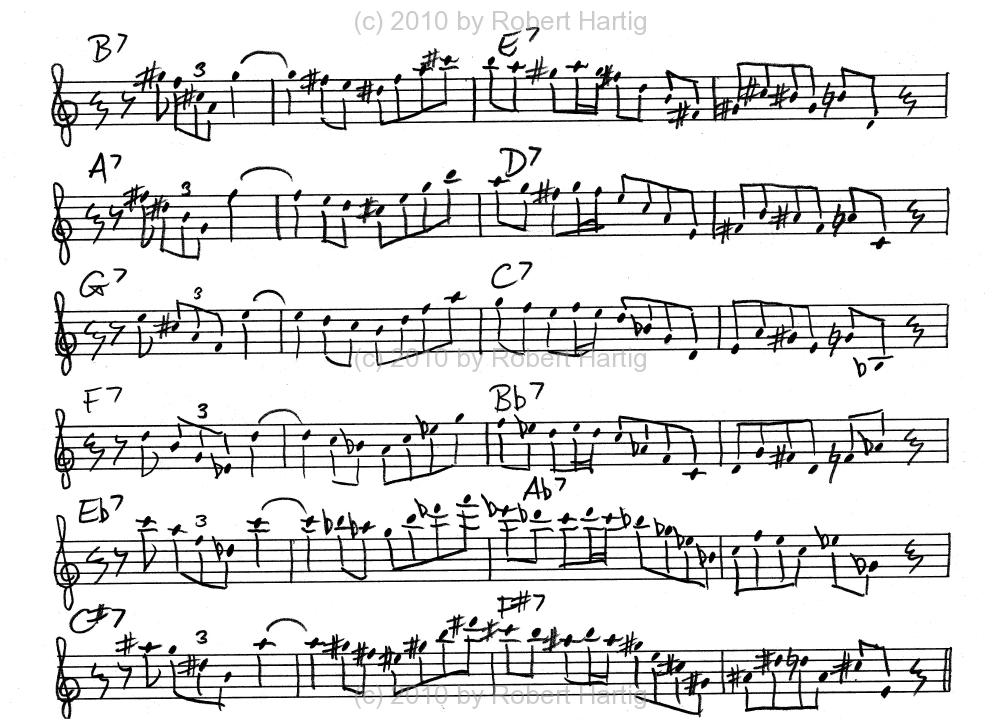
Okay, campers, listen up: Uncle Bob says it’s time again for another great sax lick. So gather round the campfire with your saxophones, and grease your fingers to keep them from igniting, because this lick comes to you from the immortal Bird. That’s right, Charlie Parker, the indisputable emperor of the alto sax–not merely a luminary of jazz, but one of its incendiaries. It pays to light your tinder with Bird’s flame, and this exercise will help you to do so. Click on the thumbnail to enlarge it to readable size.

bird_lick_cycle_of_fifthsThe lick comes from the first bridge section of Parker’s solo on “Thriving from a Riff,” which is one of the myriad contrafacts based on the changes to “I Got Rhythm” that were written back in the bebop era. An alternate and perhaps better-known name for this particular tune is “Anthropology.” Same head, same changes, just a different title.

While a number of variations exist on the chord changes to the Rhythm bridge section, the basic progression, and arguably the most frequently used, is four dominant seventh chords moving around the circle of fifths in two-bar increments. Since the cycle of dominants is the foundation for the Rhythm bridge, extending a lick written over the bridge so that it covers all twelve keys is a great way to develop fluency in every key. That’s the premise of the exercise on this page.

Note that I’ve done only half your work for you. Once you’ve mastered the written material, you’ll need to transpose the lick so that it starts on E7 instead of B7, and work your way through the remaining transpositions.

Parker played Rhythm changes in a number of keys, but the standard key of concert Bb is the one he used most often, and it’s the one that “Thriving from a Riff” was written in. It puts the Eb alto sax in the key of G, with B7 being the first chord of the bridge section. For Bb instruments such as tenor sax, soprano sax, and trumpet, the first chord will be E7. But for purposes of practicing the cycle of fifths, it really doesn’t matter which chord you start with–it’s all good, and it’ll all take you around the complete cycle through all twelve keys, which is the purpose of this exercise.

It’s de rigeur these days to offer analyses of transcribed solos that are so exacting they could split the hairs on a fly’s behind. I admire the insight and effort that go into such exhaustive examinations of an artist’s work, but I frankly find them a bit overwhelming. I do, however, appreciate having points of particular interest spotlighted, and I will offer a few such highlights here.

The opening figure, an arpeggio descending from the thirteenth of the chord, superimposes an A+(#7) over the B7. Bird couldn’t have more effectively avoided playing the basic triad tones. Note his use of the flatted fifth, creating a Lydian sonority. The parent scale at this point is a B Lydian dominant scale, but it’s only a temporary application. In the following bar, Parker clearly defines the B7 and his approach becomes purely diatonic up to bar 4, where he injects a touch of chromaticism in the form of a passing tone. Look closely and you’ll see a hidden chromatic line descending from the note D in bar 3 through C# and B# in bar four and landing on the note B. The final two notes, B and D, are chord tones, the fifth and flat seventh of the E7.

So much for the fancy analytical stuff. If it helps you, fantastic; if it just loses you, don’t worry about it. The main thing is for you to get the exercise drilled into your fingers and your ears. In other words, make a point of memorizing it. Doing so won’t make another Charlie Parker out of you, but it will make you a better player.

That’s the goal, right, campers? You bet it is. Uncle Bob has spoken. Now get your little butts back to your cabins–you’ve got some practicing to do.

On Beyond Jazz: Expanding Your Appreciation of Musical Diversity

Is it safe to come out of my bunker now? Has the war between jazz and rock finally ended? I don’t hear any incoming missiles. But then, I’m kind of out of the loop these days when it comes to who is presently saying what in the various music periodicals.

It does seem to me that in this melting pot called America, music has come a long way in developing mutual respect between the different genres. The purist dividing lines have given way to healthy crossover and cooperative experimentation between music styles and artists, and the style racists who once wrung their hands and shouted, “Miscegenation!” back in the days of “Bitches Brew” have long since been thrust aside by open-minded musicians searching for fresh, creative possibilities. Yet I wonder to what extent the old biases still continue to influence us.

Back in my college days, rock music was largely scorned by jazz musicians, and the feeling was amply returned. You couldn’t pick up a “Downbeat” magazine and read an article on fusion without some reader writing in to complain, “That’s not jazz!” If it wasn’t bebop, it it involved an approach to the drum set that was other than tang-tanka-tang, then the purists were up in arms, donning their white hoods and burning their crosses in the letter section. Even back then, naive as I was, I found the topic of this is/isn’t jazz to be petty, not to mention boring, when the groups in question involved world class musicians who knew the standard jazz vocabulary inside-out.

I also found the notion that jazz was the only worthwhile music, or the idea that any one style of music was better than the rest, to be confining, narrow-minded, and pointless. I mean, I cut my teeth on classic rock music–on groups such as Jefferson Airplane, Mountain, Jimi Hendrix, Jethro Tull, King Crimson, Yes, Genesis, and Fleetwood Mac–and I didn’t stop loving rock and roll just because I was starting to become immersed in jazz.

So why was it that jazzers and rockers seemed to have so little respect for each other? For that matter, what was it about symphonic musicians that gave them such an illusion of superiority over all the rest? And why did it go without saying (by me among the rest, I hate to confess) that country/western was inferior music?

Tell me that things have changed since those days. I think they have. From what I can see, we’ve come a long way.

At bottom, all music is divisible into just two categories: good music and bad music. Beyond that, it’s a matter of personal preference. And that is fine; in fact, it’s inevitable. Each of us is drawn to certain kinds of music and not drawn to others. It’s a matter of individual taste, which fines down even beyond general categories to subcategories and artists of all kinds. It’s all good as long as it doesn’t lead to demeaning other forms of musical expression, or to closing ourselves off to their creativity and richness.

Still today, it’s unlikely that I’ll ever purchase a country music CD. However, that choice is influenced not by musical snobbery, but by the fact that I’m a jazz saxophonist with a limited music budget, and on the relatively rare occasions when I purchase a CD, I usually stick with jazz, guided by a goal of learning my craft as well as enjoying its sound. It’s a matter of focus and preference, not elitism. If I’m driving down the highway and happen upon a good country station on the radio, then I’ll listen to it and enjoy it. Over the years and the long, long highway miles, I’ve come to appreciate that country music harbors some of the finest lyricists and songwriters in the world.

My point: Why limit yourself in what you listen to? Jazz is awesome music, but it’s not all that is out there. Broaden your world. Go to YouTube and check out some of the old film clips of Janis Joplin, Hendrix, and the Beatles. Tune in to The Thistle & Shamrock on NPR and let Fiona Ritchie give you an exhilarating earful of wild, wonderful Celtic music. The world of music has wide, wide horizons; open your ears to ways of expressing musical and creative excellence other than the ones you’re used to. Allow yourself to be influenced by the amazing diversity of music in this world. Doing so will enrich your own artistry as a jazz musician.

Band Link Up: A New Virtual Community for Musicians

Attention, jazz musicians and other purveyors of melody! Want to get in on the groundswell of an online community devoted to musicians? Then click on Band Link Up, look it over, take a minute to register, and then start posting and helping this unique labor of love to grow into a thriving virtual hangout for musicians, vocalists, singer/songwriters, and other artistes of every stripe.

I first got wind of it while installing a new operating system on my laptop. The tech who was assisting me, aka Jeff, and I got to chatting while waiting for a lengthy download to complete, and once we got onto the subject of music, things naturally progressed from there. Turns out that Jeff’s fiancee plays violin and loves to connect with other musicians. So as a gift to her, Jeff decided to put together an entire site dedicated to the purpose of helping musicians talk shop, trade ideas, share sound tracks and videos, and so forth.

I’ve already registered, and I’m encouraging all my musical friends and everyone who is actively involved in performance, recording, composing, or music education to do the same. Band Link Up shows great potential as a service to musicians. Please get on board and help make it happen.

Saxophone Mouthpiece Exercise (a Dignified Term for Screwing Around Making Weird Noises)

I stumbled upon the following saxophone mouthpiece exercise long before I really knew how to play the sax. Back when I was in high school, I needed some kind of trick to cover my butt when I was jamming with other musicians–typically rock bands in those days–and needed to disguise the fact that I didn’t have a clue what I was doing. One evening at a kegger, having exhausted my meager bag of licks, I got the sudden inspiration to pull my mouthpiece off of my horn and play it by itself. The idea certainly commanded attention, captivating my listeners for a good five seconds, though I’m not sure it was the most musical extravaganza they had ever experienced.

Anyway, many years down the road, I still make occasional use of the sax mouthpiece exercise. I’m not sure what else to call it, other than screwing around with the mouthpiece making sounds like a goose gargling. But in all seriousness, I believe you can find some value in the technique, both as a creative tool and as a means of sensitizing your oral chamber for purposes of tone color and pitch control.

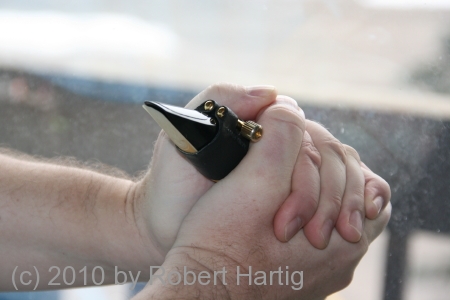
The exercise is simple: cup your hands together to form a sort of pouch, as in the first picture (click on it to enlarge it). Then blow into the mouthpiece. You can then “play” the piece by opening and closing one hand, as in the second photo. The result is a sort of demented warble that sounds like some kind of marshland bird on an acid trip.

Them’s the basics, but of course, you’ll want to experiment. You can actually control the pitch with your hand, and you’ll also want to see what kinds of sounds and pitch-bending you can do by adjusting your embouchure. The point is to explore the colors you can generate using just your mouthpiece, your hands, and your embouchure and air column. You can get some surprisingly expressive effects. In my “Eyes on Mars” album with Ric Troll, I performed an entire piece using this technique. Is it music? I guess that depends on your philosophy of music, and frankly, I wasn’t thinking about the question at the time. I was just having fun trying something different and creative. You know–being a kid.

Give the saxophone mouthpiece exercise a try and see what you think. And check out my jazz page for more tips, technical exercises, and solo transcriptions to keep you occupied.

How to Practice the Saxophone: Four Key Principles That Can Help You Advance

What does it take to develop as a jazz saxophonist–or, for that matter, as any kind of instrumentalist?

Practice.

Right, I guess we all know that. But there is practice, and then there is effective practice. Practice that makes the best use of the time you’re investing. Practice which a year from now will have produced a year’s worth of results rather than a month’s worth of plodding the treadmill twelve times over.

Two things are paramount for effective saxophone woodshedding: what you practice and how you practice. In previous posts and on my jazz page, I’ve provided plenty of material that addresses the “what” part of that equation. In this article, I’m going to talk a bit about the “how” as it pertains to technical development.

Having spent time contemplating the things that have contributed to my own growth as a sax player, I’ve identified four key principles that I believe are important for developing technical proficiency. They are:

Isolate

Repeat

Connect

Memorize

These four principles work together to help you transition from the initial, heavily intellectual process that comes as you tackle new musical material, to a more intuitive approach that develops as you spend time mastering that material and making it your own.

Each of the principles could easily be an article in itself, so I’m not going to tackle them in depth. Right now, I just want to introduce you to the concepts.

Isolate

Whether you’re learning a new scale, practicing patterns, hashing out a lick, moving around the circle of fifths, or memorizing a Charlie Parker solo, the way to approach musical material is in increments.

Think of how you eat your food. You’d never stick an entire steak in your mouth and try to swallow it whole. (You wouldn’t, would you?) No, you cut off manageable, bite-size pieces which you take your time to chew. The same idea applies to working on music: bite-size is best.

Pick groups of notes and repeat them till they lay well under your fingers. In particular, isolate problem areas and focus on them, oiling them with repetition until they’re working smoothly. Work out which alternate fingerings work best in a given situation. If you’re playing in the key of F#, for example, you may find yourself using the bis, one-four, and side fingerings for A# almost consecutively as the context for your approach to the note A# changes.

START SLOW. Concentrate on how evenly you connect the notes, not how fast you can play them. Once you’re playing a note group accurately, comfortably, and consistently, then speed up a notch or two, and continue to increase your speed till you’re playing at high velocity. If you find yourself hitting a speed where you start fumbling and misfiring, then slow down. The point isn’t to play fast, but to play masterfully. Fast will follow.

Repeat

Repetition is woven into the first principle of isolation. You isolate a group of notes or even just two notes in order to repeat, repeat, repeat them, often enough to drill them into your muscle memory. Since I’ve already written a post on repetition, there’s no need for me to–ahem–repeat what I’ve already said. Go read the article.

Connect

Once you’re playing a group of notes fluently, add a note or two in front of it or behind it. Or work on the next group of notes until you’re playing it as fluently as you were playing the first, then connect the two groups.

In the process of focusing on the second group, you may find that you’ve lost a bit of ground with the first group. That’s okay. Go back to the first group and smooth it out. The point is, you work on small units of material, then you work on connecting them to create something larger–to which you will, in turn, connect still more material.

Often you’ll encounter a sticking point between the last note or two in one note group and the first couple of notes in the group that follows. That juncture should become a new area to isolate and work out.

If this sounds like a tedious process, it can be, but it’s also a very profitable one. And not all groups of notes carry equal weight. Some come more easily; others are more challenging. Run toward the challenges, not from them.

Memorize

As long as you’re depending on the paper to tell you what to play, the music you’re working on isn’t really yours. I’m not referring to extended pieces of music where a chart is mandatory, but to scales, licks, patterns…to the building blocks of technique and the language of jazz improvisation. Memorization is an indispensable part of the jazz saxophonist’s toolkit.

The whole point of all this isolating, repeating, and connecting is to move the music off the printed page and into your head and your fingers. So at the very beginning of the process, make a point of looking away from the sheet music. Consult it as freely as you need to, but remember that your goal is to wean yourself from it. When you’re in mid-flight on the bridge to “Cherokee” on your alto sax, you had better be thoroughly acquainted with the keys of Ab, F#, E, and D, because the rhythm section is not going to pause while you look them up in your Larry Teal workbook.

Memorize everything. Tunes. Chord changes. Scales, arpeggios, circular root movements…everything you can possibly cram into your gray matter and drill by repetition into your muscle memory.

One last thing…

Think about what you’re doing. Engage your mind in the process. If you’re working on a digital pattern, consider not just what you’re playing, but also how you can use it with various chords or chord progressions. Think about how you might switch up the rhythm of a lick to create a different effect. You can build all the saxophone technique you want to, but ultimately it’s your brain, not your horn, that converts the raw material into actual music.

That’s it for today. If you enjoyed this post and would like to read more helpful articles on playing the sax, or perhaps find a jazz sax solo transcription to hash out, see my jazz page.

Practice hard–and have fun!

Amy Young and Friends Playing at Schuler Books on January 22

Tonight’s rehearsal with Amy Young and Friends went great. I’m really looking forward to the concert next Friday evening.

Amy is a talented singer/songwriter in the West Michigan area, and she has surrounded herself with a cast of fine musicians for this event. She covers a variety of styles ranging from blues to rock to folk to jazz. If you live in the Grand Rapids vicinity, please come on out and give her and the rest of the band, including me, a listen. Here are the details:

Date: Friday, January 22

Time: 7 p.m.

Place: Schuler Books,  2660 28th St. SE, Kentwood

Admission: FREE, FREE, FREEEEEE!!!

Mark it on your calendar and make it a date. Hope to see you there!