1974 Xenia Tornado: Speaking of Rare Tornado Photos

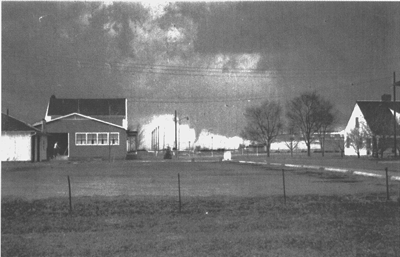
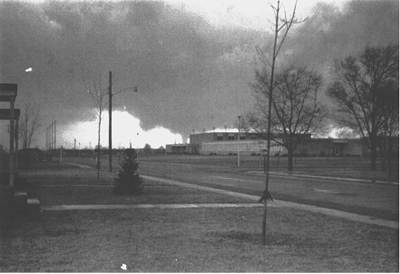
Since I”m on the topic of rare photos of historic tornadoes (see my recent post on the Palm Sunday Tornadoes), I might as well show you this one of the Xenia, Ohio, tornado. It”s another shot that you just won”t find elsewhere on the Internet.\r\n\r\n

\r\n\r\nI scanned this from the one year commemorative edition of the Xenia Daily Gazette, printed on April 3, 1975. Some years ago I contacted the Gazette to inquire whether they had any coverage of the event in their archives, and was told that they had one copy left from the original 1975 print run, as well as some twentieth anniversary editions printed in 1994. Of course I snapped up that last 1975 copy, as well as one from 1994. They”re now a treasured part of my tornado memorabilia. The paper is old and brittle, but I still take it out and read it now and then.\r\n\r\nAgain, you won”t find this photo elsewhere on the Net, though I”ve seen some other fabulous photos on Homer Ramby”s website and on Scott Koerner”s remarkable 1974 Super Outbreak site. Both sites also contain video clips, and Ramby”s includes an actual audio recording of the Xenia tornado as it approaches and ultimately destroys the residence where the cassette recorder was taping.\r\n\r\nReturning to the photo in this post, the quality may not be the best, but there”s something about these old, black-and-white images that captures the sheer horror of historic tornado events in a way that full color photos just don”t convey. The white frame house sits intact in the foreground, but black devastation looms imminent in the background, filling the sky. Did the house escape destruction, or was it part of the carnage? The newspaper doesn”t say. Either way, it”s one heck of a photo of a tornado that ranks as the baddest of the bad, in an outbreak that to this day remains unparalleled.
The Harmolodistry of Ornette Coleman

One of the most widely respected alternative voices in jazz has been that of alto saxophonist, violinist, and trumpeter Ornette Coleman. Eschewing the rigidity of popular song forms, Coleman has explored a freer format that allows for maximum expression of melodic ideas unhindered by harmonic constraints and standard-length phrases. His unorthodox, “harmolodic” approach fits under the avante-garde or free jazz umbrella. You don”t have to listen to Ornette long, though, to detect roots in the blues and a consistent use of organizational material such as motifs and sequences.\r\n\r\nI confess that when it comes to Coleman, I”m better off keeping my words few rather than betraying my ignorance. Instead, I offer this 1987 video of Coleman in Spain. His combo consists of long-time associates Don Cherry on pocket trumpet, Charlie Haden on bass, and Billy Higgins playing drums.\r\n\r\nOrnette”s style has been viewed as everything from jive to genius. He may or may not be your cup of tea, but he deserves a listen. There”s no question that the man has spent time on his horn. He has chops. He just has different chops that have arisen from, and led him in, a different direction. Is the result musical? Depends on what you like. Original? Unquestionably. Interesting? Hear for yourself, and decide whether you want to explore the Coleman sound more deeply.

The Storm Chasers Series: Reliving May 23, 2008

There”s nothing like a trip down Memory Lane in late November, particularly when it comes courtesy of Discovery Channel. Last night I convened with my storm chasing partners Bill and Tom Oosterbaan over at Bill”s house, and we watched the episode “There”s No Place Like Kansas” from the Storm Chasers series.\r\n\r\nIt was great to sit and reminisce with me droogs about May 23. We missed the Quinter tornadoes, but Reed Timmer and Joel Taylor”s superb footage of the strikingly photogenic elephant”s trunk got me feeling all warm and fuzzy. What a beautiful tornado! We had very much the same view of it as those guys, to the extent that I”m guessing our vehicles were parked pretty close to each other.\r\n\r\nWish we could have seen the Quinter wedge. I suspect we wound up on the backside of it, though, and that a couple of the tornadoes I filmed subsequent to the elephant”s trunk were in fact satellite vortices. I have no way to confirm this; I”m left to speculation, based on the fact that the funnels were on the backside of a huge mesocyclone to our northeast, and I felt at the time that its black, rainy interior harbored something big.\r\n\r\nAnyway, it was fun to relive that day with Tom and Bill, even the part where we nearly got sideswiped by the DOW. It”s all part of the story. I hope we do as well in 2009–and if 2008 was the year of the HP supercell, I hope next year will be the year of the classic.\r\n\r\nBut right now, it”s November, it”s snowing, and from where I sit, I”ll take whatever I can get.

Rare 1965 Palm Sunday Tornado Photos

I was a kid living in Niles, Michigan, when the 1965 Palm Sunday Tornadoes swept through the Midwest, including areas just twenty miles to my south. Among the photos in the newspapers was one I’ve never been able to find on the Internet. Some years ago, while researching the event at the Mishawaka-Penn-Harris Library, I came across that photo (appearing second in order below) and its brother, which precedes it.

.

Regretfully, I don’t know the name of the photographer and so can’t credit the photos the way I’d like. If that person happens to stumble across this blog, though, I’d be delighted to hear from him or her, and I invite them to post a comment.

What I do recall is that the description placed the tornado between LaPaz and Wyatt. The stout column in the second photo does seem to correspond with another shot I”ve seen of the LaPaz funnel.

More is going on in these two images than is immediately apparent. The photos seem to depict a hand-off between two different funnels. In the second image, the narrow, cone-shaped tornado shown in the first photo appears to have dissipated into the nub-like lowering on the left side of the wall cloud in photo two, while a new funnel has materialized to the right. This is corroborated by what appears to be a barely noticeable, slim tube in the first photo, located by the left, bottom branch of the left tree in the midground. The image quality in this post requires that you squint and use your imagination to see the tube, which, in this smaller format, looks like a tiny, hair-thin, downward extension of the branch. However, in the original, larger print, you can clearly make out the tube as cloud material. Its position suggests that it was forming as the funnel to the left was getting ready to lift–a transfer of energy from one vortex to another within the wall cloud.

ADDENDUM: Credit for the photos goes to Willis Haenes. Many thanks to Jim Stewart for providing the name of the photographer. Click on “Comments” below to read Jim”s message. The bottom photo appeared in a groundbreaking paper by Dr. Ted Fujita on the Palm Sunday Outbreak. According to a map by Fujita, the view is from Bremen, Indiana, looking west toward just north of LaPaz.

Why I Love Playing “Rhythm” Changes

There are several reasons why, as a jazz saxophonist, I really enjoy playing the changes to “I Got Rhythm.” The most apparent reason is that, besides the blues, “Rhythm” changes are the most ubiquitous set of chord changes in the jazz language. The beboppers of the 1940s and 50s wrote a host of tunes over “Rhythm,” some of which I’ve listed in my earlier article on contrafacts, and the number continues to grow. So internalizing “Rhythm” changes is as useful and important as learning the blues: you expand your repertoire by not just one set of chord changes, but by as many “heads” to go with those changes as you can memorize.

Sound good? It gets even better. The tune is in reality a bunch of turnarounds strung together, so at its simplest, it allows you to get a workout on the I-vi-ii–V7 progression. With various chord alterations and substitutions, the progression becomes more sophisticated. Any number of variations exist for “Rhythm” changes, but the bottom line is still this: learn “Rhythm” and you”re also learning your turnarounds.

The nice thing about the “A” section is, you can cover it pretty well using just the parent major scale of the key you”re in. That’s a good place to start. You’ll want to go beyond that, particularly since the fifth bar flats the seventh, but if you’re just beginning to grapple with the complexities of bebop, then it’s nice to work with a tune tha”s as gracious as “I Got Rhythm,” which both accommodates beginners and challenges more advanced players.

The bridge section is another great exercise, this time on the circle of dominants. Work out your mixolydian modes here, concentrating on voice leading, with the seventh and third descending from one chord to the next by half-step. Or take it deeper and focus on chord substitutions and various alterations. The b9 is especially important in the bebop approach.

I work on my “Rhythm” changes frequently. Normally played in concert Bb, they’re a great way to get inside any key and master it. I will be addressing “Rhythm” changes in my upcoming e-book. Stay tuned and be patient. I’m writing the material in my spare time, and it’s not coming quickly, but it is coming.Don’t wait on me, though, to work on your “Rhythm” changes. They’re practical, challenging, accessible, and best of all, enjoyable to play.

ADDENDUM: Pianist, composer, and music educator Kurt Ellenberger is far less favorably disposed toward “Rhythm” changes than I. To read his provocative and well-written commentary in the first of a three-part debate between Kurt and me on the pros and cons of “Rhythm,” click here.

I”m at a point in my sax playing where I”m enjoying a strange paradox. I am more concerned than ever with knowing the correct changes to tunes from memory, yet less concerned about actually playing them.\r\n\r\nLet me explain. Internalizing the changes roots me in the tune, gives me confidence that I know the song; the tune is in my head and in my fingers, it belongs to me.\r\n\r\nWith that knowledge and confidence comes the freedom to experiment, and the conviction to make my experimentations sound–hopefully–musical and interesting. I don”t have to make every note fit into the chord/scale scheme. I can, for that matter, range pretty far afield tonally as long as I have some kind of logic for what I”m doing.\r\n\r\nSequence is a biggie. Playing a pattern through a sequence provides a framework for superimposing non-harmonic tones of all kinds on a chord progression. Another thing I can do is play a ii-V7-I of my choice in a tone center other than what the music is calling for. Either of those devices creates temporary harmonic clashes–a technique known as “outside playing”–but the clashes sound cool and add interest provided I resolve them properly.\r\n\r\nDavid Liebman”s masterful book, A Chromatic Approach to Jazz Harmony and Melody, freed up my harmonic approach when I first read it years ago. Just thinking of the book makes me realize I”m due to revisit it. I can use the creative stimulus of an improvising genius such as Liebman. If you”ve acquired a good command of your instrument and the basics of improvisation, I recommend Liebman”s book highly.\r\n\r\nHandle the wrong notes right and they become the right notes. Handle the right notes wrong and they”ll sound wrong. Learning how to choose your colors and expand your tonal palette is one of the truly enjoyable challenges of playing jazz.\r\n\r\n

https://stormhorn.com/2008/11/22/

Developing Tonal Expressiveness on the Sax

One of the things that sets apart a seasoned improviser from a novice is the treatment one gives to tones. Do you know the different tricks you can use to nuance a note or passage? Can you bend, gliss, growl, flutter-tongue, alternate-finger, ghost, pop, split, and so on, or is your tone monotonously straight and undifferentiated?\r\n\r\nHere”s a fun little exercise for sax players that can help you loosen up your sound on your horn. Pick a note in the upper mid-range–say, G above the staff. Now play a long tone, but instead of trying to make the note as even as possible, play around with it. Drop your jaw. Tighten your jaw. Touch your tongue to the side of the reed and see if you can partially dampen the tone without cutting it off. Hum while blowing the note to produce a growl. Get creative. Think of different ways you can color the note; think of the note as taffy that you can pull in a lot of different directions.\r\n\r\nThe point is to start creating a palette of personal expression. Listen to the great horn men with this in mind and you”ll quickly realize how much the use of nuance and inflection factors into each player”s trademark sound.

Remarkable Findings on the Greensburg Tornado

A tornado over four miles wide? I”m trying to wrap my mind around that idea.\r\n\r\nEarlier today I listened to a recorded Powerpoint presentation by meteorologist Les Lemon on some findings on the Greensburg tornado. Now I”m chewing through a paper by Lemon and coauthor Mike Umscheid that goes into depth on what the recorded presentation, because of time constraints, could only touch on.\r\n\r\nThe findings are staggering. Bear with me, because I”m not a meteorologist and I have yet to really dig into and digest the paper. But from what I”ve gathered, radar data indicate what Lemon and Umscheid, coining a new term, have called a “vortex hole.” The hole is a part of a large-scale circulation that the authors refer to as a “tornado cyclone”–an established but rather obscure term which here seems to take on a unique application for a unique event.\r\n\r\nIn the words of Lemon and Umscheid…\r\n\r\n

Using the earlier reasoning, but in this case with a substantially larger pulse volume, we estimate actual TC [tornado cyclone] tangential velocity of 74 m s-1 or 144 kts.\r\n\r\nThis becomes even more amazing when at 0433 the radar resolved core circulation TC at 0.5o has grown to 7 km (3.9 nm) across with a mean tangential velocity of 52 m s-1 or 101 kts! The radar pulse volume at this time was 1.7 km (0.92 nm) across with this mean of 52 m s-1 (101 kts)! We recognize that by this time the radar horizon (beam center) is at ~ 1.7 km (4500 ft) altitude or just above cloud base. We, of course, don’t know if these incredibly strong velocities extend downward to the surface but we do know that damaging winds were occurring at the ground. Once again this begs the questions: What is this core circulation? Do we call this a tornado, a TC, or a mesocyclone?

\r\n\r\nI can”t feel too bad about struggling to grasp something the authors themselves are clearly shaking their heads over. I don”t do well with metric measurements, but I understand at least this much: that during its Trousdale phase, the tornado cyclone at cloud base was seven kilometers across. That”s over four statute miles. And the wind speeds were of tornado intensity.\r\n\r\nThe big question is, did the Greensburg supercell actually put down a four-mile-wide tornado? The conclusion Lemon and Umscheid make room for–staggering to contemplate–is: quite possibly. That such a mega-beast could ever exist seems beyond comprehension. Yet this, in essence, is what the authors are considering at the end of the above quote. \r\n\r\nAs if the findings in Lemon and Umsheid”s paper aren”t impressive enough in their own right, the authors corroborate them with ground-zero evidence in the form of a remarkable, firsthand log by one of the Greensburg survivors. Huddling in the basement as her house sustained EF5 damage, eighteen-year-old Megan Gardiner somehow had the presence of mind to observe what happened during the approach of the tornado and the four to five minutes it took for the vortex to pass.\r\n\r\nIf you take an interest in the Greensburg storm, Lemon and Umscheid”s paper, and Lemon”s recorded presentation, are a must. Click this link to access the presentation, together with other material on the Greensburg storm and other severe weather events delivered at the 24th Conference on Severe Local Storms in October in Savannah, Georgia.

Mastering the Hard Keys

What”s so hard about the key of B, or F#?\r\n\r\nEver think about it? If you”re an alto sax player like me, then life for you is pure bliss in the keys of G, D, A, and C, but there are other keys that feel about as comfortable as tight underwear.\r\n\r\nPractically speaking, though, the only reason some keys are hard to improvise in is because we just don”t spend enough time in them to get the feel of them. And “feel” is exactly the right word: connecting ideas in our head with muscle memory in our fingers.\r\n\r\nThe key of B actually feels fairly comfortable to me these days. I can”t say the same for F#; I can get around in it when I need to, but my relationship with it is still an awkward one. The challenge isn”t a technical one–after all, the difference between the keys of F# and B is a single note, the note E# versus E. However, playing tunes such as “Wave” and “Tune Up” have helped me to familiarize myself with the key of B in a way that I haven”t done with F#. Technique is great, but application is what brings it home.\r\n\r\nWhen I first started memorizing those two scales years ago, I bumped up instantly against the half-step between the notes A# and B. It was hard to deal with! Or so I told myself. But it wasn”t hard, it was just unpracticed. In reality, the note A# has the most fingering options of any note on the saxophone. If one fingering doesn”t work well in a given playing situation, you”ve got plenty of other possibilities to choose from. How much more could you ask?\r\n\r\nOn the saxophone and other wind and brass instruments, each key has its unique challenges. But the overarching challenge is simply overcoming unfamiliarity. I get around okay in the key of E, but Eb…mmm, not so hot. But I work at it. It”s coming–not as fast as I”d like, but it”s coming. Practice is the key to every key. It always is.

Putting the Kids to Bed

I just brought my kids in from outdoors. It was time. These below-thirties temperatures have been enough to give them a proper chilling. In fact, they”re pretty well frozen stiff, which is about what you”d expect, considering that none of them has been wearing a stitch of clothing. Hey, it”s dark and cold out, and none of the neighbors ever notice.\r\n\r\nI figured, though, that the kids have finally had enough. Tonight they can sleep inside. So I brought them in and stuck them in the refrigerator, where I plan to keep them for the next few months.\r\n\r\nOkay, I guess I”ve carried that about as far as I can before the cops come knocking on my door. Now that I”ve thoroughly horrified you, let me explain that “the kids” are my collection of carnivorous plants. Did you think storm chasing was my only eccentricity? Heck no. About the same time I became enamored with tornadoes as a kid, I also got into carnivorous plants. And like tornadoes, the plants have been hardwired into my personality ever since.\r\n\r\nA few years ago, I decided to resurrect my boyhood hobby, so I ordered a few of the United States natives and got my collection started. It has been going great guns ever since. Of course I”ve got Venus flytraps–that goes without saying. I started with four plants; I now have, at my best estimate, a billion. The things are prolific beyond anything I ever imagined. The first year, the bulbs divided and I wound up with maybe twice as many plants. I gave a few of them away, kept the rest, cross pollinated them, and then scattered the seeds on a couple trays full of wet peat, hoping that a few of them would sprout. In that hope I was not disappointed. I wound up with several hundred baby flytraps. This year I repeated the process, from bulb division to seed germination. I am now the Flytrap King of Caledonia, Michigan.\r\n\r\nMoving on from the Venus flytraps, I also own six of the eight native pitcher plants. Strangely, one of the two species I don”t own is the one that grows right here in Michigan, the northern pitcher plant. It”s by far the most common and widespread of all the US species. Harvesting one from the wild would be fairly easy, and it”s the one species with which I”d feel okay about doing so. The rest, all southern plants, are uncommon to nearly extinct due to the steady loss of habitat, and collecting them from the wild is illegal. I obtained all of mine, including my rare Sarracenia oreophila, through a reputable mail-order nursery that sells only cultivated plants.\r\n\r\nMy roundleaf sundew, on the other hand, just showed up one day. I don”t know where it came from, but I have no objections. As for my Pinguicula vulgaris, I obtained that from the Upper Peninsula, keeping it in its native marl, and it has done well for me over the last few years.\r\n\r\nWhat”s all this got to do with either jazz or storm chasing? Nothing at all. It”s just another side of me. We all have multiple sides, hopefully enough to round us out as individuals. When I was younger, I was so deeply immersed in jazz that I had a sort of tunnel vision. I couldn”t see anything of life beyond the narrow periphery of music. I was focused, but I was also boring, self-absorbed, and ill-equipped to deal with life at large and relationships in particular.\r\n\r\nBut that kind of focus gets old. There”s so much more to life, and embracing that truth doesn”t steal the thunder from storm chasing or the energy from jazz. No, it enhances those pursuits.\r\n\r\nI”m sure my kids will agree. By the way, letting them get cold helps punt them into dormancy. All North American carnivorous plants require a few dormant months, just like you and I require a good night”s sleep. Like a lot of hobby growers, I simply stick my plants in the fridge. Unlike a lot of hobbyists, I leave them in their pots. Last year that worked pretty well, but this year…well, I”ve added a few more plants, and you”d be amazed how much refrigerator space my collection is taking up.\r\n\r\nSomewhere in there, I suppose I need to make room for food. I”m not sure where, though. Maybe I”ll just keep my food out on the deck where my plants were.