Jazz Improvisation E-Book: Another Update

Writing an e-book on jazz improv is definitely a challenge. The going is slow, since I’m still faced with the exigencies of life and the need to make a living. That being said, though, I am making progress.

In the process of writing, I find myself necessarily considering my approach. Any number of ways exist to accomplish the same end in jazz. A whopping amount of educational material also exists that says pretty much the same thing. After all, this isn’t a new topic, and I”m hardly the first person to write about it. How, then, can I offer value–something not different merely for the sake of being different, but something whose distinctions can help budding improvisers to better grasp at least some of the essentials of jazz craftsmanship?

As a street-level, self-appointed educator rather than a degreed, college-level didact, I myself am learning by doing, and my first lesson has been: start simple. I can’t possibly cover all there is to know about jazz improvisation in one book; such a book would have no end, and besides, I myself have still got plenty to learn. So I”ll probably write several books. This first effort will be for beginning improvisers. Note that I didn’t say beginning musicians. I”m assuming that anyone with an interest in improvisation already knows the basics of music theory, and while I do cover some of those basics, readers should already understand how a major scale is built, and what the church modes are, and what intervals are, and triads, and seventh chords, and so forth. Such things comprise the building blocks of all Western music; my interest is to help aspiring jazz instrumentalists assemble them in a way that fits the overall jazz genre.

In my approach, I hope to help players connect their inner ear with technical finesse, so that technique and the ability to “hear” develop together. We want to be able to not only conceive cool lines, but also to “feel” them in every key, even the weird keys such as concert E, B, or F#.

At the moment, chapter four is underway. It covers the unaltered dominant seventh chord and the Mixolydian mode. No need to say more, other than, stay tuned.

Bracketing: Changing Tones for Jazz Musicians

I’ve heard the technique referred to as “bracketing,” but it’s really just the good, old-fashioned Baroque musical ornamentation known as “changing tones” applied to a jazz solo. Whatever you call it, you can add interest and lyricism to your improvisations when you precede chord tones and target notes with both an upper and lower neighbor.

Three levels of chromaticism exist with the bracketing technique: diatonic, chromatic lower (or, conceivably but uncommonly, upper) neighbor, and dual chromatic upper and lower neighbors.

Play a C7 arpeggio, thus: C, E, G, Bb. Take it slow so you can hear the chord outline.

Now, playing each grouping of three as a triplet, surround each note of the C7 with its…

  1. 1. Diatonic neighbors (based on the C Mixolydian mode): D-Bb-C, F-D-E, A-F-G, C-A-Bb, D-Bb-C.
  2. 2. Diatonic upper and chromatic lower neighbors: D-B-C, F-D#-E, A-F#-G, C-A-Bb, D-B-C.
  3. 3. Chromatic upper and lower neighbors: Db-B-C, F-D#-E, Ab-F#-G, Cb-A-Bb, Db-B-C.

The latter two approaches are relatively common in the bebop language. Obviously, you can bracket any quality of chord or any scale tone. Devise bracketing exercises that will take you through all twelve keys and you’ll be well on your way to real fluency as a soloist.

Another Hartig on Saxophone?

I came across this interesting YouTube clip by a fellow saxophonist named Tom Hartig. Naturally, I was intrigued to see what another person who shares both my last name and my passion for the saxophone is doing musically. I wasn’t disappointed. This guy has a nice little sample clip that demonstrates a unique, original, meticulously arranged approach that manages to meld a strange, haunting, even slightly disturbing feel with lyrical beauty.

Tom’s clip is well worth checking out. In his note, he says he hopes you’ll buy his CD. I do too, and I may pick up a copy myself. After all, we Hartigs have got to stick together. And I assure you, having listened to a couple of Tom”s other video clips from years gone by, that the man can really play the sax.

Saxophone Art

Ready for a little personal window into my life? I’ve got this sax art thing going on in my apartment. Nothing major, but I thought it would be fun to give you a glimpse of some of the saxophonical objects that occupy my living room.

We’ll start with my saxophone lamp. This was a gift from my beautiful mother. I’ve gotten a lot of compliments on it. It”s majorly cool–the photo doesn”t nearly do it justice. And yes, it’s made out of a real saxophone. I could take the guts out of the lamp, have the horn reworked, and then play it. But I like it as a lamp much better.

This funky little guy was given to me by my wonderful sister, Diane, one Christmas years ago. He’s the product of a nylon stocking, a bit of fabric, and Diane’s immense creativity. Another treasure. I love the gnarly expression on his face. He’s clearly a street musician. His saxophone looks a bit like something you’d find swimming around in the sea, but its lack of anatomical correctness contributes mightily to its coolness quotient.

If you’ve never seen a saxofrog before, now you have. He may not be green like Kermit, but he plays ten times the horn. My beloved buddy Duane gave him to me out of the blue one day. He’s found a nice, shady spot to busk beneath my Chinese evergreens. The frog, that is, not Duane.

I know just what you”re thinking: “Aaawwww!!!” Let me tell you, though, that besides cornering the market on Cute, my little furry bear pal, here, is a formidable alto player, and as a section leader, he”s dynamite. Besides that, he’s quite the literati, and loves to surround himself with good books.

There you have it–the things that make for a sax player”s living room. Hope you enjoyed the tour!

Phrygian Dominant Licks: Capturing the Essence of Minor Bebop

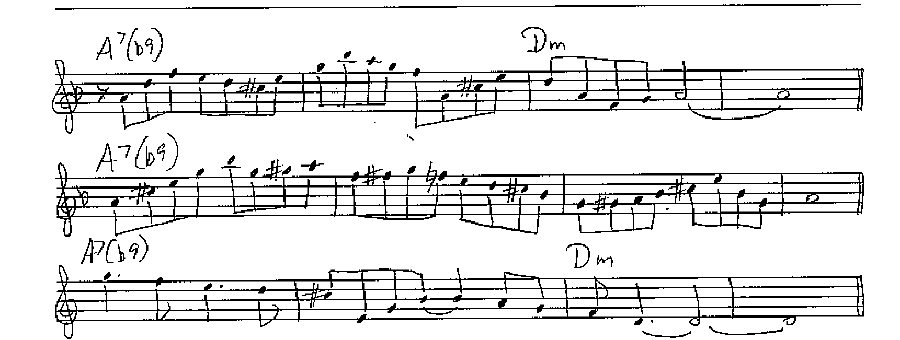
The harmonic minor scale was the first scale I learned to apply in a minor jazz setting over an altered dominant chord. No doubt that was because it was the easiest, but it also seemed to me to be the most consistent with the vocabulary of bebop a la Charlie Parker. Just as a given major scale generates the appropriate Mixolydian mode for the dominant of its key, so a harmonic minor scale produces a scale that works well with its dominant. Known as the Phrygian dominant (aka Jewish scale, Gypsy scale, or Spanish scale), this scale works beautifully with V7b9 chords. With its lowered sixth, and with the minor third interval between its lowered second and major third, it possesses an evocative, Eastern quality that makes me think of belly dancers and snake charmers.

The scale you’re likeliest to learn as the first choice for V7b9 chords is the half/whole diminished. It’s certainly a time-saver, as you need learn only three of this symmetrical scale in order to know all twelve. But the Phrygian dominant has an exotic beauty to it that the diminished scale doesn’t quite capture, and a built-in ease of use rooted in its relationship to the parent minor key.

In a previous post, I offered a couple of written exercises on major triad couplets. Now, in the spirit of Bird, here are three licks utilizing the A Phrygian dominant scale. The first and third one resolve to the tonic chord of D minor; the second is just a straight A7b9 lick, but you can still resolve it to the D minor–it just waits longer to define that chord.

As always, memorize each exercise in all twelve keys. And have fun!

[ADDENDUM: I just noticed that, in the third exercise, I didn’t include a Bb in the key signature. Please mentally insert it so you’re playing in the key of D minor and the ninth of the A7 chord is flatted.]

Triad Couplets for Jazz Improv: Two Written Exercises

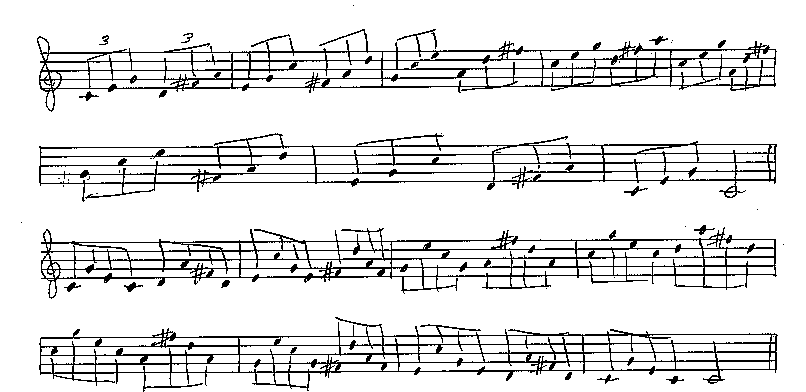
In a previous blog, I wrote about practicing scales with a jazz purpose in mind, and I offered a few suggestions. In keeping with that post, here are a couple fun little exercises that involve juxtaposing two triads a major second apart from each other and running them through their various inversions. Take them through the full range of your instrument, and work out other variations on them to develop complete facility with them.

Please bear with the small size of the staff and notation. This is the first time I’ve attempted uploading a written exercise on this blog.

Always keep application in mind. Play these exercises against a C major chord, for instance, and the raised fourth–F# of the D major triad–gives you a Lydian quality. Play the exercises against a D major and you get a dominant sound, with the C functioning as the flat seventh.

Work with the Aebersold Gettin” It Together CD, or Band in a Box, or simply with a piano, holding down a chord, so you can hear how this exercise sounds against actual harmony.

Subconscious-Lee

When you think of original voices on the alto saxophone, Lee Konitz inevitably comes to mind. A student of blind pianist Lenny Tristano, Konitz unites a limpid tone with fluid technique and a unique, uncliched melodic conception.

I find interviews with jazz musicians fascinating, and in previous posts I”ve included links to clips featuring both the playing and the personal insights of Sonny Rollins, Bill Evans, and Michael Brecker. Now joining them is this video segment from the television show The Subject Is Jazz featuring a young Lee Konitz and tenor compatriot Warne Marsh playing the tune “Subconscious-Lee,” followed by a brief but interesting interview with Konitz.

I’m struck by Konitz”s early tone–clear, pretty, and creamy. His sound has evolved quite a bit since then, and possesses an unmistakable, instantly recognizable signature quality. Melodically, note Konitz”s use of sequence, and his ease of interpolating unusual, more angular ideas into his lines. The tune, and both Konitz”s and Marsh”s playing, showcase fabulous technique masked by a cool, intellectual approach. Standing in the hot shadow of the boppers, Konitz offered a thoughtful and engaging alternative.

Michael Brecker on Practicing

Oh, man! Gold mine! Check out this video of Michael Brecker talking about his practice regimen.

I find two things particularly noteworthy:

1. As phenomenal a saxophonist as Michael Brecker was, he never considered himself to have arrived. He continued to practice voraciously, experiencing the same ebbs and floes in his woodshedding and musical growth as anyone else.

2. Michael was always reaching for new ideas. But it took him a long time and hard work to master those ideas. In his own words, he was a slow learner.

Huh? Brecker–slow? Gee, I guess the guy actually had to pay real dues to become as good as he was.

One aspect of inspiration is encouragement. I find it encouraging to think that Brecker was actually human. He didn”t just come out of the womb playing the saxophone that brilliantly. He sweated over his instrument.

Of course I already knew that. Still, listening to those recordings of Michael, I lose track of the fact that he wasn”t superhuman. Gifted he was, most definitely, but he still had to do what any of us have to do in order attain proficiency on our instrument: practice. Hearing someone who played at such a high level talk so openly and humbly about his personal challenges in continuing to grow musically…well, it just helps, that”s all. I mean, for all the time I”ve spent working on my horn, I sometimes get discouraged thinking how much I have yet to learn, and how long it has taken me just to get to where I”m at.

So I appreciate a guy like Michael Brecker sharing so transparently. His doing so helps me realize I”m no dummy. I”m just normal. And I”m in pretty good company.

Kudos, by the way, to Jazz-Sax.com, where I found the above YouTube clip. It”s a site you”ll definitely want to check out and add to your bookmarks.

Art Pepper: Sweet, Sad, and Soulful

I love Art Pepper”s playing! What a refreshing departure from the balls-to-the-walls bebop of the forties and fifties. An icon of what came to be known as the “West Coast style” of jazz, Pepper had a unique sound and improvisational approach that identify him instantly whenever you hear one of his recordings.

Tonally, Art Pepper was cut from a cloth similar to Paul Desmond. But the similarity doesn”t go very far. Pepper had the same silky, creamy texture as Desmond, but with a brittle, somewhat hard edge to it. Part fruitiness, part sigh.

Art”s improvisations are beautifully lyrical, liberally punctuated with a very personal sense of space. He delivers his ideas in crystalline clauses separated by semicolons and emdashes of breathing room. The overall effect is one I find completely captivating. No one else I”m aware of has ever duplicated it, and no one needs to. One Art Pepper is sufficient. I”m simply glad he was here, and that he left us such a lovely legacy in the way of musical expression.

nCheck out this recording of Art Pepper playing “Besame Mucho.” You”ll easily notice Art”s trademark sound and use of space. You”ll also pick up on the fact that the guy had a wonderful technique, one which served him well, not to mention those of us who admire his playing.

When you want a taste of something a little different–a blend of prettiness, sadness, and soul–listen to Art. He had a hard life, but his playing is tender and sweet.

Playing Sax Till the Cows Come Home

I play for cows.

Seriously.

At the western edge of my small hometown of Caledonia, bordering the parking lot of a Catholic church, there sits a large cow pasture. During the warm months, I periodically park my car out there on the far edge of the church lot and practice my saxophone.

The results are always rewarding. It’s an amazing thing to watch scores of cows come drifting in to check me out. Evidently, cows love a good concert.

They’re particularly responsive to high notes. Musically speaking, there’s nothing a cow appreciates so much as a good, screaming altissimo. Work your horn a little bit in that top register and watch those cattle come prancing in to stare at you with intense curiosity. It’ so gratifying. I promise you, you’ll never find a more attentive audience, or a more appreciative one. Cows are good for a musician’s ego.

And responsive? Hoo-wee! Cows are moved* by jazz. Inhibition to the wind, baby, that’s a cow crowd for you. One cow will think nothing of mounting another cow whenever the mood seizes it, and gender evidently isn’t much of a concern. When those cow hormones are running hot, all it takes is a little jazz sax to inspire some hot young heifer to attempt things she wasn’t designed for. Cows are the original Woodstock generation.

If your practice routine has settled into the doldrums and you’d like to shake it up with something a little different, I highly recommend cows. Head to the nearest pasture for your next session, start blowing, and watch what happens. It is truly a weird sight to see a hundred bovine lined up along the fence, watching you intently and all but snapping their hooves to the music.

Give it a try. You may even get fan letters, though I wouldn’t answer them if I were you.

_______________

* Being a man of taste, I have avoided the obvious pun. I refuse to say mooooved in any of my writings about cows, and have carefully avoided doing so here.**

** But not here. Mooooved.