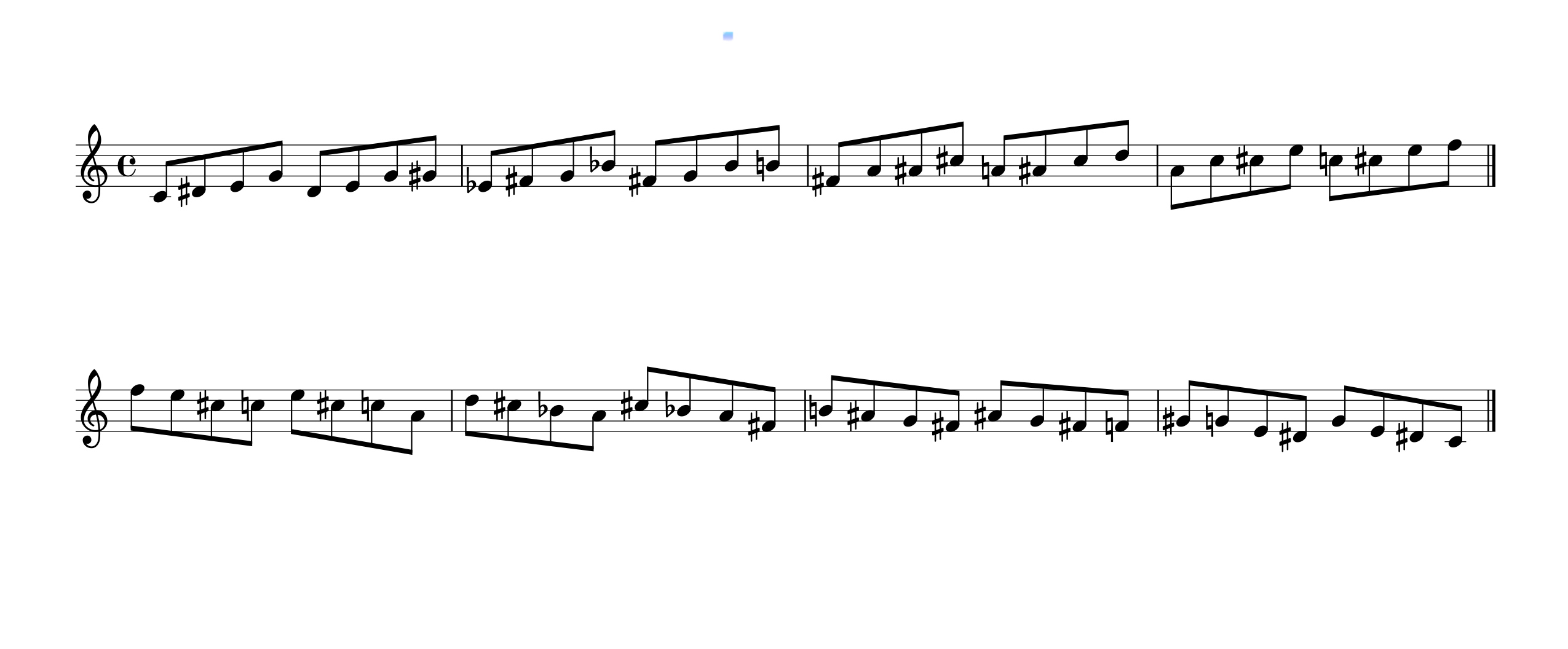
Augmented Scale Pattern by Minor Thirds

The exercise on this page forms the basis of several patterns I’ve been using to develop facility with the augmented scale. Click on the image to enlarge it.

In each bar, the scale root moves up by a minor third. In other words, the pattern takes you through four different augmented scales that outline a diminished seventh chord with their roots, thus:  C, Eb, F#, and A. Of course, you should transpose this exercise so that you also begin the pattern on C#, D, and Eb. After that, you wind up repeating material you’ve already practiced.  That’s one of the nice things about this exercise–there are only four patterns to learn!

So how do you use this pattern? You can find your own answers to that question, but here are a few thoughts:

* The best use is probably static chords, either minor or altered dominant.

* The pattern also implies a cycle of fifths with a chord change at every measure. I won’t delve into why this is so, but if you do your own analysis, you’ll see for yourself why this pattern accommodates both the cycle of fifths and tritone substitutions moving down by half-step.

The unique sound of the augmented scale offers plenty of color, and the fact that it fits no commonly used chord perfectly makes it an interesting choice for many chords as a temporary device. This pattern will help get your fingers used to moving the augmented scale through changing tone centers. Work hard, experiment, and have fun!

Be sure to check out my jazz page, featuring lots of other exercises, practice tips, insights, and solo transcriptions.

Shake It Up, Baby!

“…Uh, huh! Twist and shooouuuut! C’mon, c’mon, c’mon baaybee! Let it all”…er, hi there! Didn’t know anyone was listening to me sing.

Heh, well, then…as long as you’re here, let’s go back to that first line of the tune:

“Shake it up baaybeee!”

Are you shakin’ it up?

I don’t mean on the dance floor, I mean in your sax practice. If your sessions in the woodshed are starting to seem a bit stale, maybe it’s time you shook up your routine with the injection of some new material. Really, you should always be working on something new, not just perfecting what you already know.

It may be the introduction of a new pattern or lick. It could be a new tune, or a memorized solo that you’re taking to a different key. Whatever it is you choose, tackling new material will sharpen your mental edge and pay dividends in your technique.

So don’t be afraid to shake it up. Yes, you want to polish up the stuff you’re presently working on, and of course you want to revisit older material to maintain it. But it’s important to challenge yourself with an influx of fresh ideas. How often? That’s up to you. There’s a point at which new material is no longer new. You may not have honed it to perfection, but you’ve basically got it down. It’s time to cast your eyes on something else and move what you’ve been working on to the latter part of your practice session. Sure, you can warm up with familiar material, but then move on to newer stuff. Doing so will not only broaden your horizons, but also feed into the things you’ve been working on. And it will ensure that a year from now, you’ve got a year’s worth of woodshedding under your belt, not just a week’s worth times fifty-two.

Half a Step Away from Right

The old jazz improviser’s adage is true: You’re never more than half a step away from the right note. You can justify any clinker by calling it a chromatic neighbor as long as you play it like you mean it and resolve it to a chord tone or to the correct upper extension. That raised seventh you played over the dominant chord–that was intentional, right? Love how you used it as a leading tone to the chord root! The major third you landed on in that minor seventh chord–how clever of you to create such unexpected tension en route to the minor third.

I’m joking around a bit, but what I’m saying is perfectly true: the difference between a clinker and chromaticism lies in how you handle the note.

Knowing about the half-step difference can help you when you’re sitting in with a group and find yourself playing a tune by ear whose harmonies you’re not familiar with. Barring tunes whose chords are all purely diatonic, you’ve got to identify the qualitative differences in borrowed chords. Modulations are a different matter; often, though, you’re dealing with just a chord or two out of the norm. Can you identify the note (or notes) that has been changed? It has only been raised–or lowered, take your choice–by just a minor second; otherwise, it would be diatonic to the scale.

Often the sixth note of the scale will be lowered to serve as the minor third in a IVmin7 chord, or as the flat 5 in a IImin7b5. Or the fourth may be raised to serve as the major third of a secondary dominant (V7 of VI). Or the tonic may be raised to serve as the major third in a V7 of II. The point is, if something in the harmony you’re hearing creates a clear qualitative difference, try to identify the tone or tones involved. You may be able to simply skate over the altered chord using a diatonic scale, as you can in rhythm changes, but you really should pay attention to it so you can make judicious choices about how to handle it. Doing so isn’t necessarily a matter of using a different scale; think instead of using the same scale with a note or two in it changed, or perhaps a note added. Your scale options can become more involved, of course, but it pays to start simply until you know what you’re dealing with.

Some tunes will stretch your ears if you work with them; others are too complex to simply jump in on. Speaking personally, my ears have their limitations. If a tune has a lot of modulations and odd harmonies, I have no problem with sitting out that number. But if I think I stand a chance of playing something convincing over unfamiliar territory, I’ll give it a try. Such on-the-spot listening and response is part of the learning curve of an improvising musician. Mistakes can be embarrassing, I’ll grant you, but don’t be afraid to make them. How else are you going to learn?

If you found this post helpful, then make sure to check out my jazz page, featuring many more articles, solo transcriptions, and resources of interest to jazz instrumentalists.

Guest Post for Sax Station: Connecting Technique to Expressive Improvisation

For today’s post, I’m giving myself a break and connecting you with a guest post that I wrote for my co-conspirator in saxophonistic mayhem, Neal Battaglia. When Neal invited me to write an article for his topnotch blog site, Sax Station, I cast about for a bit and came up with a post titled “Connecting Technique to Expressive Improvisation.” After reading what I’d written, I mildly lamented the fact that I wasn’t posting it on my own blog, but I’m honored that it’s on Neal’s.

I hope you enjoy the read. And don’t stop with my article. Check out the rest of Neal’s site, because there’s a lot of really good stuff on Sax Station! Also, keep an eye out for a reciprocal post by Neal here on Stormhorn.com. I love featuring guest posts, and while Neal is less long-winded than I am, he offers some very worthwhile insights.

Praise Team or Praise Family? Some Thoughts for Worship Ministry Leaders

The single, most far-reaching improvement you can make in your praise team involves the “C” word, “connecting.”

Worship ministry leaders, let me speak frankly. I’ve been a disciple of Jesus for 30 years now, and most of that time I’ve served in praise bands of various kinds. So when I write, it’s from an insider’s perspective, and a fairly seasoned one. It’s from that point of view that I’m telling you, something vital is missing from many–I daresay most–evangelical praise teams today.

Actually, two things are missing. Let me pose a question: How much of your weekly rehearsal times do you set aside for your team to connect with each other and to pray together?

In my experience, the answer for a lot of teams, truthfully, is, not much. Sure, the team members exchange greetings and a bit of conversation prior to practice, and the leader begins the rehearsal with a quick prayer asking God to bless the team’s efforts and vowing to give him all the glory. But when it comes to really connecting with one another and with God, deliberately and intimately, rehearsal times are typically two hours wide and half an inch deep.

I understand that there’s music to be learned and practical affairs to be discussed. But ladies and gentlemen, this is probably the only day of the week other than  Sunday when you’re all together. If you don’t devote a substantial part of it to growing not just as musicians, but as a little family who cares for each other and seeks God together, then what is it, really, that makes you a ministry? For that matter, what is it, other than the music you’re playing and the venue where you’re playing it, that sets you apart from any secular band? Because ministry lies in the moment and in your ability to relate to each other as complete people, not just as components of a band who fill neat little roles with set expectations–who play your parts and then go your separate, disconnected, and quite possibly painful and lonely ways.

Ministry starts in your midst as you prioritize what God values most, and that’s not music. It’s your brothers and sisters. It’s family. Jesus revealed God as our Father, not our band director.

I submit that making time for each other and for God is every bit as important as practicing tunes, and more. Except for the occasional new tune, you already know the material–you’ve been playing it for a long time. Chances are you know the music a lot better than you know each other. So, worship director, if you want to take your team to the next level of ministry, here’s where your greatest, most potentially life-changing opportunity lies. Not in your programming. Not in sound checks. Not in massaging a new, creative twist into a particular song. The single, most far-reaching improvement you can make in your praise team involves the “C” word, “connecting.” I’m not saying the other things aren’t important. I’m just saying that there’s something else that’s more important, and if you don’t get that in place, then none of the rest matters. Not really.

I think we evangelicals need to change our ministry model from that of a praise team to a praise family. And I think we need to invest the idea of rehearsal time with greater depth and breadth, as a time not only to tighten down the tunes and their order in next Sunday’s service, but also and more importantly, to grow closer together and to God in ways that give substance to the teachings and heart of Jesus. He didn’t say that the world would know we’re his disciples by the music we play, but by the love we have for one another. Moreover, the request that Jesus’ disciples asked of him was, “Lord, teach us to pray,” not, “Teach us to play.”

So, here’s my proposal: What would happen if your team devoted the first half-hour to 45 minutes of your rehearsal time to enhancing your relationships and your prayer life? Before you ever flip on a switch, tweak a dial, or pick up an instrument, you sit down and share your lives with each other with an honesty, care, acceptance, and mutual appreciation that goes beyond just scratching the surface. And you pray–not just the team leader, but all of you, one by one, organically–from your hearts with a hunger for God that far exceeds, “Lord, we come to you and give you praise and ask that you bless our practice time, and we give you all the honor and glory, amen.”

I challenge you to try it once and see if something good doesn’t happen. Then do it again, and again, every time you come together as a praise team. Persistence will bear fruit, and I believe that the fruit will in time ripen into something far better, more powerful, more Christlike, and more genuinely ministry, than you can imagine.

Show me a praise team that has something like what I’ve just described in place and I’ll come running to join it. I’ve played a lot of music over the years with a lot of very talented musicians, both Christian and secular, so I couldn’t care less how hot a band sounds.  Music isn’t a draw for me; spiritual and relational depth are. If you can offer me that, then I’ll gladly offer you my saxophone in return–along with all the rest of who I am as a person and brother in Christ–if you’ve got room for me in your praise family.

C Edition of “The Giant Steps Scratch Pad” Is Now Available

I’m pleased to announce that “The Giant Steps Scratch Pad, C Edition” is now published and available for purchase on Lulu.com. If you play the flute, piano, guitar, or any other concert pitch instrument and want a practice companion to help you master Coltrane changes, then this collection of 155 licks and patterns is for you!

Besides the new C edition, “The Giant Steps Scratch Pad” is also available in Bb and Eb editions. A bass clef edition is next in line. I’m not sure what kind of editing it will require, since the shift is to a different clef rather than a different key. I’m hoping that the process will be a simple one and I’ll be able to release the bass clef edition soon.

If you want to learn more details on what the book has to offer, read the initial release notice for the Eb edition. The description applies to all the editions, which are identical except for the keys in which the musical material is written.

At the risk of sounding immodest, I’m not aware of any other resource, either in print or online, that offers such extensive practice material for the Giant Steps cycle. You can find plenty of information on the theory of Coltrane changes, but it has been a different story when it comes to a hands-on, made-to-be-played book that jazz musicians can take with them to the woodshed. “The Giant Steps Scratch Pad” fills that gap. If you want to solo confidently and creatively over the challenging, lopsided changes of “Giant Steps,” then pick the edition that’s right for you and order your copy today!

How to Growl on the Saxophone

After rereading one of my older posts on how to ghost a note on the saxophone, I’m reminded that even simple sax techniques–or tricks, if you wish–seem like a mystery at some point in a saxophonist’s learning curve. So it is with the growl. It’s easy once you know how to do it, but until then, you listen to players who use the growl–Phil Woods does so to great effect–and wonder how the heck they do that.

Let me enlighten you. The technique is so easy to acquire that if you’ve got your horn in your hand, you can be growling in fifteen seconds and have a pretty good feel for the growl in a few minutes. What’s the secret? Sing or hum into your instrument while you’re playing it. Pick a tone lower than the range you’re playing in.

That’s it.

I repeat: Just sing or hum into your instrument while you’re playing it. The extra source of sound creates conflicting overtones that jostle with each other to create a growling effect. (That’s my simple, non-technical explanation.)

You can experiment with humming certain pitches relative to the notes you’re playing–an octave below, a fifth below, and so forth. I don’t worry about such stuff myself, and maybe I should pay more attention to it. But I’ve never had any problems getting the essential effect.

Note that growling is not the same thing as flutter tonguing. The two techniques may sound somewhat similar, but I think that most ears can easily tell them apart. They’re very different approaches that produce different effects.

If you enjoyed this article, check out the many other helpful articles, exercises, and solo transcriptions on my jazz page.

A Fun Jazz Night at Noto’s

It has been a long time since I went to a lounge where a group of topnotch musicians was playing and sat in with them on my sax. Tonight I took the plunge and headed over to Noto’s in Cascade, where keyboardist Bob VanStee, vocalist Kathy Lamar, and drummer Bobby Thompson were performing. I’m glad I went! I had an absolute blast.

I’ve known Bobby for a couple years now and enjoy him both as a player and as a person. I’m just getting to know Bob VanStee, but I’ve known OF him since my college days, when he was well-known about town prior to his taking a 15-year hiatus from music from which he has only recently reemerged. As for Kathy, I’d heard her name but never met her until this evening. Holy cow! What a fantastic vocalist and charismatic entertainer! I love playing side man to a good vocalist, and Kathy is an absolute joy to play alongside of.

It really did me good to jump in with this trio and provide some horn work. While I brought my fake books, I wound up not having any use for them. Vocalists frequently sing tunes in keys different from the standard instrumental keys–a good reason for jazz musicians to become as fluent as possible in all twelve tone centers. I like that kind of challenge; it forces me out of my comfort zone. For instance, I’ve woodshedded “How High the Moon” in its contrafact incarnation, “Ornithology,” to the point where I can pretty well shred it in its normal key, concert G. I’ve also been working on it in concert A and F#, and bit in C. But playing it in Eb tonight took me places I wasn’t used to! Sure, Eb puts me in the nice, easy alto sax key of C, but the tune quickly modulates from C to Bb, then down another whole step to Ab. Navigating the key of Ab makes life nothing if not interesting.

Aebersold CDs and Band-in-a-Box are great assets for getting one’s chops together. But the real joy is in playing live with real-life musicians in a spontaneous framework. That’s the essence of jazz–musicians listening and responding to each other in a way that brings coherence and beauty to collective improvisation. It was wonderful to spend some time this evening with three superb talents who know what that’s about.

Bb Edition of “The Giant Steps Scratch Pad” Is Now Available!

Tenor sax, soprano sax, trumpet, and clarinet players, I’ve kept my promise and haven’t forgotten you! I’m pleased to announce that The Giant Steps Scratch Pad, Bb Edition is now published and available for purchase on Lulu.com.

In case you haven’t followed any of my related posts, “The Giant Steps Scratch Pad” is a book of licks and patterns on the Giant Steps cycle. Made for the woodshed, it had its inception over ten years ago during a period in my life when I was immersing myself in Coltrane changes. Finding nothing in the way of practice material, I bought a spiral-bound book of staff paper and began writing down my own ideas, which multiplied over time into more material than I could wrap my arms around.

In recent months, it occurred to me that the material could benefit other jazz musicians. So I transcribed it using MuseScore, and after more hassles and delays than I care to describe, finally published the Eb edition for alto sax and baritone sax players just two weeks ago. Read the release notice for more information on what the book has to offer jazz instrumentalists of every stripe who want a practice companion to help them develop their technique for improvising on “Giant Steps.” In a nutshell, information abounds on the theory of Coltrane changes, but this is the first book I know of that actually gets you soloing on “Giant Steps.”

Flutists and other concert pitch instrumentalists, fear not: The C edition is next in line, and I’m already underway with editing. Bass players and trombonists, a bass clef edition will follow after the C edition has been published. So, campers, be patient. Nobody’s going to be excluded from the party.

“The Giant Steps Scratch Pad” is now priced at $10.95. I had initially settled on $13.95, but when I factored in the cost of shipping from Lulu, I decided to trim down by a few bucks. Head to the Scratch Pad landing page to access both the Eb and Bb editions, and other editions as they become available.

I’m hoping to have the C edition published within a week, so look for another announcement soon.

A Fun Friday Gig at Saint Cecilia Music Society

It’s nights like last night that remind me how much I LOVE to play the saxophone! There’s nothing like a small combo of good players to bring out the best in me. Hopefully I help bring out the best in them, too, but in any case, the guys Friday evening brought me into my Zone.

The gig belonged to drummer Brad Dawson, and the event was his sister’s wedding reception. Brad is a superb all-around musician whom I had a chance to play with briefly before he moved to California well over ten years ago. He was a 17-year-old kid back then, but already he was playing a whole lot of drums and immersing himself deeply in jazz. He’s been back in town for while now, and tonight we finally got a chance to make some decent music together.

As for the rest of the musicians, Bob Van Stee played piano and Matt Herradia laid the bass foundation. Joining me on the front line was a flugelhorn/trumpet player whose name, I regret to say, escapes me. I wish I had his card, because he played very nicely. I  liked his use of space, particularly because my own approach tends to be an aggressive, hard bop style. It’s a pleasure when another player’s concept provides enough contrast from my own that it makes me think and gives me ideas.

The setting was the second floor ballroom in the Saint Cecilia Music Society building in downtown Grand Rapids. It’s a wonderful place for company parties and wedding receptions, and with two Steinway grand pianos on its stage, you’d think it would also be a great room to play in. But the acoustics are such that the sound seems to evaporate immediately after it leaves the musicians’ instruments. I had to really listen in order to hear Bob on the piano, and Matt’s bass came across as an indistinct thumping, though he was only six or seven feet behind me.

For all that, it was a very enjoyable evening playing straight-ahead jazz. Other than Brad, the musicians are guys I haven’t played with before, though I’ve known about Bob VanStee for years. I love that kind of situation. There’s something about jazz that connects people who previously were strangers. You can tell when a person has paid his or her dues, and you sense an unspoken camaraderie, a mutual appreciation. You hear different ideas, new ways of doing things, and you learn from them.

And of course, getting paid is always nice!