Repeat Notes

Amid the fast flow of notes that so often characterizes a jazz solo, it’s good to add a little punctuation. Your listeners need it and so do you–a pause here, an accent there, something to break things up for the sake of creative interest. I probably should devote an entire article to the concept of space. In this post, however, I want to talk for a second about a more subtle form of musical punctuation: repeat notes.

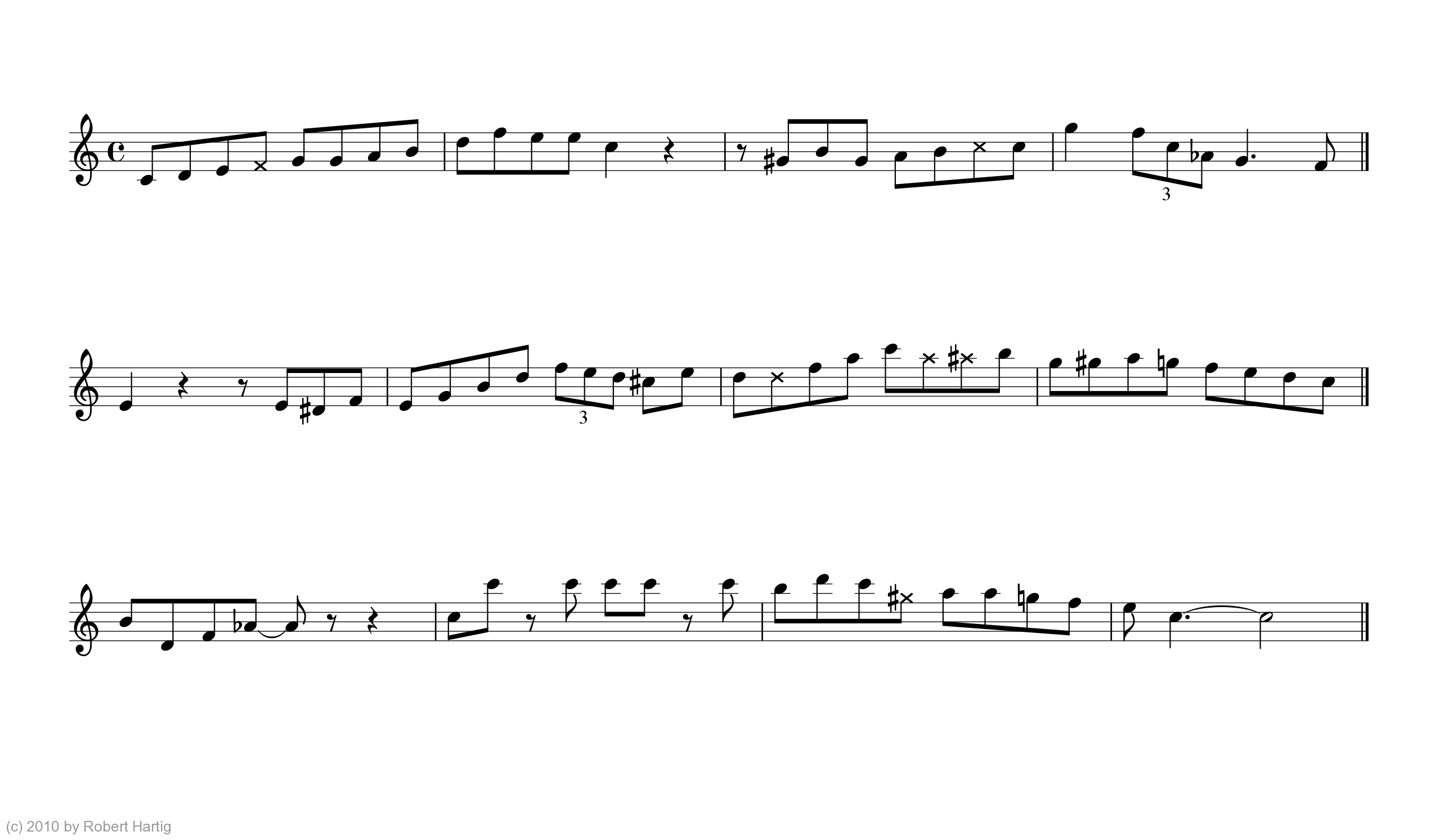
I don’t know whether I’m using an actual technical term, but “repeat notes” is the handle I’m hanging on the concept I’m about to describe. It’s as simple a technique as you can imagine: you simply repeat a note in the midst of your flow of ideas. You may repeat it just once. You may repeat it several times for dramatic effect. You may choose to ghost the note or use an alternate fingering for effect. The point is, you’re momentarily bringing the jumble of tones to rest on a single pitch, and you’re working that pitch, spotlighting it, whether for a microsecond or for several bars.

Like many musical concepts, this one is easier to illustrate than to explain. So click on the image and take a look at the exercise I’ve included. It’ll give you a start on repeat notes. From there, the possibilities are limited only by your imagination.

By the way, the note heads with X’s are ghost notes. For whatever reason–probably because we’re talking about punctuating solos–it seemed appropriate to include a few of them in this exercise along with the repeat notes.
Kirk Whalum on What To Practice When You’re Stuck

You are reading what will likely prove to be the shortest post I’ve ever written on this blog. There’s no need for me to write a lot. I’m just going to redirect you to Neal Battaglia’s Sax Station website, where I came across a terrific YouTube video by Kirk Whalum. If you’re looking for some new practice ideas with which to challenge yourself and improve your saxophone technique, you have got to check this out!

What Is Jazz?

The headline for this post is a bit deceptive. I’m really not interested in offering one more definition of jazz, or of discussing elements such as swing, syncopation, improvisation, blue notes, and so on. All of that has been abundantly covered in a bazillion books on jazz history, jazz theory, and jazz musicians.

A better title, though a more confusing one at first glance, might be, “What ISN’T Jazz?” It’s a question I’ve contemplated off and on. In that respect, I guess I’m no different from a multitude of other jazz musicians who have pondered the same issue over the years and ventured their opinions. Often you don’t hear the question expressed as a question, but as a conviction delivered with some heat: “That isn’t jazz!”

Let me say up front that I consider the topic of what is and isn’t jazz to be pretty academic. I’m more fascinated by the fact that some people get so passionate about defending a sacred ideal, some essence of jazzness, than I am by the subject itself.

Yet I have to confess that I find the same attitude rearing up in me on occasion–times when it bothers me to hear the word “jazz” used to describe something I wouldn’t consider to be even close to jazz. Improvised music, quite possibly; jazz, no.

So what am I, an elitist? If I am, I’m certainly not hardcore about it. Frankly, the intensity and hair-splitting that I’ve witnessed over the jazz/not-jazz issue has struck me as ridiculous, not to mention pointless, since it’s one of those debates that will never be settled.

That being said, I think the word “jazz” does get used too freely at times.

Case in point: I’ve played in lots of church worship teams over the years. Most of them have involved a lot of white folks playing guitars. Nothing wrong with that, but I cringe whenever I hear someone say, “Let’s jazz it up.” It’s kind of like hearing a mariachi accordionist say, “Let’s rock and roll!” What does it mean to “jazz it up”? I’m not sure, but I can testify that the results I’ve witnessed have never resembled jazz. Musicians who rarely if ever listen to jazz, let alone practice it, aren’t going to just suddenly produce it like Bullwinkle pulling a rabbit out of the hat.

So here I am, caught between two extremes. On the one hand, I can be a jazz racist, aggressively and vehemently defending the purity of the form (according to my ideal of it) and getting my undies all in a bunch over musical miscegenation. On the other hand, I can adopt so inclusive a perspective that the word “jazz” can mean just about anything under the sun, and consequently mean nothing at all.

It seems like there ought to be a less polarized option. Maybe there is. If so, finding it is probably best begun by defusing some of the negativity inherent to this topic. Coming from a jazz purist, the words, “That’s not jazz!” come across as an indictment. Upon hearing Weather Report in concert, Ben Webster is reported to have flown into one of his famous rages, walked onstage, and overturned Joe Zawinul’s electric piano. Such behavior is an extreme, but it captures the attitude of those who are so entrenched in an ideal that they judge and attack whatever doesn’t match up.

It doesn’t have to be that way. It shouldn’t be that way. How can any two people have a decent, productive discussion with that kind of Hatfield-McCoy mentality?

So let me be plain: When I say that something isn’t jazz, I’m not saying it’s bad music. Neither am I saying it’s good music. I’m not making value judgments at all. I’m just saying that I don’t consider the music I’m hearing to fit under the jazz umbrella. That’s all. Why try to make something be what it isn’t? Why not just let it be what it is and recognize that, if it’s done well, it has its own legitimacy?

Distinguishing between jazz and non-jazz involves at least a certain amount of subjectivity. That’s certainly true of me as I share a few of my own thoughts on the topic. With that acknowledgment, I’d like to address what I think are a few misconceptions about jazz:

* IMPROVISATION. Some people use the word “jazz” to describe extemporaneous playing. But while improvisation is a crucial hallmark of jazz, it’s not an exclusive one. Rock musicians improvise. Bluegrass musicians improvise. Classical musicians improvise. Beethoven wove melodies and harmonies out of thin air long before Louis Armstrong and Sidney Bechet ever played a blue note.

* THE BLUES SCALE. Playing the blues scale is not the same thing as playing jazz. Playing the blues scale is playing the blues scale. The blues scale and blue notes are components of a good jazz vocabulary, but they’re only a part of it, and, as with improvisation, they’re not exclusive to jazz. Rock guitarists use the blues scale extensively.

* HARMONY. The chords associated with jazz are usually quite colorful due to the use of upper tones and creative voicings. Ninths, elevenths, and thirteenths are normative, along with various chord alterations. In jazz, a V7 chord is rarely just a V7 chord; keyboard players and guitarists add upper extensions as a matter of course. While simple triads are used from time to time, jazz is not a triadic idiom. It is vertically complex, giving rise to sophisticated voice leadings.

That’s one big reason why non-jazz musicians who decide they’re going to “jazz up” a piece of music usually wind up sounding hokey rather than hip. Conceptually, they don’t have the harmonic (and rhythmic) know-how to pull it off. If that’s you, don’t let me discourage you from making the attempt. Rather let me encourage you, while you’re in the process, to learn a bit about jazz harmony and voice leading. There’s plenty of knowledge that’s available on the topic both in print and online. This Wikipedia article is a good place to start.

* HORNS. Adding a sax or trumpet to a tune, or even using that tune to showcase a horn player, does not automatically result in jazz.

* TUNES. Jazz is not a matter of the song that’s played but of how it’s interpreted. Playing “In the Mood” or “Take the A Train” doesn’t mean that a band is playing jazz. It means they’re playing melodies and chord changes that were written in the Big Band Era, but stylistically, the way a tune is handled might be closer to a polka than to jazz.

I could easily add to the above list, but what I’ve written is enough to get the idea across. Again, though, the topic of what is and isn’t jazz is prone to subjectivity. It’s safe to say that at some point, a piece of music–or rather, how that piece gets interpreted–crosses a jazz/non-jazz line. But different people, including and especially jazz musicians, will have different ideas about where that line lies.

That’s one reason why I don’t work myself into a lather over whether, for example, the stuff that Kenny G. puts out is jazz. Does it really matter? Kenny’s music may not be my personal cup of tea, but I have a hunch that if you hired the guy for a standards gig, he’d make it through the evening just fine. As it stands, what he does for a living beats delivering pizzas.

As for the debate over what is and isn’t jazz, a more fruitful question to ask is, do you like what you hear? Do you like what you’re playing? Then enjoy it and don’t worry too much about defining it. It may or may not be jazz, but good music is good music no matter what you call it.

Patterns on Diatonic Fourths

In a recent post, I wrote about how reacquainting myself with diatonic fourths was helping me to get inside keys in a different way, breaking me away from the usual tertian harmony and giving me a more open sound in my sax improvisations.

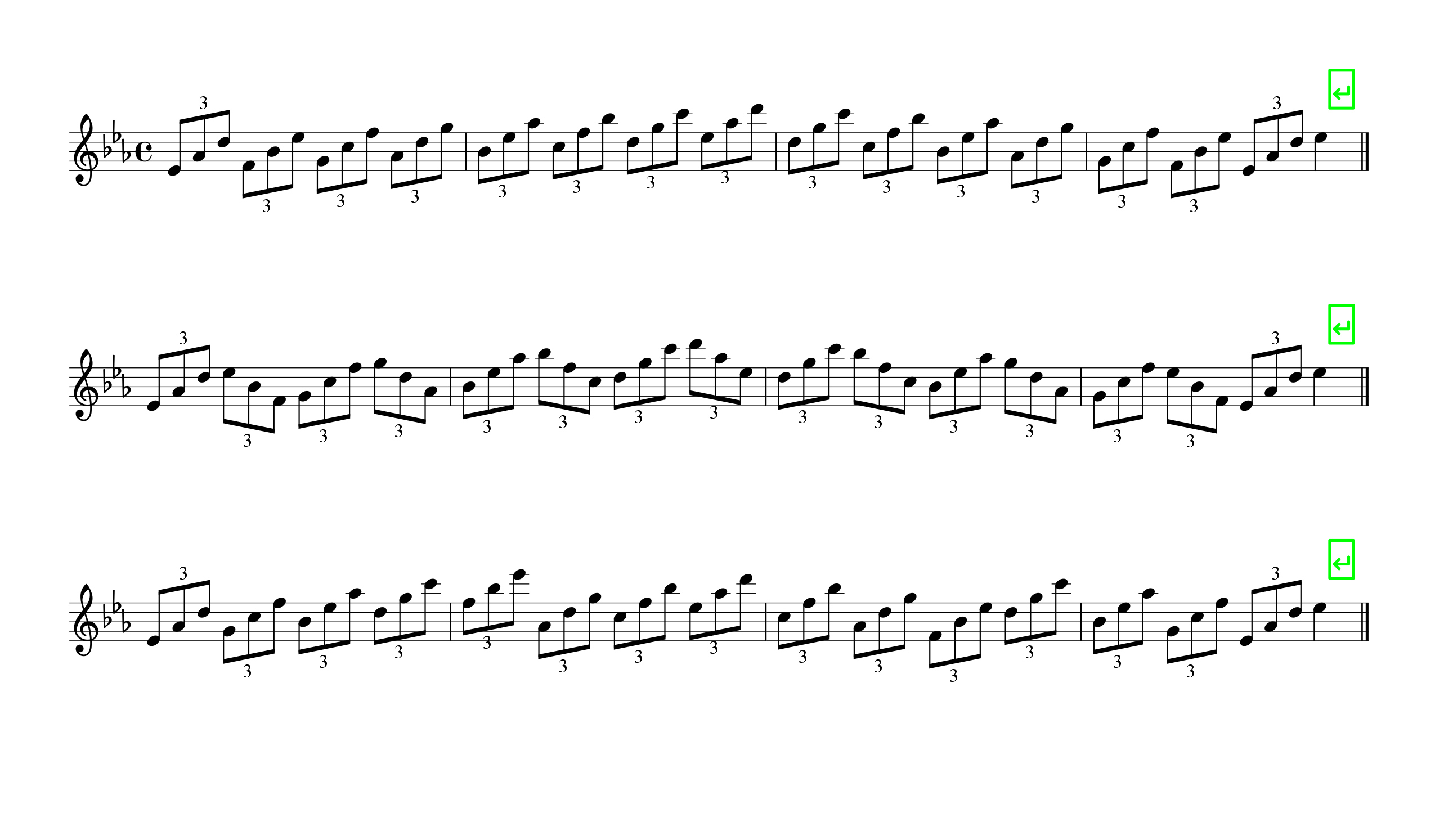
fourth-patterns-in-ebI thought I’d share with you a few of the exercises I’m using. Click on the thumbnail to enlarge it. As always, take each pattern up and down the full range of your instrument.

This is my first use of scoring software in a blog post. I’ve only recently familiarized myself with MuseScore and I still have plenty to learn about it. (The latest upgrade has introduced some significant improvements since I first reviewed this great open-source music transcription program a couple months ago.) It took me a little casting about to convert the music file to a format that works in WordPress, and the example here isn’t perfect. Kindly bear with the little green boxes at the ends of the staves and with the vagueness of some of the bar lines. I expect I’ll figure out how to get everything picture-perfect in the future, but for now, I’ve spent enough time dithering about. Now I’m putting the results out on the table, imperfect but serviceable.

If you’ve never worked with fourths before, get ready for a bit of a challenge. Fourths don’t lay under the fingers as easily as thirds. But that’s part of their merit: the fact that they break you away from easy formulae, making you think differently and programming your fingers with a new kind of muscle memory.

Stick with it and have fun!

Update on “The Giant Steps Scratch Pad”

“If something’s worth doing, then it’s worth doing right.”

Hear, hear! I agree with that old axiom. But doing something right often takes longer than we expected when we first got our project underway. In the case of “The Giant Steps Scratch Pad”–my book of licks and patterns for Coltrane changes–it has been taking considerably longer. So I thought I’d share another update for those of you who are interested. Here’s the status of the project and my plans for it:

* After many a headache and blind alley, the music and text files for the Eb edition are now merged into a single document and the interior of the book is ready to go.

* Registration for copyright has been filed at the U. S. Copyright Office.

* Rather than use one of the templates at Lulu.com, I’ve decided to have the cover professionally done by a friend of mine who specializes in graphic design for book and CD covers. I meet with him next week. This should be the last big task (knock on wood).

* Once the cover is completed, the Eb edition will be ready for publication through Lulu.com. At that point, I’ll just need to set up a store account and make the book available.

* Bb, C, and bass clef editions will follow once the Eb edition is published. So tenor sax, trumpet, piano, flute, trombone, and bass players, never fear! I’ve definitely got you on the radar. It just makes sense, from my standpoint, to publish the material as I initially wrote it first, so I can at least get alto sax player like me underway.

That’s it for now. When there’s more to tell, I’ll let you know, so stay dialed in.

What about Fourths?

How did I ever forget about fourths? Used to be, I was getting a fairly decent handle on the Angular Interval, but in the course of practicing other material I forgot all about it.

Then yesterday, as I was pondering what else I could do to help me get more deeply inside the key of F# (which I continue to practice religiously–you’d think I’d have it down by now), suddenly it dawned on me: What about fourths? What better way to break away from the tedious predictability of tertian harmony than to reacquaint myself with the spacious, somewhat stark-sounding quartal sound.

So last night I began the process, and tonight I tightened down on what I started yesterday and then added onto it.

In my experience, fourths are more difficult to play diatonically than as sequences of straight perfect fourths. I’m not talking about fourth diads; those are fairly easy to get one’s chops around. But start stacking fourths and then taking them stepwise up and down a scale, and from a standpoint of technique, suddenly the job is no longer quite so simple.

And that’s perfect. Becoming truly fluent in an odd key such as F# is challenging, and to really unlock it, you’ve got to hit it from every angle. Practicing fourths can help you break out of the box, introducing angularity to your playing and helping you to land on notes you wouldn’t ordinarily think of in relation to other notes.

But of course you’d rather find out for yourself than listen to me talk. Since there’s no better teacher than experience, here’s a little exercise that will help you to experience fourths for yourself. It’s one of the patterns I was working on earlier tonight, set in the key of Eb (another key I’ve just started tacking onto F# as one I want to saturate myself in).

Now, it’s late and I’m lazy, too lazy to actually write out an exercise and go through all the hassle of scanning it. So I’m just going to tell you the pitches, okay? They’re arranged in groups of three, which you’ll play as triplets ascending and descending the Eb major scale. Here they are:

Eb-Ab-D, F-Bb-Eb, G-C-F, Ab-D-G, Bb-Eb-Ab, C-F-Bb, D-G-C, Eb-Ab-D; D-Ab-Eb, C-G-D, Bb-F-C, Ab-Eb-Bb, G-D-Ab, F-C-G, Eb-Bb-F, D-Ab-Eb.

That’s it for tonight. I’m tired and more in the mood to read and drink my Dark Horse Raspberry Ale than to write. I’ve already done my heavy lifting on my horn for today. Now it’s your turn.

Guest Blog: Jazz Pianist Kurt Ellenberger Tells Why He Hates Rhythm Changes

“I’m attracted to sophisticated harmony, interesting voice-leading, rich chords and dense chord voicings, and tone color…None of that is present in rhythm changes, and the ornate weaving through the static changes is just not compelling enough to mitigate what is missing.”–Kurt Ellenberger

Some time back, I wrote a post titled “Why I Love Playing ‘Rhythm’ Changes.” Evidently not every jazz musician feels the same way. Judging from the following post, jazz pianist Kurt Ellenberger may be slightly fonder of rhythm changes than he is of leprosy, but it’s a close contest.

I’d be tempted to whap Kurt for taking a whack at my article, except that Kurt is one of those rare musicians who makes me want to put my saxophone down and just listen to him play. He is a truly amazing, well-rounded pianist and complete musician who, drawing from a huge array of musical influences, can sweep you away on an inventive, marvelously textural journey that will make you forget there’s anything but the music you’re listening to.

Kurt is also a composer, the jazz professor at Grand Valley State University, the creator of Frakathustra’s Blog (aka Also Sprach Frak), and the author of “Materials and Concepts in Jazz Improvisation.”

All of the above to say, Kurt is hugely qualified to express a conflicting opinion. He’s also a great guy with a nutty sense of humor. So I guess I won’t whap him. Instead, I’m featuring him here as a guest blogger, knowing that he has some valuable, thoughtful, and provocative perspectives to share.

Naturally I’ll be writing a rebuttal.* Ain’t no Hatfield crosses a McCoy without there be a return salvo. For now, though, it’s time for Kurt to share his thoughts in an article he calls…

Why I Hate Rhythm Changes

By Kurt Ellenberger

In case the title isn’t clear enough, I’ll say it unequivocally: I don’t like rhythm changes at all, I have no interest in the form, nor any affinity for it whatsoever, and I know I’m not alone. I’ve heard many of my fellow jazz musicians say similar things, but we’ve done it in a sheepish manner, as if uttering some kind of sacrilege against one of the sacraments of the jazz church. Sacrament or not, I think it’s probably the most banal structure in all of jazz.

That’s a provocative statement requiring some explanation, which I’m happy to provide. But first, some context and background.

When I was listening to jazz for the first time as a teenager, there were certain tunes that I never (for the most part) liked very much. As I became more knowledgeable about form and harmony, I found there was a consistent pattern to my dislike: They were tunes based on rhythm changes such as “Moose the Mooch,” “Rhythm-a-ning,” “Shaw Nuff,” “Cottontail,” “Anthropology,” “Dexterity,”and others.  There were few that I liked, a very few.  In fact, I can name them specifically, because there were only two that I can remember being interested in: Bill Evans’ studio version of “Oleo” and some of Miles Davis’ recordings of “The Theme.” That’s not to say I didn’t appreciate the playing and the technical prowess in display in countless other recordings, I just didn’t enjoy listening to the form, regardless of how well it was played, and that hasn’t changed to this day.

As a dutiful jazz student, I worked hard to learn the form.  I transcribed solos, studied them as jazz etudes, extracted licks and learned them in 12 keys, until I could make it through and play it in a reasonably convincing manner.  I say “convincing” because I always felt as if I was acting a part when playing rhythm changes. I had no passion for it and I couldn’t manufacture a musical love affair.  I’m sure that it came across as such, no matter how hard I tried.  I relied on clichés and formulaic licks, especially at faster tempos. I never felt like I was improvising; rather, that I was regurgitating my stable of licks in a form that was completely uninteresting to me in order to be employable as a jazz musician.

As time went on, my emotional detachment from rhythm changes made it harder and harder to fake it. I just couldn’t force myself to play those licks as required to maintain the facade.  When someone called a tune based on rhythm changes, I tried to avoid a solo entirely if at all possible.

I examined the form to see if I could figure out what I didn’t like about it, and it wasn’t hard to determine.  Rhythm changes is a 32-bar form (AABA). The ‘A’ section is eight measures in length, the first four of which are (as Bob writes in his post) a simple turnaround repeated. In the second four measures, the bass moves from tonic to dominant, highlighting the subdominant briefly, before moving back to tonic again(there are some minor variations there, but essentially this is what is found). The ‘B’ section attempts to generate some degree of harmonic “surprise” as it moves from tonic to V/vi (chromatic mediant). This transparent and trite interjection fails to surprise as it immediately decays into a string of very predictable secondary dominants leading to the dominant of B-flat, which then sets up the return of the ‘A’ section.   To summarize:

* There are three ‘A’ sections in the piece, comprising 24 of its 32 measures.

*The ‘A’ section is a prolongation of the tonic.

*The ‘B’ section is nothing more than a series of passing chords leading to tonic.

The form is therefore virtually static from a harmonic (granted, Schenkerian) perspective which is problematic for me. In general, I prefer music that has a higher degree of harmonic activity and direction, or, absent that (as in music of a more minimalist nature, much of which I enjoy tremendously), there must be some other complexity in play to retain my interest. These preferences have become more pronounced over the years. As a result, I’ve lost interest in a lot of tunes that are similar in construction.

The primary reason that I pursued jazz was because of my love for the music of Bill Evans, which goes a long way in explaining what motivates and inspires me musically. To be precise, I’m attracted to sophisticated harmony, interesting voice-leading, rich chords and dense chord voicings, and tone color, all of which Evans excels in. None of that is present in rhythm changes, and the ornate weaving through the static changes is just not compelling enough to mitigate what is missing. Yet I really was attracted to Evans’ recording of “Oleo,” going so far as to transcribe it in order to learn what he was doing.** His recording is remarkable in that it eschews the original harmony almost completely, and treats the form in a very free manner, with implied new progressions (especially in the ‘A’ section), prolonged hemiolas and other polyrhythms, and surprisingly chromatic melodic figures; in other words, it’s barely recognizable as rhythm changes, which is probably why I like it.

I write this with enormous respect and admiration for all of the great musicians who have done (and continue to do) remarkable things with rhythm changes. I can appreciate that on many levels, but I simply don’t respond to it emotionally, and without that, what’s the point?

——————-

* ADDENDUM: To read my rebuttal to Kurt’s post, click here.

** It is interesting to note that, as far as I know, Evans recorded rhythm changes only once in a studio album (“Oleo” from “Everybody Digs Bill Evans”). I certainly don’t know the reason, but the fact that he didn’t record it again is notable for a jazz pianist of that era. I’ve wondered about it for many years, especially given my love for Evans’ music and my own dislike for rhythm changes.

Mastering the Sax: Building a Baseline of Ability

As I sat in my car by the railroad tracks last night out in the countryside, practicing my saxophone and doing my best impression of a Shady Character Waiting To Make A Drug Deal for the benefit of curious passers-by, it struck me how far I’ve come since I began woodshedding in earnest back in college. It’s a long way, but not far enough. There are high-school-age kids who can do what I do. Not many, but they’re out there, along with a host of college music majors who are blazing incendiary trails across today’s jazz firmament.

I can’t afford to think about it. Topnotch jazz programs featuring world class saxophone instructors have multiplied over the years, and out of that educational milieu are arising some brilliant young players. There are bound to be a few who at half my age possess twice my ability.

A few. But probably not all that many. Because while those music majors have been in the practice rooms busily learning their instruments, I’ve been in my car by the tracks doing the same thing. However, my practice schedule has probably been more spotty than theirs, and so have my opportunities to play jazz live with other experienced jazz musicians. Unless you’re in a position where you can immerse yourself in music without interruption, the demands of making a living have a way of imposing themselves on your practice time. They can stop you if you let them, but they probably don’t have to. You just have to accept a slower rate of growth that accommodates the rest of life.

The learning curve for mastering a musical instrument is different for everyone. We all have different circumstances, different degrees of natural ability, different competing interests that round us out as individuals, and so on.

I thought about this last night as I worked out some bop tunes in the key of F# and revisited “Giant Steps.” My storm chasing excursion out west last weekend had cost me several days of practice, and my fingers could tell the difference. But they snapped back into shape quickly.

Playing the saxophone is not like riding a bike. You don’t just hop back on and regain instant command after not having ridden in a while. You’ve got to reclaim old ground.

What does happen, though, is that when you practice diligently, you continue to raise the baseline of your abilities. Persistent, focused practice not only will put you at the top of your game, but it will also build and expand a musical foundation you can fall back on during those times when your practice routine falls by the wayside.

My book on “Giant Steps” patterns is nearing pub time, but to be honest, I haven’t spent much time actually playing “Steps” in recent history. So last night I broke out my workbook and my Aebersold CD of Coltrane tunes, and I got a pleasant surprise. It has been years since the period in my musical development when I saturated myself in “Giant Steps.” But I found myself navigating the changes, finding my way through familiar patterns, exploring ideas–not on the same level as if I’d been consistently practicing Coltrane changes, true, but well enough for me to feel pretty good about what I was doing. In fact, in some ways I played the tune better than I did in the past. Other musical material that I’ve acquired over the years provided a richer repository of ideas and technical finesse. Old and new came together, and while the result wasn’t perfect, it was at least coherent.

To sum up: Stick with your instrument. Never give up. Life has its seasons and its discouragements, but persistence really does pay off. Don’t measure your musical growth by other players, but by the satisfaction you get as you set and accomplish realistic personal goals. Be honest with yourself, be as diligent in practicing as you can be, be hard on yourself only when you have to be, listen to and study great players, and don’t get so obsessed with arriving at your destination that you forget to enjoy the journey. Do this, and over time you’ll build a solid baseline of craftsmanship and musicality that will serve you well during the off-seasons of your musical life.

The Giant Steps Scratch Pad: Getting Back on Track

Finally…the grunt work is done. I’m pleased to announce that today I finished keying in the last of the patterns and licks in my “Giant Steps” practice book. Not only so, but I completely revised the introduction and wrote a new section of “Preliminaries and Practice Tips.”

Preparing “The Giant Steps Scratch Pad” for publication has been a longer haul than I had anticipated, but the extra time and effort I’ve invested have produced a much better product. And in the process of transcribing it using MuseScore notation software, I’ve had ample opportunity to better consider my options for self-publishing.

“The Giant Steps Scratch Pad” will be available in C, Eb, Bb, and bass clef editions. I’m now weighing the pros and cons of print versus electronic editions and the feasibility of offering both. Whatever I decide, the hardest part is now behind me (knock on wood). I still need to figure out how to merge my text and music score files into a single document, and I need to create a cover, and I need to set up an online store. But the book in its essence now exists in a format that is a huge improvement over the scanned, handwritten material I had initially envisioned as an e-book.

Bottom line: If you’ve ever wanted to build the chops needed to play John Coltrane’s tune “Giant Steps,” this book will help you immensely.

Continuing on in the spirit of shameless self-promotion–hey, it’s my blog, and I get to do this sort of thing!–I thought I’d share the “Preliminaries” part of the section titled “Preliminaries and Practice Tips.” You know, just to whet your whistle, start a little buzz, put a bug in your ear, that kinda thing. I think you’ll find this little writeup interesting, maybe even enlightening, possibly even useful:

“The Giant Steps Scratch Pad” is straightforward. It’s about building your chops for Coltrane changes. Still, there are a few things you’ll want to keep in mind.

“Giant Steps” cycles through three key centers spaced a major third apart. The tune is written in B concert (if you can really pin it to a single key), and it takes you through the keys of B major, G major, and Eb major. A quick glance will tell you that the notes B, G, and Eb (D# enharmonically) spell out a B augmented triad.

Formally, the tune consists of two eight-bar sections in an A-B format. Each section has its unique hallmarks:

* The A section can be distilled into a series of V7–I cadences that descend by major third, thus: F#7–BMaj7, D7–GMaj7, Bb7­­–EbMaj7. Simple enough, except that Coltrane had the audacity to insert a bar line in the middle of each cadence. So instead of a nice, perfectly symmetrical treadmill of chord changes, you wind up with this awkward roller-coaster: BMaj7–D7, GMaj7–Bb7, EbMaj7–F#7.

* The B section is essentially a series of two-bar ii–V7–I cadences that ascend by major third. But of course, once again Coltrane complicates a simple thing by beginning each two-bar phrase with a major chord, then in the following bar modulating abruptly to the ii–V7 of the next key. In other words, the chord series Am7–D7–GMaj7, C#m7–F#7–BMaj7, Fm7–Bb7–EbMaj7, becomes EbMaj7–Am7–D7, GMaj7–C#m7–F#7, BMaj7–Fm7–Bb7.

In a nutshell, “Giant Steps” was John Coltrane’s way of tweaking simple, essential musical formulae in a way that has had jazz musicians stubbing their toes ever since.

Just remember: The A section of “Giant Steps” descends by major thirds through three keys, and the B section ascends by major thirds through those same keys. Got it? Good. With that conceptual foundation in place, here are a few pointers for practicing…

I’ll close with that cliffhanger. Can’t you just feel the tension? You want to know my “Giant Steps” practice tips, don’t you.  I can just tell. Don’t worry, you can find out all about them once the book is released. So stay tuned, jazz campers. A little more work and then I’ll look forward to announcing publication.

“Giant Steps” E-Book: Taking a Step Back in Order to Step Forward

Here’s an update on my book of “Giant Steps” licks and patterns.

By now I had hoped to have it available for purchase online as an e-book. However, after getting feedback from a couple friends whose wisdom and musical expertise I highly respect, I’ve decided to take a little more time to do the job right.

Initially, the idea of simply scanning my handwritten practice book appealed to me. I liked the homespun, pencil-and-staff-paper feel. Nothing fancy, just solid practice material that will help jazz musicians get a firm handle on Coltrane changes. For that reason, I had titled the book–and still plan to title it–“The Giant Steps Scratch Pad.”

But there are limitations to the approach I’ve described. For one thing, legibility is an issue in some parts of the scanned material. In the process of copying all of my handwritten material, the scanner was also picking up on smudges and erasures, and it was failing to clearly copy some of the lighter print. After taking up pencil and eraser and editing several pages for better effect, and doing a bit of clean-up work with PhotoShop as well, the result is acceptable. Frankly, I kinda like it, and part of me wants to offer it as is. But I can do better.

So I’m going to get the material properly notated using transcription software. Not only will the finished result look much more polished, but I will be able to offer it for the entire suite of C, Bb, Eb, and bass clef instruments. The scanned approach doesn’t offer that flexibility; I had written the patterns for my own instrument, the Eb alto sax, and the book was what it was.

Taking to heart the advice I’ve gotten, then, I’m taking a step back in order to take “Giant Steps” forward. Hopefully the delay won’t be a long one. I’m eager to get the book published. I just want to make sure it’s everything it can be right out of the starting gate.

So keep your eyes peeled for further developments. The hard, creative work is already done. I just need to explore my options, then take the best one and git ‘er done.

–Bob