Francesca Amari and Friends Valentine’s Gig at One Trick Pony

Laaayyy-deez and Gen’lmen!!!

Wives, Husbands, and Sweethearts!!!

Announcing the one and only, the fabulousFRANCESCA AMARI and her band of musical pranksters…

…in a Valentine”s Day extravaganza of love songs, from the tender, to the sultry, to the humorous–all delivered with the spark, presence, and sensitive musicality of Francesca. I’ll be backing her up on the alto sax, along with Dave DeVos on bass and Dave Molinari on keyboards.

The place is One Trick Pony at 136 East Fulton in downtown Grand Rapids, Michigan. It”s going to be a memorable evening of music at a very nice venue. Francesca is a wonderful entertainer, and the rest of us don”t suck mud. So treat yourself and your special someone to a truly enjoyable Valentine”s date filled with great music and good times.

The show starts at 8:00 p.m. Do join us.

Phil Woods and Jackie McLean Play “Cherokee”

I love playing the Ray Noble tune “Cherokee.” It’s a classic bebop vehicle, and the bridge section represents a respectable knuckle-buster for even the more accomplished players. “Cherokee” is typically played anywhere from up-tempo to way, way, way up-tempo. I like to play it fast, but I’ve got my limitations. Once I hit around 300mm, I’m scrambling to stay on top of things.

Maybe one day, if I practice reeeaallly hard, I’ll be able to play it almost as well as these guys. Here are Phil Woods and Jackie McLean playing “Cherokee.” Sit back and get ready for a real bebop tour de force by two virtuoso, veteran alto sax players. Each is a distinct, mature voice in his own right, but here you can tell they’re both unabashed Bird disciples. The ideas don’t stop, and they’re dripping with classic bop vocabulary. Amazing, and a pure joy to listen to.

Using Substitute Dominants

Sooner or later, if you haven’t done so already as a jazz improviser, you”re going to want to broaden your harmonic palette with substitute dominant chords.

Say that term, substitute dominant, and what immediately springs to mind for most musicians is what is also refer to as a tritone substitute, so called because the root is a diminished fifth–a tritone–away from the root of the dominant seventh chord in any given key. For instance, let’s say you’re in the key of C major. The dominant of C is G7. In traditional theory, the G7 is a major/minor seventh chord.

If you drop down a tritone from the G7 and build another major/minor seventh chord, you wind up with a Db7. That is your tritone substitute, the most commonly used substitute dominant.

Note that the Db7 is just a half-step above your tonic chord, C major. Now, you could use a a Db Mixolydian mode with it. But another good choice would be a Db Lydian flat seventh scale–i.e. Db, Eb, F, G, Ab, Bb, Cb, and Db octave. Note that, as is so often the case, a single note makes all the difference. In this case, simply raising the fourth scale degree of the Db Mixolydian mode a half-step, from Gb to G, gives you the Lydian flat seventh scale.

Now, here’s where things get particularly interesting: let’s say you want to inject a little color with an altered dominant, a G+7(#9). That chord immediately suggests that you”ll use a diminished whole tone scale. Guess what? The diminished whole tone scale uses the same notes as the Lydian flat seventh scale; the only difference is, it starts on the G instead of the Db. So in this case, you can use the same scale for either the altered dominant or the substitute dominant! Nice, eh?

One of the earmarks of the tritone substitute is that it flipflops the third and the seventh, which are critical tones in the function of the dominant sound. The flat seventh of the V7 chord is the third of the bII7 chord, and vice-versa. This means that no matter which chord you use, dominant or substitute dominant, the tritone interval between the third and the fifth remains, with all its tension that demands resolution to the tonic chord.

Using the substitute dominant in a ii-V7-I progression gives you ii-bII7-I. You can also alternate the dom/subdom sound on your journey toward the I, thus: V7-bII7-I.

By the way, the tritone substitute is nothing new. In Bach”s day, it was called a Neopolitan chord. Jazz is deeply rooted in European harmony; the genius behind it lies, in part, in how African American musicians fused that harmony with tonal colors and rhythmic approaches that no Western musician would have dreamed of. Jazz truly is a distinctly American art form.

Reflections on the Old and New Years

As I begin this post, the year 2008 has just three hours left. There is much about it that I’m sure most of us won”t miss, but the downsides of life are all too easy to focus on, and we need no reminding of them. Instead, I’d like to thank God for a few of the blessings with which he has filled my life this past year.

I thank my Lord Jesus for…

* My close friends and family. You know who you are. I treasure you!

* Keeping me afloat financially as I”ve gone about forging a new direction as a freelance writer.

* Awesome storm chases in Missouri, Kansas, and Iowa–and my awesome storm chasing partners, Bill, Kurt, and Tom.

* The simple, wonderful gift of good beer.

* My new DSLR camera, and how it is helping me to view the world with an artist”s eye.

* The gift of music, and of growth as a saxophonist and jazz improviser.\r\n* So many, many other blessings, some of which I’m aware and others of which I’m unaware. Such is the grace of Christ.

* Finally, but really first and above all, the Lord himself. For his kindness. For his friendship. For his discipline, and guidance, and for his life that has become my life.

Thank you, Lord, for this year of 2008. Above all, thank you for You.

To all who read these words…

…to musicians, and songwriters, and singers, and all whose souls have been shaped by the melodymaker’s craft…

…to storm chasers, and weather fanatics, and those who have fallen in love with the hiss of inflow over prairie grasses, and the convective sculptures of the Great Plains…

…I salute you! Here”s to a Happy New Year!

This evening, the sun sets on 2008. Tomorrow, for better or worse, 2009 dawns on us all. In the face of a troubled planet, may the grace of the Messiah spring up in unexpected places and cause this next twelve-month”s time to be a hopeful and rewarding one.

Wishing you blessing, prosperity, wisdom, inner peace, and a deepened capacity to live the life God created you to live,

Bob

Aka “Storm”

Bracketing: Changing Tones for Jazz Musicians

I’ve heard the technique referred to as “bracketing,” but it’s really just the good, old-fashioned Baroque musical ornamentation known as “changing tones” applied to a jazz solo. Whatever you call it, you can add interest and lyricism to your improvisations when you precede chord tones and target notes with both an upper and lower neighbor.

Three levels of chromaticism exist with the bracketing technique: diatonic, chromatic lower (or, conceivably but uncommonly, upper) neighbor, and dual chromatic upper and lower neighbors.

Play a C7 arpeggio, thus: C, E, G, Bb. Take it slow so you can hear the chord outline.

Now, playing each grouping of three as a triplet, surround each note of the C7 with its…

  1. 1. Diatonic neighbors (based on the C Mixolydian mode): D-Bb-C, F-D-E, A-F-G, C-A-Bb, D-Bb-C.
  2. 2. Diatonic upper and chromatic lower neighbors: D-B-C, F-D#-E, A-F#-G, C-A-Bb, D-B-C.
  3. 3. Chromatic upper and lower neighbors: Db-B-C, F-D#-E, Ab-F#-G, Cb-A-Bb, Db-B-C.

The latter two approaches are relatively common in the bebop language. Obviously, you can bracket any quality of chord or any scale tone. Devise bracketing exercises that will take you through all twelve keys and you’ll be well on your way to real fluency as a soloist.

Another Hartig on Saxophone?

I came across this interesting YouTube clip by a fellow saxophonist named Tom Hartig. Naturally, I was intrigued to see what another person who shares both my last name and my passion for the saxophone is doing musically. I wasn’t disappointed. This guy has a nice little sample clip that demonstrates a unique, original, meticulously arranged approach that manages to meld a strange, haunting, even slightly disturbing feel with lyrical beauty.

Tom’s clip is well worth checking out. In his note, he says he hopes you’ll buy his CD. I do too, and I may pick up a copy myself. After all, we Hartigs have got to stick together. And I assure you, having listened to a couple of Tom”s other video clips from years gone by, that the man can really play the sax.

Saxophone Art

Ready for a little personal window into my life? I’ve got this sax art thing going on in my apartment. Nothing major, but I thought it would be fun to give you a glimpse of some of the saxophonical objects that occupy my living room.

We’ll start with my saxophone lamp. This was a gift from my beautiful mother. I’ve gotten a lot of compliments on it. It”s majorly cool–the photo doesn”t nearly do it justice. And yes, it’s made out of a real saxophone. I could take the guts out of the lamp, have the horn reworked, and then play it. But I like it as a lamp much better.

This funky little guy was given to me by my wonderful sister, Diane, one Christmas years ago. He’s the product of a nylon stocking, a bit of fabric, and Diane’s immense creativity. Another treasure. I love the gnarly expression on his face. He’s clearly a street musician. His saxophone looks a bit like something you’d find swimming around in the sea, but its lack of anatomical correctness contributes mightily to its coolness quotient.

If you’ve never seen a saxofrog before, now you have. He may not be green like Kermit, but he plays ten times the horn. My beloved buddy Duane gave him to me out of the blue one day. He’s found a nice, shady spot to busk beneath my Chinese evergreens. The frog, that is, not Duane.

I know just what you”re thinking: “Aaawwww!!!” Let me tell you, though, that besides cornering the market on Cute, my little furry bear pal, here, is a formidable alto player, and as a section leader, he”s dynamite. Besides that, he’s quite the literati, and loves to surround himself with good books.

There you have it–the things that make for a sax player”s living room. Hope you enjoyed the tour!

Phrygian Dominant Licks: Capturing the Essence of Minor Bebop

The harmonic minor scale was the first scale I learned to apply in a minor jazz setting over an altered dominant chord. No doubt that was because it was the easiest, but it also seemed to me to be the most consistent with the vocabulary of bebop a la Charlie Parker. Just as a given major scale generates the appropriate Mixolydian mode for the dominant of its key, so a harmonic minor scale produces a scale that works well with its dominant. Known as the Phrygian dominant (aka Jewish scale, Gypsy scale, or Spanish scale), this scale works beautifully with V7b9 chords. With its lowered sixth, and with the minor third interval between its lowered second and major third, it possesses an evocative, Eastern quality that makes me think of belly dancers and snake charmers.

The scale you’re likeliest to learn as the first choice for V7b9 chords is the half/whole diminished. It’s certainly a time-saver, as you need learn only three of this symmetrical scale in order to know all twelve. But the Phrygian dominant has an exotic beauty to it that the diminished scale doesn’t quite capture, and a built-in ease of use rooted in its relationship to the parent minor key.

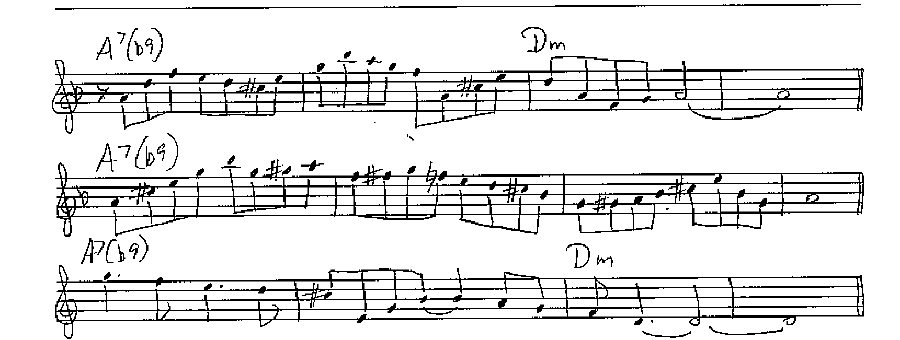
In a previous post, I offered a couple of written exercises on major triad couplets. Now, in the spirit of Bird, here are three licks utilizing the A Phrygian dominant scale. The first and third one resolve to the tonic chord of D minor; the second is just a straight A7b9 lick, but you can still resolve it to the D minor–it just waits longer to define that chord.

As always, memorize each exercise in all twelve keys. And have fun!

[ADDENDUM: I just noticed that, in the third exercise, I didn’t include a Bb in the key signature. Please mentally insert it so you’re playing in the key of D minor and the ninth of the A7 chord is flatted.]

Triad Couplets for Jazz Improv: Two Written Exercises

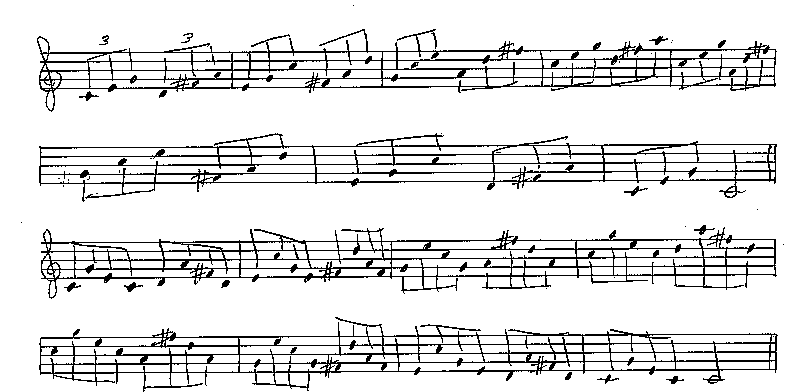
In a previous blog, I wrote about practicing scales with a jazz purpose in mind, and I offered a few suggestions. In keeping with that post, here are a couple fun little exercises that involve juxtaposing two triads a major second apart from each other and running them through their various inversions. Take them through the full range of your instrument, and work out other variations on them to develop complete facility with them.

Please bear with the small size of the staff and notation. This is the first time I’ve attempted uploading a written exercise on this blog.

Always keep application in mind. Play these exercises against a C major chord, for instance, and the raised fourth–F# of the D major triad–gives you a Lydian quality. Play the exercises against a D major and you get a dominant sound, with the C functioning as the flat seventh.

Work with the Aebersold Gettin” It Together CD, or Band in a Box, or simply with a piano, holding down a chord, so you can hear how this exercise sounds against actual harmony.

Subconscious-Lee

When you think of original voices on the alto saxophone, Lee Konitz inevitably comes to mind. A student of blind pianist Lenny Tristano, Konitz unites a limpid tone with fluid technique and a unique, uncliched melodic conception.

I find interviews with jazz musicians fascinating, and in previous posts I”ve included links to clips featuring both the playing and the personal insights of Sonny Rollins, Bill Evans, and Michael Brecker. Now joining them is this video segment from the television show The Subject Is Jazz featuring a young Lee Konitz and tenor compatriot Warne Marsh playing the tune “Subconscious-Lee,” followed by a brief but interesting interview with Konitz.

I’m struck by Konitz”s early tone–clear, pretty, and creamy. His sound has evolved quite a bit since then, and possesses an unmistakable, instantly recognizable signature quality. Melodically, note Konitz”s use of sequence, and his ease of interpolating unusual, more angular ideas into his lines. The tune, and both Konitz”s and Marsh”s playing, showcase fabulous technique masked by a cool, intellectual approach. Standing in the hot shadow of the boppers, Konitz offered a thoughtful and engaging alternative.