Dominant Seven Flat Nine Exercise on the Cycle of Fifths

If you want to develop comfort and ease with changing keys swiftly, then practice patterns on the circle of fifths. In particular, work on dominant seventh chords; doing so will help you to develop facility in voice leading from the seventh of one chord to the third of the next, and vice versa.

The exercise on this page is one of countless possible dominant seventh patterns. I like it because it brackets the chord root with the flatted ninth and raised seventh, then descends from the root through the lowered seventh to the third of the ensuing chord. Bottom line: you get a nice combination of color tones and harmonic motion. Click on the image to enlarge it.

This is a pretty straightforward exercise, and I don’t think I need to say anything more other than, memorize it, apply it to the full range of your instrument, and have fun!

Oh, yeah…and, check out my jazz page for more exercises, solo transcriptions, and articles of interest to jazz musicians.
On Beyond Jazz: Expanding Your Appreciation of Musical Diversity

Is it safe to come out of my bunker now? Has the war between jazz and rock finally ended? I don’t hear any incoming missiles. But then, I’m kind of out of the loop these days when it comes to who is presently saying what in the various music periodicals.

It does seem to me that in this melting pot called America, music has come a long way in developing mutual respect between the different genres. The purist dividing lines have given way to healthy crossover and cooperative experimentation between music styles and artists, and the style racists who once wrung their hands and shouted, “Miscegenation!” back in the days of “Bitches Brew” have long since been thrust aside by open-minded musicians searching for fresh, creative possibilities. Yet I wonder to what extent the old biases still continue to influence us.

Back in my college days, rock music was largely scorned by jazz musicians, and the feeling was amply returned. You couldn’t pick up a “Downbeat” magazine and read an article on fusion without some reader writing in to complain, “That’s not jazz!” If it wasn’t bebop, it it involved an approach to the drum set that was other than tang-tanka-tang, then the purists were up in arms, donning their white hoods and burning their crosses in the letter section. Even back then, naive as I was, I found the topic of this is/isn’t jazz to be petty, not to mention boring, when the groups in question involved world class musicians who knew the standard jazz vocabulary inside-out.

I also found the notion that jazz was the only worthwhile music, or the idea that any one style of music was better than the rest, to be confining, narrow-minded, and pointless. I mean, I cut my teeth on classic rock music–on groups such as Jefferson Airplane, Mountain, Jimi Hendrix, Jethro Tull, King Crimson, Yes, Genesis, and Fleetwood Mac–and I didn’t stop loving rock and roll just because I was starting to become immersed in jazz.

So why was it that jazzers and rockers seemed to have so little respect for each other? For that matter, what was it about symphonic musicians that gave them such an illusion of superiority over all the rest? And why did it go without saying (by me among the rest, I hate to confess) that country/western was inferior music?

Tell me that things have changed since those days. I think they have. From what I can see, we’ve come a long way.

At bottom, all music is divisible into just two categories: good music and bad music. Beyond that, it’s a matter of personal preference. And that is fine; in fact, it’s inevitable. Each of us is drawn to certain kinds of music and not drawn to others. It’s a matter of individual taste, which fines down even beyond general categories to subcategories and artists of all kinds. It’s all good as long as it doesn’t lead to demeaning other forms of musical expression, or to closing ourselves off to their creativity and richness.

Still today, it’s unlikely that I’ll ever purchase a country music CD. However, that choice is influenced not by musical snobbery, but by the fact that I’m a jazz saxophonist with a limited music budget, and on the relatively rare occasions when I purchase a CD, I usually stick with jazz, guided by a goal of learning my craft as well as enjoying its sound. It’s a matter of focus and preference, not elitism. If I’m driving down the highway and happen upon a good country station on the radio, then I’ll listen to it and enjoy it. Over the years and the long, long highway miles, I’ve come to appreciate that country music harbors some of the finest lyricists and songwriters in the world.

My point: Why limit yourself in what you listen to? Jazz is awesome music, but it’s not all that is out there. Broaden your world. Go to YouTube and check out some of the old film clips of Janis Joplin, Hendrix, and the Beatles. Tune in to The Thistle & Shamrock on NPR and let Fiona Ritchie give you an exhilarating earful of wild, wonderful Celtic music. The world of music has wide, wide horizons; open your ears to ways of expressing musical and creative excellence other than the ones you’re used to. Allow yourself to be influenced by the amazing diversity of music in this world. Doing so will enrich your own artistry as a jazz musician.

Band Link Up: A New Virtual Community for Musicians

Attention, jazz musicians and other purveyors of melody! Want to get in on the groundswell of an online community devoted to musicians? Then click on Band Link Up, look it over, take a minute to register, and then start posting and helping this unique labor of love to grow into a thriving virtual hangout for musicians, vocalists, singer/songwriters, and other artistes of every stripe.

I first got wind of it while installing a new operating system on my laptop. The tech who was assisting me, aka Jeff, and I got to chatting while waiting for a lengthy download to complete, and once we got onto the subject of music, things naturally progressed from there. Turns out that Jeff’s fiancee plays violin and loves to connect with other musicians. So as a gift to her, Jeff decided to put together an entire site dedicated to the purpose of helping musicians talk shop, trade ideas, share sound tracks and videos, and so forth.

I’ve already registered, and I’m encouraging all my musical friends and everyone who is actively involved in performance, recording, composing, or music education to do the same. Band Link Up shows great potential as a service to musicians. Please get on board and help make it happen.

Key Saturation: Mastering the Hard Keys on Your Sax

Tonight I practiced my saxophone for the first time since I pulled my back muscles this past Monday. It feels great to be able to walk freely again, and this evening it felt doubly great to hop into my car, head out to my beloved railroad tracks, and woodshed my horn for several solid hours.

Much of my time was spent working on the key of F#. That’s one of my favorite, time-tested approaches in practicing: to periodically pick a single key or tone center and saturate myself in it. By “saturate,” I mean hitting the key from every possible angle: running patterns on the scale. Drilling myself on the key’s dominant chord, including alterations and substitutes. Working chromaticism into the diatonic framework. Transposing and memorizing great jazz players’ solos. So on and so forth.

All of us practice key saturation to some extent simply by default. We don’t think of what we’re doing in those terms, but it’s the reason why we commonly become proficient in keys such as concert Bb, F, Eb, and C. We naturally spend lots of time working on those keys because they’re the ones that a great deal of jazz is written in. We think of them as the easy keys–easy because, we tell ourselves, they have fewer sharps or flats. But the real reason they’re easy is because we’ve practiced them enough to become conversant in them.

By that same reasoning, the “hard” keys–keys such as concert E, A, D, and F#–are hard not because they have lots of sharps or flats, but because we haven’t spent any real time getting intimately familiar with them.

The truth is, “hard” is just a mindset. There are no hard keys; there are only unpracticed keys. There are no difficult scales, only unpracticed ones.

That’s why it pays to pick a key or tone center you’re unfamiliar with every now and then, and spend several practice sessions saturating yourself in it. If you’ve never done so, give it a try.

If you’re an alto player, for instance, how well do you get around in the alto key of Ab? Not too hot? Then why not devote part of your next session to bombarding that key. Pick a solo transcription you know well and start learning it in Ab. Ditto a few tunes. Hash out diads and arpeggios, starting with the basics and working in bracketing and chromaticism. Wrap your fingers around a few ii-V7-I’s. And don’t forget your bebop scales.

Mastering a key takes time and consistency, but the saturation approach will get you there if you stick with it. And you just may find, as I’ve found, that key saturation can become addictive as those hard keys become less difficult and a lot more enjoyable.

Sixth Interval Exercises for Jazz Improvisation

Two posts ago, I talked about the use of the sixth as a sort of sweetening agent in improvised solos. If you haven’t yet done so, I recommend that you read that article before proceeding with the following exercises. It’s always good to understand a little about the whys and wherefores of what you’re doing, particularly when it comes to connecting saxophone technique with jazz improvisation.

One thing I didn’t mention in the previous post, and an important point at that, is the angularity that sixths bring to a musical line. Broad interval that they are, sixths are by definition intensely angular, and as such provide a colorful and interesting way to break up a linear flow.

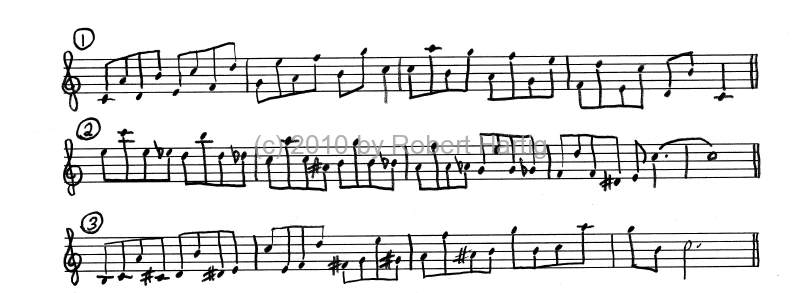
The three exercises on this page are all based on the C major scale. (Click on the image to enlarge it.) The first exercise features basic sixth diads, moving up and then back down an octave.

The second exercise begins on the third of the C major scale (the note E) and moves up a sixth to the tonic C, thereby strongly implying the C major chord and establishing the key center. The exercise moves downward from there, incorporating the added color of passing tones and chromatic lower neighbors.

Exercise three, ascending an octave, approaches each lower note of the diads with a chromatic lower neighbor. While the result is a series of three-note groups, I’ve written the exercise in eighth notes rather than triplets to create a syncopated effect.

Consider each written exercise to be just the abbreviated form of what you actually need to practice. You should take all three exercises up and down through the entire range of your saxophone. You’re smart enough to figure out the missing pieces for yourself, and you should do so.

I suggest that you start by picking one pattern and memorizing it in all twelve keys, beginning with the first exercise. Then proceed to the next pattern and do likewise.

Yes, I know–I’m a drill sergeant and you hate me. But I promise you, all that hard work will pay big dividends with time. One of these days, you’ll thank me. Really. “Thank you, Bob,” you’ll say. Until then, my ego is tough enough to handle the lack of love.

Sweeten Your Sax Solos with Sixths

Just a little “S” alliteration to brighten your day. Think you can say the above headline ten times, fast?

It’s true, though. If you want to sweeten up your improvised solos, then get familiar with the interval of the sixth. There’s none sweeter.

Practice the sixth as an interval study on all your major scales, up and down. And think about its application. Remember that the sixth is the inversion of the third, and it possesses the opposite quality of its corresponding third. If the third is a major third, then when you invert it, you’ll get a minor sixth. And vice versa: a minor third inverted becomes a major sixth.

A standard and particularly pleasing use of the sixth is to jump from the third of the tonic chord up to its root at the end of a passage. But that’s just for starters; there are many ways to incorporate the sixth into your improvised solos. And sequences work beautifully, which is good incentive to spend time with diatonic sixth studies on major scales, as I’ve recommended above.

The sixth is particularly nice when you approach it with neighboring tones and passing tones. I may put together some exercises to get you started exploring the possibilities, so stay tuned. The sixth is a really handy interval to have in your arsenal as a sax player, and it’s well worth taking the time required to wrap your fingers around it.

Saxophone Mouthpiece Exercise (a Dignified Term for Screwing Around Making Weird Noises)

I stumbled upon the following saxophone mouthpiece exercise long before I really knew how to play the sax. Back when I was in high school, I needed some kind of trick to cover my butt when I was jamming with other musicians–typically rock bands in those days–and needed to disguise the fact that I didn’t have a clue what I was doing. One evening at a kegger, having exhausted my meager bag of licks, I got the sudden inspiration to pull my mouthpiece off of my horn and play it by itself. The idea certainly commanded attention, captivating my listeners for a good five seconds, though I’m not sure it was the most musical extravaganza they had ever experienced.

Anyway, many years down the road, I still make occasional use of the sax mouthpiece exercise. I’m not sure what else to call it, other than screwing around with the mouthpiece making sounds like a goose gargling. But in all seriousness, I believe you can find some value in the technique, both as a creative tool and as a means of sensitizing your oral chamber for purposes of tone color and pitch control.

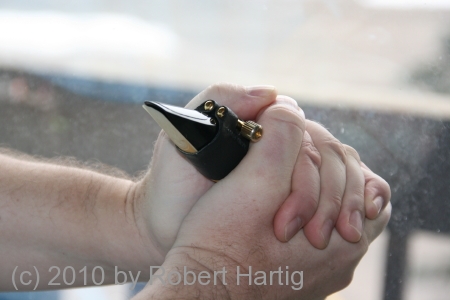
The exercise is simple: cup your hands together to form a sort of pouch, as in the first picture (click on it to enlarge it). Then blow into the mouthpiece. You can then “play” the piece by opening and closing one hand, as in the second photo. The result is a sort of demented warble that sounds like some kind of marshland bird on an acid trip.

Them’s the basics, but of course, you’ll want to experiment. You can actually control the pitch with your hand, and you’ll also want to see what kinds of sounds and pitch-bending you can do by adjusting your embouchure. The point is to explore the colors you can generate using just your mouthpiece, your hands, and your embouchure and air column. You can get some surprisingly expressive effects. In my “Eyes on Mars” album with Ric Troll, I performed an entire piece using this technique. Is it music? I guess that depends on your philosophy of music, and frankly, I wasn’t thinking about the question at the time. I was just having fun trying something different and creative. You know–being a kid.

Give the saxophone mouthpiece exercise a try and see what you think. And check out my jazz page for more tips, technical exercises, and solo transcriptions to keep you occupied.

How to Practice the Saxophone: Four Key Principles That Can Help You Advance

What does it take to develop as a jazz saxophonist–or, for that matter, as any kind of instrumentalist?

Practice.

Right, I guess we all know that. But there is practice, and then there is effective practice. Practice that makes the best use of the time you’re investing. Practice which a year from now will have produced a year’s worth of results rather than a month’s worth of plodding the treadmill twelve times over.

Two things are paramount for effective saxophone woodshedding: what you practice and how you practice. In previous posts and on my jazz page, I’ve provided plenty of material that addresses the “what” part of that equation. In this article, I’m going to talk a bit about the “how” as it pertains to technical development.

Having spent time contemplating the things that have contributed to my own growth as a sax player, I’ve identified four key principles that I believe are important for developing technical proficiency. They are:

Isolate

Repeat

Connect

Memorize

These four principles work together to help you transition from the initial, heavily intellectual process that comes as you tackle new musical material, to a more intuitive approach that develops as you spend time mastering that material and making it your own.

Each of the principles could easily be an article in itself, so I’m not going to tackle them in depth. Right now, I just want to introduce you to the concepts.

Isolate

Whether you’re learning a new scale, practicing patterns, hashing out a lick, moving around the circle of fifths, or memorizing a Charlie Parker solo, the way to approach musical material is in increments.

Think of how you eat your food. You’d never stick an entire steak in your mouth and try to swallow it whole. (You wouldn’t, would you?) No, you cut off manageable, bite-size pieces which you take your time to chew. The same idea applies to working on music: bite-size is best.

Pick groups of notes and repeat them till they lay well under your fingers. In particular, isolate problem areas and focus on them, oiling them with repetition until they’re working smoothly. Work out which alternate fingerings work best in a given situation. If you’re playing in the key of F#, for example, you may find yourself using the bis, one-four, and side fingerings for A# almost consecutively as the context for your approach to the note A# changes.

START SLOW. Concentrate on how evenly you connect the notes, not how fast you can play them. Once you’re playing a note group accurately, comfortably, and consistently, then speed up a notch or two, and continue to increase your speed till you’re playing at high velocity. If you find yourself hitting a speed where you start fumbling and misfiring, then slow down. The point isn’t to play fast, but to play masterfully. Fast will follow.

Repeat

Repetition is woven into the first principle of isolation. You isolate a group of notes or even just two notes in order to repeat, repeat, repeat them, often enough to drill them into your muscle memory. Since I’ve already written a post on repetition, there’s no need for me to–ahem–repeat what I’ve already said. Go read the article.

Connect

Once you’re playing a group of notes fluently, add a note or two in front of it or behind it. Or work on the next group of notes until you’re playing it as fluently as you were playing the first, then connect the two groups.

In the process of focusing on the second group, you may find that you’ve lost a bit of ground with the first group. That’s okay. Go back to the first group and smooth it out. The point is, you work on small units of material, then you work on connecting them to create something larger–to which you will, in turn, connect still more material.

Often you’ll encounter a sticking point between the last note or two in one note group and the first couple of notes in the group that follows. That juncture should become a new area to isolate and work out.

If this sounds like a tedious process, it can be, but it’s also a very profitable one. And not all groups of notes carry equal weight. Some come more easily; others are more challenging. Run toward the challenges, not from them.

Memorize

As long as you’re depending on the paper to tell you what to play, the music you’re working on isn’t really yours. I’m not referring to extended pieces of music where a chart is mandatory, but to scales, licks, patterns…to the building blocks of technique and the language of jazz improvisation. Memorization is an indispensable part of the jazz saxophonist’s toolkit.

The whole point of all this isolating, repeating, and connecting is to move the music off the printed page and into your head and your fingers. So at the very beginning of the process, make a point of looking away from the sheet music. Consult it as freely as you need to, but remember that your goal is to wean yourself from it. When you’re in mid-flight on the bridge to “Cherokee” on your alto sax, you had better be thoroughly acquainted with the keys of Ab, F#, E, and D, because the rhythm section is not going to pause while you look them up in your Larry Teal workbook.

Memorize everything. Tunes. Chord changes. Scales, arpeggios, circular root movements…everything you can possibly cram into your gray matter and drill by repetition into your muscle memory.

One last thing…

Think about what you’re doing. Engage your mind in the process. If you’re working on a digital pattern, consider not just what you’re playing, but also how you can use it with various chords or chord progressions. Think about how you might switch up the rhythm of a lick to create a different effect. You can build all the saxophone technique you want to, but ultimately it’s your brain, not your horn, that converts the raw material into actual music.

That’s it for today. If you enjoyed this post and would like to read more helpful articles on playing the sax, or perhaps find a jazz sax solo transcription to hash out, see my jazz page.

Practice hard–and have fun!

Amy Young and Friends Playing at Schuler Books on January 22

Tonight’s rehearsal with Amy Young and Friends went great. I’m really looking forward to the concert next Friday evening.

Amy is a talented singer/songwriter in the West Michigan area, and she has surrounded herself with a cast of fine musicians for this event. She covers a variety of styles ranging from blues to rock to folk to jazz. If you live in the Grand Rapids vicinity, please come on out and give her and the rest of the band, including me, a listen. Here are the details:

Date: Friday, January 22

Time: 7 p.m.

Place: Schuler Books,  2660 28th St. SE, Kentwood

Admission: FREE, FREE, FREEEEEE!!!

Mark it on your calendar and make it a date. Hope to see you there!

Bird Song: Hearing Charlie Parker for the First Time

If there is one name that is synonymous with the alto saxophone, it’s Charlie Parker. For that matter, no jazz musician of any kind–saxophonist, trumpet player, bassist, pianist, you name it–can explore the craft without becoming keenly aware of, if not at some point deeply immersed in, the music of Bird. If Dizzy Gillespie was the clown prince of the bebop school, Charlie Parker was its pied piper, a quirky and unpredictable genius whose God-given creative torch burned too brightly to be quickly extinguished by the excesses that eventually overcame him.

Some jazz musicians grow up with Parker played regularly at home as a vital part of the musical ambiance. Others discover Parker’s music later in life. I fall into the latter category. Ours was not a particularly musical household, though Mom loved the Nutcracker Suite and Dad dug his Louis Armstrong, Bessie Smith, and Sidney Bechet records.  My own musical tastes, once they began to develop, naturally tended toward the rock of the seventies, particularly art rock bands such as Jethro Tull, King Crimson, Yes, Genesis, and Pink Floydd.

I did have the advantage of playing in a big band beginning in the eighth grade. That experience gave me an invaluable exposure to the music of Basie and Ellington, and to the American songbook at large. But bebop? What was that?

Then came my first year at Aquinas College, and a course on modern music appreciation with Dr. Bruce Early. The class covered plenty of ground, as I recall, including the music of some of my favorite rock bands. Inevitably, we got into the various kinds of jazz, which was Bruce’s real thrust with the class. Dixieland I was familiar with, and as for big band swing, I had been playing that since junior high school. But suddenly, jazz began to take on deeper dimensions for me. And one day, Bruce dropped a record onto the turntable, and out of the speakers came the most unbelievable saxophone music I had ever heard. It was blazing. Brilliant. Blinding. Beautiful. Wild, yet–though I wouldn’t have thought of the description at the time–wonderfully logical.

That was my first exposure to Charlie Parker, and it left me stunned. How on earth could anyone play a saxophone like that?

I didn’t have ears enough to comprehend what it was that I had heard. I only knew that it pointed toward possibilities on the alto sax that I had never dreamed of. It was like stepping through a door out of a tiny room and discovering an entire mountain range on the other side.

Fortunately, I was too young and too dumb to feel utterly overwhelmed. That’s probably why I’m still playing the saxophone today. Some contemporaries of Parker weren’t so fortunate. I read of one saxophonist who, after hearing Bird in flight, pitched his horn into the river in despair. Today I understand that sentiment a little better–because, now that I’m more than twice as old as Parker was when he first lit his fire and greased his skillet, I still can’t cook the way he could. I have, however, learned a lot from him, and continue to learn.

If Bird hadn’t been given to the monstrous indulgences that eventually destroyed him, I wonder, as many musicians have wondered, what else he might have accomplished. Would bebop have been his apogee, his singular torch against whose sun-like flame all his future achievements would have paled? Or would it have been the spark to still brighter creative expressions? Dizzy is still with us; had Bird’s life been other than what it was, he might be here, too. But it wasn’t and he’s not, and all we can do is speculate on what might have been or might not have been–and absorb the alto saxophonist’s legacy. In the words of Charles Mingus, “If Charlie Parker was a gunslinger, there’d be a whole lot of dead copycats.”