Some New Audio Clips for Your Listening Pleasure

Last Monday I got together with Ric Troll (guitar), Dave DeVos (bass), and Randy Marsh (drums), and we rehearsed a few of Ric’s original tunes in his studio, Tallmadge Mill. These guys are wonderful jazz musicians, and Ric is a composer of long standing. His music can be chewy stuff to work through, but this last session the tunes started to gel and we got some pretty nice grooves going.

Ric recorded the whole session, so I’m able to share some sample tracks with you. What you’ll hear are the tunes in rough, but there’s some very nice playing going on.

The New Hip is a basic 12-bar blues, but Ric’s head suggests a soloing approach different from your standard bebop. Attempting to free myself from cliches, I incorporated a more angular style.

The Urge is a fun tune with a high-energy A section and a swinging, cooler-sounding bridge that offers a lovely contrast.

Orcs has been the most challenging number, with it’s polymetric approach and shift to 7/4. It is coming together, though, and will be one heck of a tune once we’ve nailed down the form and the feel. Listen to Randy–the guy just tears it up on the set! Here’s a second take for all you double-dippers.

If you like what you hear, check out my Jazz Page for more sound samples as well as solo transcriptions, articles, and exercises of interest to improvising musicians.
A Table of Non-Diatonic Tones and Their Common Uses

A while back I shared some ideas on how jazz improvisers can make optimal use of the added flat sixth tone of the major bebop scale. I pointed out that, besides its obvious use as a passing tone that evens out the scale and allows players to move seamlessly from root to octave (or third to third, or fifth to fifth, etc.), the flat sixth also functions readily in a number of harmonic contexts common in jazz.

Yet, useful as the flat sixth (or sharp five) of the major bebop scale can be, it is nevertheless only one of five non-diatonic tones that occur in a major key. In addition, the tonic, supertonic, subdominant, and submediant scale degrees can all be similarly raised a half-step and used in a variety of harmonic applications.

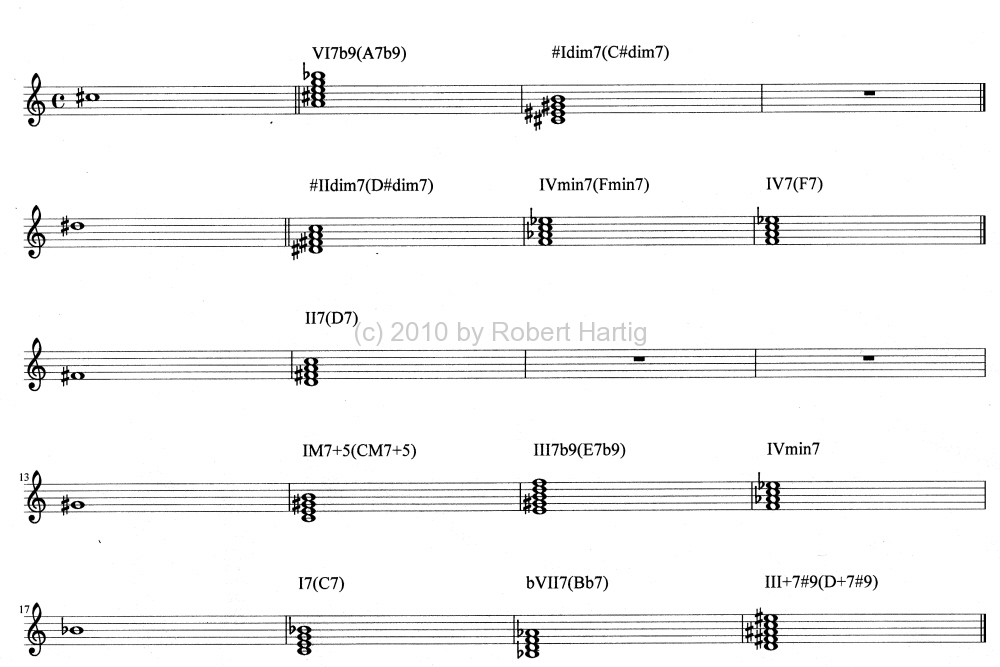
borrowed-tone-applications-002The image to your right  is a table that shows some common uses for each non-diatonic tone in the major scale. (Click on the thumbnail to enlarge it.) The table is by no means exhaustive; it’s just meant to give you a handy reference to harmonic situations you’re likely to encounter as an improviser.

The table is based on the C major scale. In that key, the five non-diatonic tones are C#, D#, F#, G#, and A#.  From top to bottom, the staves begin with a given tone, then show how that tone fits into various chords. The chords are numbered according to their functions and also named (eg. IVmin7, Fmin7). Depending on their application, I may use the enharmonic equivalents of some tones. For instance, instead of A#, I’ve chosen to show Bb, which makes better sense in actual usage.

In stave 1, the VI7b9 and #Idim7 are interchangeable, leading almost inevitably to the IIm7 chord. In the next stave down, the #IIdim7 wants to resolve to the mediant. By adding the scale’s leading tone as the chord root, you wind up with a B7b9, which is the V7 of III. Glancing over the rest of the table, you’ll notice numerous other uses in secondary dominant harmony.

I’m not going to go into detailed explications of every chord, as–assuming that you know your basic jazz theory–the uses of the different non-diatonic tones should be self-evident. Again, the table is not definitive. It’s intended simply to give you a handy reference that can heighten your awareness and help you make more deliberate use of all twelve tones in the chromatic scale. You’re bound to think of other applications not shown in the table.

For practice purposes, you could try working with a single tone. Incorporate it into a major scale to create an eight note scale. Then work out various chordal possibilities that utilize the tone, always keeping in mind the parent major key you’re working in as a frame of reference.

If you’ve found this article useful, make sure you check out the many other articles, exercises, and solo transcriptions on my jazz page. And, as always, practice hard and with focus–and have fun!

Hard-to-Read Music Exercises on Stormhorn: Follow-Up

Have you been having a hard time reading the exercises I’ve provided in my more recent music instructional posts–the ones in which I’ve used transcription software rather than scanned, handwritten material? Some people–including me–have had problems, though not everyone. It seems that some of the lines on the music staves appear faint to nonexistent in places, making it hard to tell the identity of notes.

From what I’m able to tell so far, the issue appears to be part browser-related and part a matter of scale, requiring that the image be adequately enlarged.

Browser: Firefox is my preferred browser. Unfortunately this is the browser on which the problem crops up for me. However, once I click on the image and then zoom in a step or two, everything clears up nicely.

Internet Explorer: When I click on the image, I just don’t have the same problem as with Firefox. The image is clear.

In a nutshell…

If you’re having a hard time reading the exercises, try (a) switching browsers; (b) magnifying the image; or (c) both.

I have an idea up my sleeve that may make everyone happy if it works. I’m going to try it next time I include written exercises in a music post. That shouldn’t be too far down the road now, as it has been a while since I’ve shared such a post. So stay tuned.

Until then, I’ll value your input on the clarity of the exercises. If you’ve had trouble, let me know whether the above suggestions fix things for you. And if you’ve had no problems, let me know that as well.

Thanks!

Bob

Hard-to-Read Exercises on Stormhorn Music Posts

One of my readers has commented that he had difficulty reading an exercise in one of my music posts. I’m guessing that he’s not the only who’s had that problem, since I’ve encountered it myself.

For some reason, while the original image files for my music examples are quite legible, something happens when I upload them to WordPress. The result is that the staves have been reproducing unevenly, making it difficult in places to determine the placement of notes.

Each new instructional post has sent me searching for a fix. So far I’ve been unsuccessful, and I’ve depended on you, my readers, to fill in the blanks, trusting you’d find that the benefits of the exercises outweighed the inconvenience. However, this approach obviously is just a stop-gap, not an acceptable solution.

I’m not sure what the cure is–whether the problem lies in the transcription software I’m using, in WordPress, or in my own lack of technological expertise. Other sites don’t have the same trouble, so I’ve got to believe there’s a simple, viable solution. Until I find it, I thought I’d let you know that I’m aware of the problem, it bothers me at least as much as it does you, and I’m looking for a way to solve it. Meanwhile, thanks for your forbearance!

All the best,

Bob

This Week: Gig and Recording Project

I’m pleased to say that all the time I’ve been spending these days practicing my saxophone is going to get some practical application. This week Thursday, October 7, I’ll be playing with keyboardist Paul Lesinski at The Seasonal Grille in downtown Hastings, Michigan. Then Saturday, I’ll be getting together for a recording project over at Tallmadge Mill studios west of Grand Rapids.

THURSDAY’S GIG: October 7, the town of Hastings is promoting a Ladies’ Night on the Town. With The Seasonal Grille offering a combination of wonderful ambiance, superb Italian cuisine at eminently affordable prices, and a good selection of wines and beers, I’m sure the place will be doing a thriving business. I’m pleased to be providing the music there with Paul. Come on out and get a mouthful, an earful, and a beerful!

Place: The Seasonal Grille

Address: 150 W. State Street in downtown Hastings, Michigan

Phone: (269) 948-9222

Time: 6:00-9:00 p.m.

SATURDAY RECORDING SESSION: I’m really excited about this! The guys I’m getting together with are some of my musical heroes. Ric Troll, owner of Tallmadge Mill Studio and organizer of the get-together, is not only an extremely tasty drummer, and more recently a guitarist, but also a wonderful composer. Anything I could say about him would be too little, and that goes for the rest of the guys as well. Randy Marsh, Kurt Ellenberger, and Dave DeVos are not merely superb players, they’re also fantastic, complete musicians, widely known and respected in West Michigan. I’m thrilled that I’ll be playing some original music with them this weekend. Look for cuts from the session here on Stormhorn.com in the future as they become available.

That’s the news for now. It’s late and I’m tired. Time to call it a night.

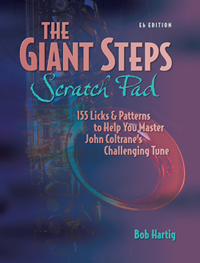
Now Available: Bass Clef Edition of “The Giant Steps Scratch Pad”

A few minutes ago I completed the last of the downloads, filled in the information fields, and then, with one final click of the mouse, published the bass clef edition of “The Giant Steps Scratch Pad.”

At last! I can finally say that I’ve accomplished the goals I set for this book as it evolved from my initial concept to something considerably more ambitious. The “Scratch Pad” is now available in all four editions: C, Bb, Eb, and bass clef.

So, trombonists, bass players, tuba players, and–well, have I missed anyone?–whoever else lives and moves in the bass clef universe, here is the practice resource for Coltrane changes that you’ve been hoping for, pining for, craving with all the intensity of your bass clef hearts. All kidding aside, if you’re at a stage of development on your instrument where you want to tackle the challenge of “Giant Steps,” this book is for you. It’s made for the woodshed and will help you build formidable chops for John Coltrane’s rite-of-passage tune.

Instant PDF download, $9.50
C edition Add to Cart
Bb edition Add to Cart
Eb edition Add to Cart
Bass clef edition Add to Cart
View Cart

Print editions–retail quality with full-color cover, $10.95 plus shipping: order here.

Voice Leading for the Giant Steps Cycle

Both in print and on the Internet, there’s no paucity of theoretical material available when it comes to “Giant Steps” and Coltrane changes. Of course, theoretical knowledge can’t take the place of time in the woodshed hashing out the changes on your instrument. But it can help you make some sense of what you’re practicing by revealing the order in what can at first seem like an odd, rambling array of chords. Once you understand some of the voice leading in “Giant Steps,” you’ll be able to pinpoint certain guide tones and use them effectively in your solos.

This post is by no means intended to offer an in-depth explication of “Giant Steps” theory. All I’m going to do is call your attention to how a few select tones proceed, so you can be mindful of them for the reason I’ve just stated. Let’s begin by naming the changes to the first four bars of section A in “Giant Steps.” In concert pitch, they are: Bmaj7 D7 / Gmaj7 Bb7 / Ebmaj7 / A-7 D7.

The second four bars repeats that chord progression a major third lower, thus: GMaj7 Bb7 / Ebmaj7 F#7 / Bmaj7 / F-7 Bb7.

If you delete the last two bars in each four-bar phrase and crunch together the remaining chords, you get the following sequence: Bmaj7 D7 / Gmaj7 Bb7 / Ebmaj7 F#7. This is the essential Giant Steps cycle. As you can see, once you reach the end of the cycle it repeats itself as the F#7 resolves downward by a fifth to the Bmaj7.

So far, so good. Now let’s see what happens when we start moving some basic chord tones. We’ll start with the root of the Bmaj7 chord. If you move it down by a whole step, you wind up on the note A, which functions as the fifth of the next chord, the D7. Move A down another whole step and you land on the root of  Gmaj7. Continuing down by whole steps in this manner–in other words, moving down the B whole tone scale–will move you from root to fifth to root to fifth through the entire Giant Steps cycle.

You can also apply the same down-by-major-second movement starting on the fifth of the Bmaj7, which is F#. In this case, the fifth moves down a whole step to E, which functions as the ninth of the D7 chord. (You could also look at it as the fifth of an A minor chord that serves as the ii/V7 to the D7.) This note in turn moves downward to the fifth of the Gmaj7. Again you’re descending through a whole tone scale, this one beginning on the fifth of the Bmaj7.

So if you want a handy memory aid to help you organize your guide tones in the Giant Steps cycle, simply think of two whole tone scales (using half notes to match the harmonic rhythm), one descending from the root and the other from the fifth of the Bmaj7 chord.

When you spotlight the third of the major seventh chords, things get more interesting. The third of the Bmaj7 is D#. Moving down a half step lands you on the note D, which is the root of the D7. To get from there to the third of the next chord, Gmaj7, you have to jump down a minor third. When you extend this downward movement of half step/minor third throughout the entire cycle, you wind up with an augmented scale.

You also get an augmented scale when you use the same movement starting on the seventh of the Bmaj7 chord, thus: A#, A / F#, F / D, C#.

To recap:

* For voice leading from the root and fifth of the major chords in “Giant Steps,” consider using, respectively, the B and F# whole tone scales.

* For voice leading from the third and seventh, use the D# and A# descending augmented scales.

I hope these concepts will help you see the symmetry in Coltrane changes and make life easier for you as a result. If you want a resource you can take into the practice room with you to help you master “Giant Steps,” check out my book The Giant Steps Scratch Pad. It’s available in C, Bb, Eb, and bass clef editions. See below for ordering info.

Happy practicing! Oh, and be sure to visit my jazz page for plenty more tips, solo transcriptions, exercises, and articles of interest to jazz musicians.

The Giant Steps Scratch Pad

.
Instant PDF download, $9.50
C edition Add to Cart
Bb edition Add to Cart
Eb edition Add to Cart
Bass clef edition Add to Cart
View Cart

Print editions–retail quality with full-color cover, $12.95 plus shipping: order here.

Guest Post for Sax Station: Connecting Technique to Expressive Improvisation

For today’s post, I’m giving myself a break and connecting you with a guest post that I wrote for my co-conspirator in saxophonistic mayhem, Neal Battaglia. When Neal invited me to write an article for his topnotch blog site, Sax Station, I cast about for a bit and came up with a post titled “Connecting Technique to Expressive Improvisation.” After reading what I’d written, I mildly lamented the fact that I wasn’t posting it on my own blog, but I’m honored that it’s on Neal’s.

I hope you enjoy the read. And don’t stop with my article. Check out the rest of Neal’s site, because there’s a lot of really good stuff on Sax Station! Also, keep an eye out for a reciprocal post by Neal here on Stormhorn.com. I love featuring guest posts, and while Neal is less long-winded than I am, he offers some very worthwhile insights.

Praise Team or Praise Family? Some Thoughts for Worship Ministry Leaders

The single, most far-reaching improvement you can make in your praise team involves the “C” word, “connecting.”

Worship ministry leaders, let me speak frankly. I’ve been a disciple of Jesus for 30 years now, and most of that time I’ve served in praise bands of various kinds. So when I write, it’s from an insider’s perspective, and a fairly seasoned one. It’s from that point of view that I’m telling you, something vital is missing from many–I daresay most–evangelical praise teams today.

Actually, two things are missing. Let me pose a question: How much of your weekly rehearsal times do you set aside for your team to connect with each other and to pray together?

In my experience, the answer for a lot of teams, truthfully, is, not much. Sure, the team members exchange greetings and a bit of conversation prior to practice, and the leader begins the rehearsal with a quick prayer asking God to bless the team’s efforts and vowing to give him all the glory. But when it comes to really connecting with one another and with God, deliberately and intimately, rehearsal times are typically two hours wide and half an inch deep.

I understand that there’s music to be learned and practical affairs to be discussed. But ladies and gentlemen, this is probably the only day of the week other than  Sunday when you’re all together. If you don’t devote a substantial part of it to growing not just as musicians, but as a little family who cares for each other and seeks God together, then what is it, really, that makes you a ministry? For that matter, what is it, other than the music you’re playing and the venue where you’re playing it, that sets you apart from any secular band? Because ministry lies in the moment and in your ability to relate to each other as complete people, not just as components of a band who fill neat little roles with set expectations–who play your parts and then go your separate, disconnected, and quite possibly painful and lonely ways.

Ministry starts in your midst as you prioritize what God values most, and that’s not music. It’s your brothers and sisters. It’s family. Jesus revealed God as our Father, not our band director.

I submit that making time for each other and for God is every bit as important as practicing tunes, and more. Except for the occasional new tune, you already know the material–you’ve been playing it for a long time. Chances are you know the music a lot better than you know each other. So, worship director, if you want to take your team to the next level of ministry, here’s where your greatest, most potentially life-changing opportunity lies. Not in your programming. Not in sound checks. Not in massaging a new, creative twist into a particular song. The single, most far-reaching improvement you can make in your praise team involves the “C” word, “connecting.” I’m not saying the other things aren’t important. I’m just saying that there’s something else that’s more important, and if you don’t get that in place, then none of the rest matters. Not really.

I think we evangelicals need to change our ministry model from that of a praise team to a praise family. And I think we need to invest the idea of rehearsal time with greater depth and breadth, as a time not only to tighten down the tunes and their order in next Sunday’s service, but also and more importantly, to grow closer together and to God in ways that give substance to the teachings and heart of Jesus. He didn’t say that the world would know we’re his disciples by the music we play, but by the love we have for one another. Moreover, the request that Jesus’ disciples asked of him was, “Lord, teach us to pray,” not, “Teach us to play.”

So, here’s my proposal: What would happen if your team devoted the first half-hour to 45 minutes of your rehearsal time to enhancing your relationships and your prayer life? Before you ever flip on a switch, tweak a dial, or pick up an instrument, you sit down and share your lives with each other with an honesty, care, acceptance, and mutual appreciation that goes beyond just scratching the surface. And you pray–not just the team leader, but all of you, one by one, organically–from your hearts with a hunger for God that far exceeds, “Lord, we come to you and give you praise and ask that you bless our practice time, and we give you all the honor and glory, amen.”

I challenge you to try it once and see if something good doesn’t happen. Then do it again, and again, every time you come together as a praise team. Persistence will bear fruit, and I believe that the fruit will in time ripen into something far better, more powerful, more Christlike, and more genuinely ministry, than you can imagine.

Show me a praise team that has something like what I’ve just described in place and I’ll come running to join it. I’ve played a lot of music over the years with a lot of very talented musicians, both Christian and secular, so I couldn’t care less how hot a band sounds.  Music isn’t a draw for me; spiritual and relational depth are. If you can offer me that, then I’ll gladly offer you my saxophone in return–along with all the rest of who I am as a person and brother in Christ–if you’ve got room for me in your praise family.

C Edition of “The Giant Steps Scratch Pad” Is Now Available

I’m pleased to announce that “The Giant Steps Scratch Pad, C Edition” is now published and available for purchase on Lulu.com. If you play the flute, piano, guitar, or any other concert pitch instrument and want a practice companion to help you master Coltrane changes, then this collection of 155 licks and patterns is for you!

Besides the new C edition, “The Giant Steps Scratch Pad” is also available in Bb and Eb editions. A bass clef edition is next in line. I’m not sure what kind of editing it will require, since the shift is to a different clef rather than a different key. I’m hoping that the process will be a simple one and I’ll be able to release the bass clef edition soon.

If you want to learn more details on what the book has to offer, read the initial release notice for the Eb edition. The description applies to all the editions, which are identical except for the keys in which the musical material is written.

At the risk of sounding immodest, I’m not aware of any other resource, either in print or online, that offers such extensive practice material for the Giant Steps cycle. You can find plenty of information on the theory of Coltrane changes, but it has been a different story when it comes to a hands-on, made-to-be-played book that jazz musicians can take with them to the woodshed. “The Giant Steps Scratch Pad” fills that gap. If you want to solo confidently and creatively over the challenging, lopsided changes of “Giant Steps,” then pick the edition that’s right for you and order your copy today!