preload
Feb 19

As I’ve continued to spend time incorporating the augmented scale into my working vocabulary as a jazz saxophonist, I’ve made one recent discovery which simplifies its application, at least in part. It is this: the same augmented scale used with the tonic chord in a major key also works beautifully for the altered dominant.

For example, in the key of C, use the C augmented scale for both the tonic C Maj 7 and the G+7(b9, #9). Just keep in mind how you handle the root of the scale when the G dominant is sounding, same as you would do if you were playing a G Mixolydian mode.

The reason this same-scale approach works is because every augmented scale, being symmetrical by design, is actually three different scales spaced a major third apart, all sharing the same notes and interval relationships. The C augmented scale also functions as an E and an Ab augmented scale, and each version works nicely with an altered dominant seventh chord built on its leading tone. Thus the Ab augmented scale is the scale of choice for imposing the augmented sound on the altered G7 chord.

Try the above tip with a blues as well. It works fine, adding color and enough “wrong notes” to sound right, providing you bring the free-floating augmented sound back to earth by resolving it properly to a chord tone and maybe adding a nice, earthy dash of the blues scale.

If you have other ways in which you like to use the augmented scale, please drop a comment and share them. And check out my jazz page for more articles and transcriptions geared for the practicing jazz musician.

Tagged with:
Jan 03

There’s nothing like picking up my saxophone again after being away from it due to illness. This past week-and-a-half I was laid up with a nasty chest cold. It was so bad that for three days, I literally couldn’t speak, something that has never occurred before. I’m a sucker for bronchitis, but I’ve never had laryngitis that I can recall, up until last week.

Praise God, though, it’s now behind me, and this evening I put in a solid two hours practicing my sax. Oh, man, did it feel good! It’s amazing how quickly my technical dexterity can lose its edge, but a few more sessions with my horn ought to have me back in top flight. Tonight I spent time running patterns on the diminished scale, the diminished whole tone scale, and the augmented scale, and worked on re-memorizing Charles McPherson’s alto sax solo on “Lynn’s Grins.” It all felt a bit clunky, but that’s okay. And it’s amazing what memorizing a transcribed solo can do for freeing up both one’s chops and one’s ideas.

Speaking of solo transcriptions, keep your eyes open. I plan to post another one soon, featuring Cannonball Adderley blazing his way through Rhythm changes.

That’s all for now. Back soon with some musical goodies.

Tagged with:
Nov 30

Have you had enough of the augmented scale yet? Hungry to get back to something nice and basic–a good, old-fashioned diminished scale, for instance?

chromatic_couplets_for_altered_dominants How about the best of both worlds. The two exercises shown here (click image to enlarge) take you through two sets of chromatic couplets, each beginning with the note A. However, the first exercise is built on a diminished scale while the second is based on an augmented scale.

While both scales are symmetrical scales, which implies ambiguity of tonal centers, let’s for the sake of convenience call the topmost scale a Bb whole-half diminished scale, and the bottom scale a Bb augmented scale. A quick glance will tell you that both exercises start on the leading tone of the scale, which also corresponds to an altered dominant chord that the scale works well with.

I love the ethereal, rather mystical sound of  chromatic couplets used in this fashion. The first half of each exercise emphasizes chordal structure; the second half, without adding any extra pitches, creates a more linear feel.

Remember, because each scale is symmetrical, it functions equally well with more than just one chord of the same quality. The first pattern, built on the diminished scale, will not only work with an A7b9, but also with C7b9, Eb7b9, and F#7b9. The second pattern is a good choice for A+7#9, C#+7#9, and F+7#9.

And with that, it’s time for me to wrap up this post and go practice what I’m preaching. For more exercises and articles of interest to jazz and improvising musicians, visit my jazz page.

Tagged with:
Nov 19

I’ve been having fun lately getting the augmented scale underneath my fingers in all, ahem, twelve keys. Okay, right, there are really only four versions of this symmetrical scale that a person needs to learn, after which the note sequences repeat themselves. One of the nice things about symmetrical scales is the reduced workload.

But it’s still work, and a person has to start somewhere. For me, the work in fact began several years ago, when I first dabbled with the augmented scale long enough to become dangerous. I didn’t stick with it to the point of really mastering the scale and its application, but I did acquire a favorite augmented scale lick that I’ve used ever since. I worked it out for myself, then subsequently discovered that Oliver Nelson had employed a variation of the descending pattern long before in his solo on “Stolen Moments.”

Sigh. Christopher Columbus I’m not, and there’s nothing new under the sun. Except, of course, the way that each of us nuances and applies musical material which personalizes it and makes it uniquely ours.

favorite_augmented_scale_pattern Anyway, since I’ve lately been turning my attention once again to the augmented scale, both in my practice sessions and in my blogs, I thought I’d share my favorite augmented scale pattern with you. Click on the image to enlarge it. One of its most obvious applications is for outside playing. The sequence of the pattern, with anchor tones spaced by major thirds, outlines both augmented and major triads, and overall emphasizes the augmented sound.

For more information and exercises on the augmented scale, check out my posts on The Augmented Scale and Using the Augmented Scale with “Giant Steps.” You’ll also find these articles listed on my Jazz page, along with numerous other insights and exercises for improvising musicians.

Tagged with:
Nov 12

In a recent post on the lydian flat seven scale, I explored the theory behind the scale, and I promised that I’d have more to say in the future.

lydian-flat-seven-jam I’m as good as my word, and am back with something you can wrap your fingers around in the woodshed. Click on the image to enlarge a little exercise I put together that explores a few of the ins and outs of the lydian flat seven scale. It’s nothing fancy, just something you can work with that will help open up your ears to the scale’s colors and possibilities.

The scale is a G lydian flat seven scale. For best results, play it with some kind of harmonic accompaniment sounding a G7+ll behind it. An Aebersold CD or Band-in-a-Box is ideal. Transpose according to the requirements of your instrument.

By the way, the lydian flat seven scale also works beautifully when you’re soloing on two major-minor seventh chords that are a major second apart. The A section of the tune “Killer Joe” is a classic example, with it’s repeated, I7-bVII7 pattern.

But getting back to the exercise, please note a couple points of interest. In the eighth bar, I take a momentary excursion to the augmented scale, just to slip outside and add a bit of color. And in bars 11 and 12, I inject some chromaticism by using a favorite lick of mine based on the C#+7(#9). The chord is the tritone-substitute for G7+11, and since the same scale works for both of them, the lick transfers nicely.

By now, the more observant of you will have noticed that the exercise is seventeen bars in length. There’s a reason for that, a deep, cryptic logic that is too difficult to explain here other than to say that I wasn’t thinking and seventeen bars is what I wound up with. Deal with it. And have fun!

Tagged with:
Oct 19

After posting a couple days ago on how to use the augmented scale with “Giant Steps” changes, I’ve experienced a renewed interest in woodshedding John Coltrane’s high-hurdle chord cycle.

There was a time in my musical life, maybe ten years ago, when I became moderately obsessed with “Giant Steps.” I painstakingly wrote down my practice material in a music notebook, which I continued to add to until I had a veritable blizzard of ideas to work with.

Today, looking through the web, I see plenty of resources that explore the theory behind the changes to “Giant Steps.” However, I don’t see much in the way of licks and patterns, of application-oriented stuff that a sax player can actually wrap his or her fingers around. So, since I’m presently re-exploring my “Giant Steps” notebook, I thought I’d share a page with you.

giant-steps-licks Click on the image to the right to enlarge it. It’s all hands-on stuff. If you want to study Coltrane’s theory involving key centers moving by major thirds, you can find plenty of information on the Internet, such as this excellent Wikipedia article. But understanding the “Giant Steps” cycle isn’t the same as playing it, and that’s where this article can help.

One caveat: since I’m an alto sax player, I wrote out the changes in my key. If you play an instrument pitched in Bb or C, such as tenor sax or flute, you’ll need to transpose.

The patterns shown here are for the first four bars of the tune’s A section. With it’s lopsided arrangement of V7-I cadences–which would be simple enough in themselves to negotiate if Coltrane hadn’t placed the bar lines so inconveniently–this section is the one that can be hard to master. I wrote out material for the B section as well, but what I’ve shown here will probably be more to your immediate interest.

I’m considering offering the complete contents of my “Giant Steps” practice book as an e-book for a reasonable price. So if you like what you see here, let me know. I’ll appreciate your feedback.

Enjoy the material, practice hard, and have fun!

Tagged with:
Oct 16

I tend to arrive at things the hard way, which is to say, by personal discovery. For instance, I come across a large circular object and find that it has a unique quality, namely, that it rolls, and this gets me all excited, and of course I have to go tell all my friends. “Hey, Fred,” I say, rolling my circular object around on the lawn in front of him, “check this out! Pretty nifty, eh?”

“Ermmm, yeah. Nice. A wheel,” says Fred.

“A what?” I reply.

“A wheel,” Fred repeats, confirming my sudden suspicion that others may have already crossed this territory before me.

“Exactly, ” I say. “A wheel. Isn’t it great?”

Fred scrutinizes me for a second, then walks away. Now you know why I don’t have any friends named Fred. Used to, don’t anymore.

Anyway, the same principle probably applies to this post on using the augmented scale over “Giant Steps” changes. I’m sure it has already been done, and I’m probably just the last person to know about it. But since I haven’t come across any other literature that addresses the subject, either on the Internet or elsewhere*, I thought I’d talk about it here.

I do seem to recall reading somewhere about a connection between the augmented scale and the Coltrane tune, but it was just a passing comment that never went into any detail. I have no idea where I came across it. Evidently it planted a seed, though, because the relationship between the scale and the set of chord changes, both of whose symmetrical constructions emphasize the interval of a major third, has been intriguing me lately.

So earlier this evening, having thought the theory of the thing through, I finally sat down with my sax and my Jamie Aebersold “John Coltrane” CD and played around with the concept. It’s still very new to me, as is the sound of the augmented scale, but I’m satisfied at this point that I’ve acquired a very useful and colorful tool.

Simply put, the augmented scale is as close as you can get to a universal scale that covers “Giant Steps” in its entirety–not just the cantilevered dominant-tonic cycle, but also the ii-V7-I cadences. The application isn’t picture-perfect, but it works, and besides, a little dissonance is beautiful, right?

I’m not going to get deeply into the theory behind my thinking. I’m just going to assure you that, just as you can play an entire 12-bar blues using one blues scale, you can improvise on all of of “Giant Steps” using a single augmented scale. It’s not something you want to base an entire solo on, particularly since the augmented scale is such a foreign sound; but for that same reason, it’s also a very nice color to tap into, and you can coast along on it for as long as you please without having to think too much about making the changes. As long as you stay within the scale, you’re golden.

But of course, you want an example. So without further ado, here are a couple of licks on four bars of the “Giant Steps” cycle. Me being an alto man, I’ve written them for Eb instruments, so you may need to transpose. Click on the image to enlarge it.

augmented-scale-on-giant-steps-changes A few points to be aware of:

* Use care in handling the perfect fourths of the dominant chords and the flatted thirds of the tonics.

* I’ve shown the standard chords without alterations. However, by virtue of its construction, the augmented scale works best with “Giant Steps” when you flat the ninths and raise the fifths of the dominant chords, and flat the fifths of the minor sevenths.

* The sound of the augmented scale is quite different from everyday major/minor tonalities. So set those standards aside and suspend judgment until you’ve worked with the augmented scale long enough to get it into your ear.

That’s it. As for any further brain work, that’s up to you. Of course, you’re probably way ahead of me on it to begin with. That’s why, at this point, I’m turning my mind in other directions. For instance, I was sitting under an apple tree the other day, and an apple dropped off and bonked me on the head. I wondered why. What makes things fall? It’s almost like there’s some kind of a force or something. Has anyone looked into that?

They have?

Nuts. I was afraid of that.

————————–

* ADDENDUM: I take it back. After posting this article, I came across an excellent writeup by Jason Lyon that digs deeply into the theory of using the augmented scale with “Giant Steps.”

Tagged with:
Aug 31

Just out of curiosity, I poked around on YouTube to see whether any video tutorials existed that would allow listeners to get the actual sound of the augmented scale into their ears. I came across this excellent lesson by guitarist Geoff Stockton.

Geoff does a great job explaining the construction of this symmetrical scale and giving its basic application to major seventh and minor seventh chords. His video not only helps you understand the theory behind the augmented scale, but very importantly, gives you a superb introduction to how the scale sounds. Listen and absorb!

Tagged with:
Aug 24

…John Coltrane and Oliver Nelson brought [the augmented scale] to the masses in the late ’50s and early ’60s. In more recent years, tenor legend and bandleader Michael Brecker (who passed away in January of this year) made good use of the scale, and required that Mike Stern, John Scofield, Pat Metheny, and other guitarists who played for him over the years also know how to harness the pattern’s power.

–from “Secrets of the Symmetrical Augmented Scale” by Josh Workman, EQ online edition

If you want to lend a touch of mysterious, Eastern-sounding chromaticism, angularity, and symmetrical sequence to your solos, consider the augmented scale. I’ve dipped into this unusual, colorful scale from time to time, and lately, in spending more time exploring its sounds and possibilities, I’m becoming captivated with what it has to offer.

The augmented scale is a hexatonic scale–that is, it only has six tones. It is also, like the diminished and whole tone scales, a symmetrical scale. This means that the interval relationships between scale degrees are repeated to create a symmetrical pattern. In the case of the augmented scale, moving upward from the tonic, the scale intervals are: minor third, minor second, minor third, minor second, minor third, minor second.

Here’s what that looks like on the staff.

C augmented scale

There are a couple easy ways to understand the augmented scale. One way, using the C augmented scale to illustrate, is to think of approaching each note of a C augmented triad with its leading tone–i.e. the note B leads to C, D# leads to E, and F## ( or more simply, G) leads to G#. Note that while in this approach you begin with the note B, the actual tonic of the scale is C.

Another way to picture the augmented scale is to superimpose two augmented triads with roots a half-step apart, then organize the resulting tones linearly in a scale. In the case of the C augmented scale, you would superimpose C+ on top of B+. Again, the actual tonic of the scale is C.

A variation of this approach is to superimpose two augmented chords with roots a minor third apart from each other. To get a C augmented scale, you would superimpose Eb+ (same as D#+) on top of C+.

As is also true of the diminished and whole tone scales, the symmetrical nature of the augmented scale makes its root ambiguous. The repeated pattern of a minor third and minor second produces not just one, but three possible tonics separated by a major third. In other words, when you learn the C augmented scale, you’re also learning the E augmented and G# augmented scales. This means that when you’ve learned the C, Db, D, and Eb augmented scales, you’ve learned all the rest as well. Nice, eh? You get all twelve scales for only a third of the work!

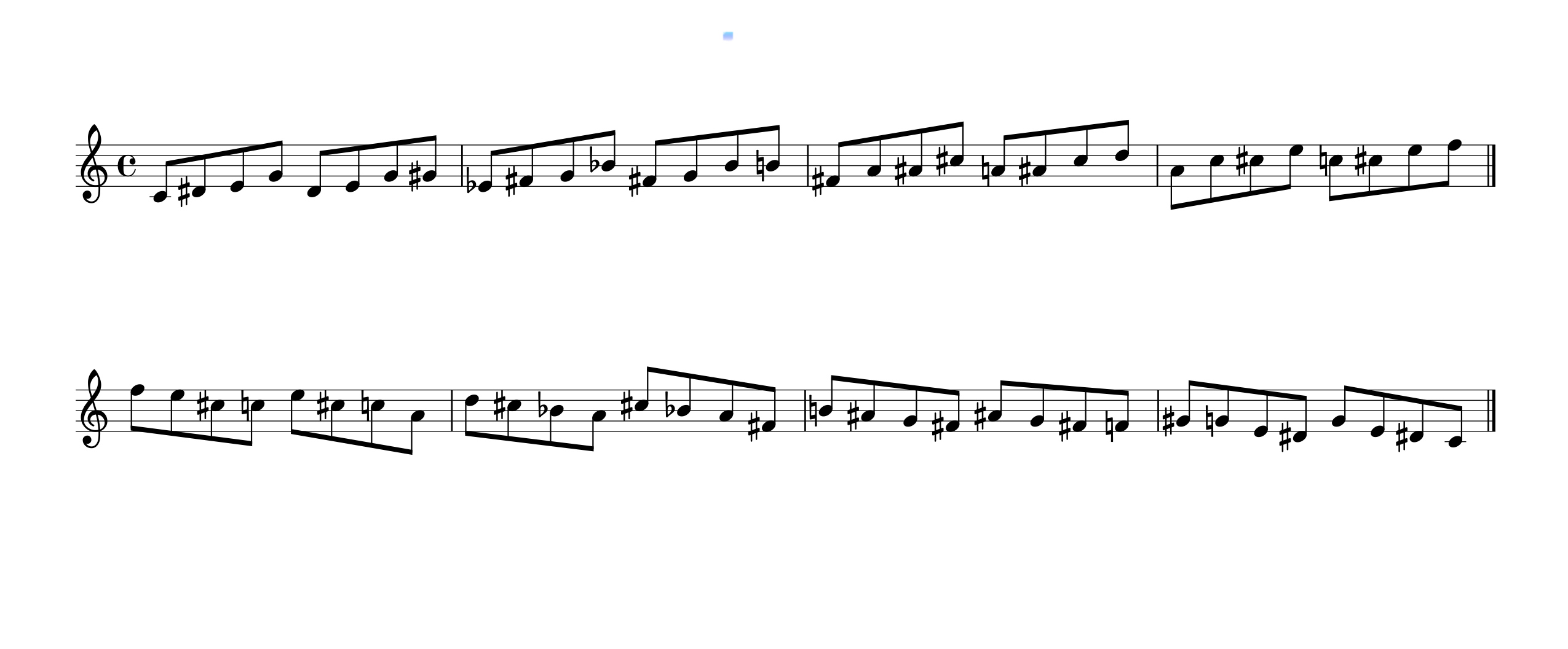
There’s plenty more to say about the augmented scale, but I’m not going to try to cover it all here. Dig inside the scale and discover its possibilities for yourself. Here’s a simple pattern to help you get started. The pattern is in C (and E, and G#/Ab). Memorize it, then transpose it to Db, D, and Eb.

C augmented scale pattern

Oh, yes–lest I forget, you’ll want to know how to apply the augmented scale. I’m still working that out myself, but here are a few pointers. Use the C augmented scale with
* a C+ or CM7.
* a C7 or C+7, but watch how you handle the #7. The chromatic tones can be viewed as passing tones, or they can become upper extensions if you alter the chord.
* a B7(b9) or B7 altered chord.
* an Am, Am6, or Am#7 chord.

You can also use the augmented scale with “Giant Steps” the same way you’d use a blues scale with the blues. But that’s a separate post.

This scale doesn’t come easily, but it’s well worth acquiring. However, it’s a more advanced study. You’d be wise to make sure you’ve got your basic major and minor tonalities down, including your cycle of dominants and ii-V7-I patterns, before you go digging into the more abstract stuff. Just my opinion. Take it with a grain of salt as you find your own way. Whatever you do, keep practicing–and have fun!

Tagged with: