preload
May 18

A bit buggy but good results, and you can’t beat the price: that pretty much sums up my experience with MuseScore, a free music notation software that I found online a few days ago.

Since this happens to be not only my first encounter with MuseScore but also with music transcription programs in general, I have nothing with which to compare this software. I much doubt that it can compete with Sibelius or Finale, but then, neither does it cost $600. You can’t get more budget-friendly than “free.” And, shortcomings aside, this software is getting the job done for me as I work on my “Giant Steps” e-book.

So what are the shortcomings whereof I speak? Here are a few that have made my notation process a bit frustrating:

* Various items that I’m supposed to be able to drag and drop, don’t.

* Text settings: I customize them, hit apply, and nothing happens. Or something happens, but it wasn’t what I ordered. Kind of like telling the waitress to bring you coffee and you wind up with a cup of tea instead.

* The instruction manual leaves out some key information. It’ll get you up and running, but sooner or later–and my money is on sooner–you’ll encounter an issue that the manual doesn’t address. At that point, it’s a matter of guesswork.

* The program is prone to shut down if you try to make it perform too fast, or what it considers to be too fast. For instance, don’t make the mistake of hitting the “undo” button multiple times very quickly.

So much for the negatives. Those aside, MuseScore is doing what I need it to do for me, and while the going is slow (which could be at least partially due to my own inexperience), I’m pleased with the results overall. Moreover, as the first open source transcription program available, the possibilities for MuseScore are expansive. As has been pointed out in another review, this program could become to Finale and Sibelius what Open Office is to Microsoft Office.

Bottom line: If your needs for music transcription software are fairly straightforward and you don’t have a gob of cash to spend on the brand-name stuff, then give MuseScore a try. The advantages of this software easily outweigh its snags, and I have to say, the results look great! MuseScore is clearly a labor of love, and I think you’ll come to value this free, useful music composition tool.

Tagged with:
Mar 14

This afternoon was a great time in the studio with my friends Ric Troll and Dave DeVos. Ric’s recording studio, Tallmadge Mill, is a topnotch home studio. Some years ago, Ric and I used it to record Eyes on Mars, a CD of free jazz and experimental music featuring drums and saxophone. Now another project is on the griddle, this time with the very welcome addition of Dave on bass.

After warming up with “Big Foot,” a Charlie Parker blues, the three of us launched into a broad variety of original tunes, some with written heads and changes by Ric, and others that were simply concepts and musical games which maximized listening and empathic, responsive improvisation. What a privilege to make music with two such high-caliber musicians–guys who enjoy exploring far beyond the American Songbook, and who possess the imagination and technical finesse to turn such experimentation into a genuinely musical experience.

More recording lies in store. I’m not sure just how much, but I’ll keep you posted as things develop. At some point, I should also have a few audio clips to share with you, so stay tuned to this blog for updates.
Tagged with:
Jun 29

Morning. I’m still in bed, and from the next room, sounds of family are drifting through the door. I’m in Dallas with my sister Diane, visiting with my brother Brian, sister-in-law Cheryl, and little nephew Samuel. Since the last time I saw him, Sam has transitioned from babyhood to little-boyhood. He has acquired a vocabulary, a white baseball cap that it’s very important to wear (backwards or sideways, as is the custome), and a very cool train set that we played with last night.

My lady Lisa is holding down the fort back in Grand Rapids, where the weather is providing a much cooler contrast to the upper-90s heat that’s on the menu for this week here in north Texas. Chasing storms is of course out of the question. I’ve family to visit, a bit of work to do, and in any case, there are no storms. Summer has hit and the atmosphere is capped as tightly as an oil drum. On Stormtrack, chasers are bidding the 2009 chase season adieu. I note that the SPC has outlooked days 5-6, but they’re not using the kind of language that gets me very excited.

I’m keeping this short. I can hear the sound of forks clicking on breakfast plates. It’s time to shower up and get myself going.

Tagged with:
Jan 14

The single-digit temperatures are here at last, and it looks like they’ll be staying for a few days.

Tonight the mercury is supposed to dip down to ten below zero. That, my friends, is cold. Tomorrow, the projected high–and we”re using that word, high, loosely here–is seven degrees. Think twice before wearing your thong swimsuit to the beach. Particularly if you’re a guy. (For that matter, if you’re a guy, think twice about it any time of year; better still, just don”t do it.)

On Friday, we see the kind of warming trend that puts a smile on the faces of Michiganders everywhere as the temperatures skyrocket up to nine degrees. And by Saturday, we”re feeling downright tropical at a steamy twenty degrees.

This is most assuredly January in Michigan. It”s the month of the Wolf Moon, an apt name if ever there was one. At night, as the temperatures plummet and the stars gleam like ice chips in the arctic sky, you can hear the howls echoing eerily across the frozen lakes. It”s a haunting, wild sound that you never forget, emanating from ice fishermen who are freezing their butts off. What those guys are doing out there in temperatures like these is beyond me.

nOkay, so enough about cold weather. How about a word on a hot CD? My friend Ed Englerth‘s album Restless Ghost has been nominated for a Jammie Award. The Jammies are the regional equivalent of the Grammies–not as prestigious, to be sure, but not lacking in glamor and promotional value. It would be great if Ed scored, particularly since I played on a number of songs on the CD. It really is a great album, and Ed is a terrific songwriter and lyricist who deserves much wider recognition.

Dec 18

I came across this interesting YouTube clip by a fellow saxophonist named Tom Hartig. Naturally, I was intrigued to see what another person who shares both my last name and my passion for the saxophone is doing musically. I wasn’t disappointed. This guy has a nice little sample clip that demonstrates a unique, original, meticulously arranged approach that manages to meld a strange, haunting, even slightly disturbing feel with lyrical beauty.

Tom’s clip is well worth checking out. In his note, he says he hopes you’ll buy his CD. I do too, and I may pick up a copy myself. After all, we Hartigs have got to stick together. And I assure you, having listened to a couple of Tom”s other video clips from years gone by, that the man can really play the sax.

Feb 13

I love Art Pepper”s playing! What a refreshing departure from the balls-to-the-walls bebop of the forties and fifties. An icon of what came to be known as the “West Coast style” of jazz, Pepper had a unique sound and improvisational approach that identify him instantly whenever you hear one of his recordings.

Tonally, Art Pepper was cut from a cloth similar to Paul Desmond. But the similarity doesn”t go very far. Pepper had the same silky, creamy texture as Desmond, but with a brittle, somewhat hard edge to it. Part fruitiness, part sigh.

Art”s improvisations are beautifully lyrical, liberally punctuated with a very personal sense of space. He delivers his ideas in crystalline clauses separated by semicolons and emdashes of breathing room. The overall effect is one I find completely captivating. No one else I”m aware of has ever duplicated it, and no one needs to. One Art Pepper is sufficient. I”m simply glad he was here, and that he left us such a lovely legacy in the way of musical expression.

nCheck out this recording of Art Pepper playing “Besame Mucho.” You”ll easily notice Art”s trademark sound and use of space. You”ll also pick up on the fact that the guy had a wonderful technique, one which served him well, not to mention those of us who admire his playing.

When you want a taste of something a little different–a blend of prettiness, sadness, and soul–listen to Art. He had a hard life, but his playing is tender and sweet.

Feb 01

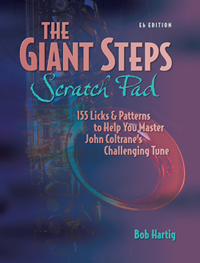
“Giant Steps” by John Coltrane.

Sooner or later, a sax player has to deal with it–that most lopsided, knuckle-busting of all digitally oriented tunes.

It’s a tough nut to crack, but it’s also a very rewarding one. The tune has a beautiful, geometrical logic to it. Practicing patterns to it comes easy, but breaking away from the patterns and doing something truly inventive in an improvisation is a challenge. You’ve really earned your saxophone merit badge when you can get around comfortably in “Giant Steps.”

Around ten years ago, I steeped myself in “Giant Steps” for a lengthy period, to the exclusion of just about everything else. My focused practice paid off: I got to where I could negotiate the changes with a fair degree of fluency and creativity at over 300 on the metronome. Not a bad achievement–but I forgot how to play the blues. I kid you not! You’d think all that technical work would bleed over into the rest of my playing, and I”m sure there were ways it did. But when it came to sounding pretty on a basic bebop blues, my fingers just didn’t seem to remember the territory. It was weird.

I can still get around “Giant Steps” today if I need to, but I’m pretty rusty at it. However, my blues playing sounds much more convincing. It”s a trade-off. If I had all the hours of the day to practice, I’d practice all hours of the day. But in this busy life, I do what I can. We can’t all be Coltrane. For that matter, none of us can. I’m content to listen to him, admire him, learn from him…and enjoy playing my horn.

Jan 24

Phil Woods–a problem? Who could have any problem at all with Phil?

I can, and here it is: the guy is too good!

If I didn’t know better, I’d swear he was blowing choruses on Donna Lee while still in his diapers. Of course, Woods paid some serious dues to play as beautifully as he does, but he seems to have been playing that way awfully early in the game. Here”s a black-and-white video clip of Phil from back in 1968.

He would have been…um, let’s see, born in 1931…okay, well, one can certainly be playing a lot of horn at age thirty-seven. I guess that much is obvious. And in Phil’s case, he evidently was playing outstandingly at least fourteen years earlier. His extensive discography goes back to 1954, two years before I was born. Phil had to have been darned good even then for a record company to pick him up at the tender age of twenty-three.

I guess that’s why he’s Phil Woods. Why he’s a jazz icon. Because he was a killer player back then and remains so today. He had the fire in him at an early age, he took it and ran with it, and he’s been running ever since.

And playing beautifully.

You got a problem with that?

Jan 18

Let’s talk about Cannonball Adderly. Better yet, let’s get an earful of him–or should I say, of his sextet. Cannon doesn’t take the spotlight in the tune you’re about to hear, preferring to let his other band members shine.

The year is 1962, and the setting is the cutting-edge Jazz Scene USA television series. “Primitivo” is the name of the Cannonball composition. The title aptly describes this brooding, chant-like modal piece with its droning bass and loose yet relentless rhythmic feel. Yusef Lateef plays a marvelous, haunting oboe solo–no pyrotechnics, nothing fancy, just a beautiful use of motif, with phrases ending on the same pitch–a note that falls off at the end like a sigh.

There’s plenty more to say about this tune, but I’m talking too much. Let’s listen.

Wow. Talk about mood. Talk about colorful note and scale choices. Talk about rapport between musicians. This tune has it all.

Jan 16

The old adage, “One picture is worth a thousand words,” is quadruply true when it comes to video. So if you wonder why I work up such a lather over storm chasing, just check out the clips on Robert Prentice”s Atmospheric Images on YouTube.

In particular, you definitely want to watch Prentice”s video segment on the history-making 1999 Moore-Bridge Creek, Oklahoma, tornado. This was the last tornado to be rated an F-5 under the old Fujita Scale (updated last February and renamed the Enhanced Fujita Scale), and it sent that rating system out with the highest winds ever recorded–over 300 miles per hour.

My own videos are not, to date, of a quality I care to make public, though they are improving. Thankfully, seasoned chasers such as Prentice have produced a huge volume of top-quality storm videos, and Prentice has very generously made much of his material public. If you’re at all interested in storm chasing or severe weather, Prentice”s clips are a must-see.